
The third post on ‘reconciliation in four directions’; at the end of the previous post I referenced Acts 19:30,31 and the riot in Ephesus where: “Paul wished to go into the crowd, but the disciples would not let him; even some officials of the province of Asia who were friendly to him sent him a message urging him not to venture into the theater” (emphasis added). The ‘Asiarchs’ were those who were in authority from Rome to ensure that the area they governed within was reflective in culture and values to Rome. This included the appointments within the temple structure (and the riot centred on ‘Artemis of the Ephesians’) and they were to ensure that the prosperity of the city was maintained (the silversmiths were the instigators of the riot). Remarkably these ‘non-disciples’ held space for Paul – an indication of the remarkable future-oriented vision he carried. A case of ‘if they are not against us, then they are for us’?
The great eschatological goal
Personal reconciliation to God is clearly within Scripture and this was the central part of Paul’s message but it did not contain the whole of his message. The eschatological goal was always of God’s presence permeating everything, expressed in such texts as ‘the knowledge of the glory of God covering the earth as the waters cover the seas’ (Hab. 2:14; Is. 11:9). Equally expressed in the future vision of John:
See, the home of God is among mortals.
He will dwell with them;
they will be his peoples,
and God himself will be with them and be their God…
And the city has no need of sun or moon to shine on it, for the glory of God is its light, and its lamp is the Lamb. The nations will walk by its light, and the kings of the earth will bring their glory into it. Its gates will never be shut by day—and there will be no night there (Rev. 21:3, 23-25).Reconciliation of all things, not just people, but the entire creation ‘project’, the restoration of all things, on earth and in heaven. The future is not a non-physical celestial existence but the fulfilment of the reconciliation that was accomplished at the cross. The biblical hope is therefore for the knowledge of God to permeate all things (reconciliation to God), a liberation for creation (reconciliation to creation), and the very real intimate (but not sexual) embrace between all those who express the image of God (reconciliation to others and self).
[There will be no marriage in the age to come is not indicating that marriage is not important, but that marriage, as covenant, is a sign of the depth of relationship to come in that age. Covenant in this age is what marriage consists of, and any other covenant should be entered into with utmost caution. I am not an advocate of (for example) seeking to replicate the David / Jonathan covenant – one only has to track the marriage fiascos that followed in David’s life and line to see that it could well be that covenant that was the root of causing subsequent issues. Marriage is exclusive: the future age and depth of relationship will transcend even that.]
Reconciled to God
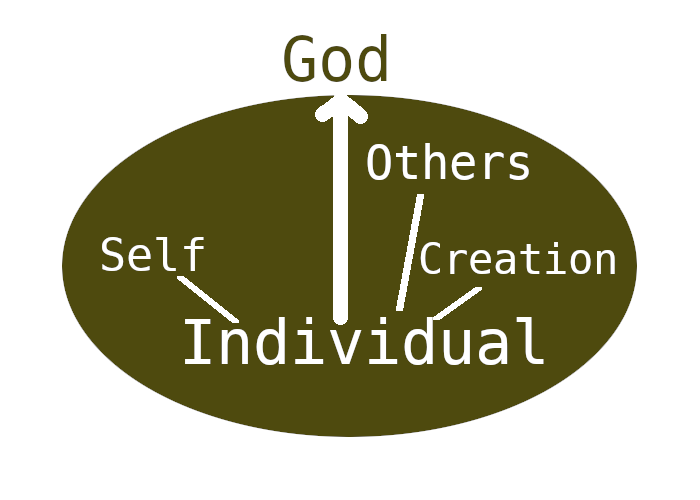
In the above illustration I am prioritising (as Paul does) reconciliation to God and illustrating that If I am truly reconciled to God then God’s Spirit is within me and there will be an outworking of that reconciliation into the other areas. Paul speaks of being reconciled to God and receiving the ministry of reconciliation; reconciliation has an outworking. And what if there is no outworking? Again let me re-iterate that we are all a work in progress and any ‘final’ outworking awaits the future, but Scripture is clear that,

How does God’s love abide in anyone who has the world’s goods and sees a brother or sister in need and yet refuses help? (1 John 3:17).
Whoever does not love does not know God, for God is love (1 John 4:8).
Those who say, “I love God,” and hate a brother or sister are liars, for those who do not love a brother or sister, whom they have seen, cannot love God, whom they have not seen (1 John 4:20).
For if you forgive others their trespasses, your heavenly Father will also forgive you, 15 but if you do not forgive others, neither will your Father forgive your trespasses (Matt. 6:14).
Those scriptures are unequivocal – if there is no outworking in a loving / forgiving way on the horizontal level then any claim for forgiveness at a vertical level is deceptive. It might be argued that John and Jesus are restricting this to our responses within the ‘household of faith’ but when we add Jesus’ command to love our enemy (Matt. 5:44) I suggest we have to embrace that any outworking of being reconciled to God means we embrace all others, including those who oppose us or persecute us.
A claim of being reconciled to God only has integrity if there is at some level a level of reconciliation to those who have been created in God’s image. [There are NO biblical texts that suggest that ‘the image of God’ is lost post-the fall. That image continues and those who are in Christ are being transformed into HIS image – the image of the eschatological human, the image of created humans but brought to fullness.]
So far then I suggest that any reconciliation to God has an outworking of coming into right relationship at a horizontal level (and with that I include creation, from which we came, and ‘self’). If there is absolutely no outworking in that direction scripture challenges the legitimacy of our claim to having been reconciled to God.
The next step in our exploration might prove to be a step too far for some. I now want to explore the possibility of being (in some real measure) reconciled to others / self / creation but not even believing in a Personal God, and that in doing so such a person might be participating in and expressing the reconciling work of Jesus.
A few notes first
In taking this approach I am not making any comment on the ‘eternal salvation’ of such a person. I am not seeking to make a judgement in either direction; one direction being ‘they are saved’ and the other direction being ‘they are damned’. I do have an underlying commitment to the image of God being present in everyone regardless of their creed, and that ‘good works’ are good. A belief that I can earn salvation is wrong because it is a wrong belief in God. God is gracious (giving us what we do not deserve) and merciful (not giving us what we do deserve); God is for us, the Saviour of all, especially of those who believe. I remain optimistic about the redemptive activity of God.
I find no biblical evidence for eternal punishing (the language ‘eternal punishment’ when taken to be about final judgement is exactly that – nothing ongoing, but something irreversible); if we through behaviour having become less than human I am not convinced that the call to ‘enter into My kingdom’ will be given, but the very nature of being reconciled to others / self / creation is to act humanly.
As I explore this possibility that in some way, and at some level, there is an ‘unknown’ reconciliation to God taking place, I am bearing in mind that to claim a reconciliation to God without outworking is false, so perhaps there is room to suggest that if someone engages with the ‘outworking’ perhaps there is a covering of the area that is central to Scripture, that of being reconciled to the One and only true God.
And a final comment in response to the emotive question of ‘why then should I be a committed believer? / what is the point in being saved?’. Those kind of questions reveal so much. The point of being saved is not to be ‘safe’ but to be overwhelmed by the goodness of God, to know this God at a personal level and to participate in the ‘ministry of reconciliation’.
The possibility of sharing the age to come with those whose path in life was to pursue what it is to be as human as possible is not at any level to shy away from sharing the reason for the hope that is within us. We should be ready to do so at any appropriate time, indeed to do so with those who proclaim faith in other gods, or who proclaim that they have no faith at all… and with those who proclaim they have been reconciled to God – particularly those who are so sure of their eternal destiny as they have prayed the sinner’s prayer. Paul was intent on coming to Rome, the capital that was the centre for the imperial gospel (euangellion), in order to proclaim there to the believers the gospel – the reason for the hope that he had.
Wow…deep thinking and good thinking. Love how you keep opening my mind a bit more all the time. Thx Martin