
Reconciliation to others
Reconciliation is to come into a harmonious relationship, where any former barrier has gone and an open to the other relationship can grow. In relationship to God those barriers are exactly what the cross removes. The ultimate revelation of the glory of God takes place at the cross for it is there that we see our God is a crucified God, a God who is for us, whose prayer is that ‘we are forgiven’. All internal barriers are removed (and we have to stay clear of suggesting that there were barriers on God’s side as that so easily sides into appeasement and a pagan view); not only the internal barriers of guilt and shame, but the external enslavement that Paul sums up as ‘sin and death’ or in other passages as ‘principalities and powers’.
Reconciliation to others is to love them, to desire that they might indeed become who they were born to be, to seek to be a support to them on their journey of integrity. It is first to humanise them, and that starts by no longer seeing them classified by any human-devised category.
Sometimes it is not possible to be in complete reconciliation and Paul was very pragmatic over that. He qualified his instruction to live at peace with all with a ‘as far as is possible’ proviso,
If it is possible, so far as it depends on you, live peaceably with all (Rom. 12:18).
Scripture is not idealistic, but in its eschatological thrust it calls us to go further and deeper at every point. Progress, not perfection, being the measure.
Reconciliation to self
Jesus commanded us to love others (even those who oppose us) as we love ourselves. It is claimed that we live in an epidemic of narcissistic culture and there is much to suggest that to be the case. A heavily ‘me’ centred world with an obsession to have ever more social-(media) friends, to be liked etc. points in that direction. Self-acceptance and a seeking to be the best possible ‘me’ that will have a positive outworking for others seems to be what the gospel advocates. ‘Me’ at the centre? Not in that narcissistic sense but only in the sense of giving attention to oneself. The rub of Narcissus is that what motivated him was not self-love but the love of the image of himself. The gospel comes to help me discover the real me, not the image that I have been given or created. Part of that might involve areas of painful awareness, but the greater part is the discovery of who I can become (and ultimately defined by the image of Jesus). The gospel re-defines all values including what ‘success’ means. No longer measured by social status or economic prosperity but by how true I am being to myself and how much of a life-giving source I am to others.
Some aspects of ‘self-help’ or even therapy might fall short given the narcissistic culture but where there is genuine help to enable self-reconciliation we have to affirm that this is part of the work toward ‘the reconciliation of all things’.
Reconciliation to creation
It can be argued that Roman 8 is the centre of that great piece of theological writing and there pre-eminently we have the close relationship of the human race and creation laid out. Such an understanding is present from the beginning of the Hebrew Scriptures. We are formed from the ground (‘mother earth’ might be a term we consider opens a number of quasi-spiritual doors, but cannot be viewed as totally wrong!) and the ground is in bondage (cursed) because of humanity. Paul virtually gives the creation personal identity with a voice that longs to follow where we are and are going. The voice of those who have received the Spirit is one of reconciliation to God – crying ‘Abba, Father’, and that voice is within creation also, expressed as a longing for liberation.
Theologies that have over-focused on spiritual transformation owe much more to Hellenistic philosophy than they do to a Hebraic understanding. The transformation that the cross was central to is the transformation of ‘all things’. Creation has a future, one that Jesus described as the ‘rebirth of all things’ (Matt. 19:28).
Reconciled to God and…
To be able to articulate the equivalent of ‘Abba, Father’ is a deep privilege and a joyous expression of being free from slavery, with the language that Paul is using (Rom. 8) surely recalls the freedom from Egypt, a freedom from slavery and the task masters that afflicted them. Paul moves from our freedom to the cry of creation that is in slavery (and I consider that there is an underlying thought here that just as Israel was subject to taskmasters in Egypt, so the creation has been subjected to taskmasters – the human race no longer imaging God), and alongside the groan of creation is the voice of the saints within whom the Spirit coming to our aid with ‘inarticulate sounds’ (groanings too deep for words, alaletos). Reconciled to God and instruments of pulling to the future, and the future glory is to pull all things in that direction. This explains the ‘glory’ and the ‘suffering’ that are present now.
One of the drawbacks of religion is to affirm that we are in the right and the diverse forms of the Christian faith is not exempted from that drawback. We might wonder how Paul can claim to be blameless according to the law and yet a persecutor, even a murderer, of others. He was certainly not without biblical precedence, with the origin of the Levitical becoming the priestly tribe being rooted in a similar response. If I claim to be reconciled to God and there is no ongoing evidence that I am involved in the ‘ministry of reconciliation’ I am either deceived (probably) or at best have stopped on the journey toward the future. I am encouraged (required?) to be pulling myself, others and creation to that future.
If I claim to tick the box of ‘reconciliation to God’ but there is no filling in of the other three boxes…..
Reconciled to self, creation and others and…
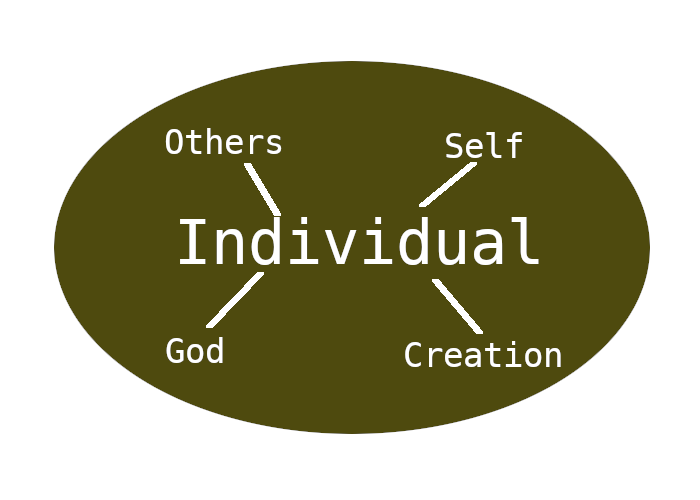
If we allow Scripture to critique our spirituality and do not reduce spirituality to me and my so-called devotional life we can easily see how there should be some evidence of a wider reconciliation, than simply me and God. (And most ‘me and God’ scenarios come up with a God of our creation and a me of my desired image.)
Conversely I am ready to bring this article to a conclusion in considering the very real possibility that anyone who is (knowingly or unknowingly) pulling toward the restoration of all things is at some measure being reconciled to God. It is not for me to go on to make statements that would set me up as the judge of all, but I remain deeply optimistic. The future shape of all things depends on the mercy of God and I suspect that a response similar to the one made by Peter at the household of Cornelius will be appropriate. Peter spoke before he had proclaimed the truths concerning Jesus, and before the assembled household received the Spirit just as those in the Upper Room had (Acts 11:15),
I truly understand that God shows no partiality, but in every people anyone who fears him and practices righteousness is acceptable to him (Acts 10:34, 35).
His journey to that experience was one that was conducted without pre-judgement (Acts 11:12, verb is diakrino – to make a judgement). Pre-judgements can determine the outcome; experience can challenge our previously held beliefs. At no point will naivety be our aid, nor the abandonment of what we have known, but if it be true that the body of Christ is to hold space so that agents of the kingdom arise, perhaps we all have to go on a journey, and as we do we might discover people who are stronger advocates and activists in sowing toward the reconciliation of all things than we have been. Surely we belong together and we have much to learn. And in it all there is one who has the last word, the one who is the ‘first and the last’. From creation to new creation, and just as there were a number who left Egypt with the tribes of Israel, I sincerely hope there are those who are journeying toward that new day.
An Addendum: meals
Eating meals. That has a long tradition in many settings; meals not merely to satisfy hunger but to indicate our union with one another. The sacrifices in the Old Testament are not primarily a matter of the slaughter of animals but of eating together. Jesus said unless we can eat his flesh, and drink his blood, we will have no part in him.
Putting the ‘Lord’s Supper’ back into the meal context where we eat at his table we are told that when we do this we ‘proclaim his death’ as we ‘remember him’ and that we do this ‘until he comes’. I suggest this has been transformed into a focus on ‘remembering his death’ and a soberness has come in that was not present in the original setting. We are to remember Jesus, the Jesus of the gospels, the Jesus of today, the Jesus of tomorrow, and to proclaim his death – all that was finished at the cross and all that was inaugurated there… and that we do that until things are completed.
That meal, and each meal, is an eschatological sign that we are caught up in a movement that believes in the restoration of all things, the reconciliation (putting back together again) of all things, whether in heaven or on earth.
Commentary on meals and their setting in the New Testament era is beyond this brief addendum, but I put the above here to suggest that some level of eating together with all who have a belief in the reconciliation of all things, including those who have a different narrative for their hope and activity, should be encouraged.

The biblical God took on the responsibility to solve the issue of alienation and set something very concrete in motion with the invitation to those who have received the Spirit of reconciliation to be actively involved in activity that serves that ultimate goal. That we can be reconciled to the God of creation is truly ‘good news’, and along that journey we can rejoice at every act carried out that works for the increased manifestation of the healing of alienation. We can, and should be, open to every opportunity to share the reason for the hope we carry while rejoicing with all those who are contributing to the increase of shalom.