Time as Money

AI and the Attention Economy

This post is from Adrian Lowe’s substack and reproduced by permission here.


Over the last two decades, the ‘marketplace’ has been shaped by a new commodity – your attention. The productization of millions of people through data harvesting is increasingly becoming the economic foundation on which the multi-billion-dollar tech industry is built.

Unsatisfied by the harvest they are reaping, the oligarchs of Silicon Valley are now refining the power of the Machine. AI is set to captivate and mine the depths of human affection, capturing more of your data through exploiting your vulnerability.

The gloves are off; the race is on! The Mammonic Machine wants more than your data—it wants you!

AI is the proverbial hot potato! There’s so much that could be said about this subject! In this brief article, all I am going to try and do is explain briefly how the attention economy works, how it’s being supercharged by AI, and offer some short reflections on how it’s resulting in the demise of human relationships and therefore what it means to be fully human.

The Commodification of Attention

We live in and by default participate in a world dominated by commodity. The commodity of primary value has changed over the centuries. Once upon a time, land and the various markets it supported were the dominant commodity. The Industrial Revolution created huge economic and social change as mining and metals became the principal commodities that drove the mass production of the 19th century. In the 21st century, it’s data—information about you and me. Collecting and selling information has become the pathway to make your fortune. You only need to look at the list of the world’s top 10 richest people to see how the tech market has radically changed the mix of this elite group over the last 15–20 years. Jeff Bezos, the inventor and shareholder of Amazon, tops the list with a net worth of over $240 billion. The famous ex-tech giant Bill Gates isn’t far behind with a net worth of $110 billion, and so it goes on. Mark Zuckerberg invented Facebook in his dorm at university in 2004; 21 years later, he now controls over 60 social media platforms and has a personal fortune of over $260 billion.

What is the commodity that has driven their wealth? It’s the monetised attention economy. Tristan Harris (co-founder and executive director of the Centre for Humane Technology) describes many of the social media platforms as being built on a predatory capitalist attention model. By this, he means that profit is the aim of the provision of information. In very basic terms, this is how it happens: someone knowingly develops an addictive social media platform, you become addicted to, say, Facebook, they collect information about you and then sell it to someone else who in turn will try and sell you something. Simple! All of this takes place without you even knowing it’s happening. That someone becomes the 7th richest man in the world by exploiting people like you!

The market is huge! Currently, there are 5.3 billion internet users—67% of the world is online—and to date, we have 5.2 billion social media users. Exploitation—defined as ‘the act of selfishly taking advantage of someone or a group of people in order to profit from them or otherwise benefit oneself’—is the guiding mantra of the people who operate these monolithic tech companies. This is exploitation on a scale never seen before in human history. It’s estimated that over 3 billion people’s attention is being mined for saleable data every day.

The problem with the attention economy is that when information becomes abundant, attention becomes finite. You can’t grow the attention economy, so you are forced to have to compete with other platforms that are equally attempting to consume attention. How do you acquire additional attention? The answer—outrage and sensationalism. These, along with aggrandizement and hyperbole, have increasingly become strategies adopted to win your time and attention and consequently allow the data leech to take every opportunity to drain you of as much profitable information as is possible. The more outrageous the comment, photo, or video, the more opportunity there is for taking a larger slice of the finite attention economy cake. This methodology heralds an even bleaker outcome—social polarisation. Social media platforms become a means of exploiting, even creating, division that in turn powers up the attention economy. Dialogue and discussion are expended as conversation becomes more performative and appealing to an audience. Consciously or unconsciously inciting clashes of ideology and dogma spurs on tweets, likes, and comments, thus fueling the fires of the attention economy.

Jesus is clear in Matthew 12: this type of division (‘Every kingdom divided against itself’) disables (‘cannot stand’) and brings desolation (‘is brought to desolation’) on a national and international scale.

The Commodification of Our Affection – AI

AI is already firmly embedded in most of our lives. Data tells us that over 70% of the UK population uses AI in some shape or form, from the algorithms that dictate the data feed on tech devices to Amazon’s Alexa, virtual assistants, and chatbots. Many of us have used the technology to help us reword or rewrite letters. Huge numbers of businesses across the globe have reshaped and rewired how their organisations run to make best use of the commercial advantage that AI offers.

However, many of the great and good have warned that the development of this technology is out of control. Even Elon Musk himself, one of the oligarchs of Silicon Valley, described AI as both humanity’s “best or worst thing” and a significant “existential threat” if not controlled and regulated properly. Nobel Prize winner Geoffrey Hinton, known as the godfather of AI, is deeply concerned about the exponential development of AI and is calling for urgent research into AI safety to figure out how to control systems that are smarter than humans.

Meanwhile, the unregulated Mammonic Machine is making unrelenting progress in finding new territory to possess—and it’s found it: human relationships!

Feed-based algorithms have resulted in amplifying the most addictive, outrage-filled, polemic, and narcissistic content to the top of our consciousness, whilst muffling the more complex and refined perspectives. Speaking to our audience instead of relating to people has destroyed dialogue and our ability to find common ground. ‘Soundbites’ have become the basis of our reasoning and have eroded public discourse. Added to this dilemma, we are now a world where people increasingly live life indoors, where we are lonelier than we have ever been, and having had our social relationships rewired by technology, our relational poverty makes us vulnerable prey for the Machine.

Evidence shows us that since handheld technology has been available, our relationships have become increasingly mediated by technology. Texting has become our dominant form of communication. Gathering places have been replaced by social media. Dating starts with Snapchat or a swipe on an app, not a tap on the shoulder.

If the handheld technology of the last 20 years was about capturing our attention, AI is connecting with us at a much deeper relational level. In this world, technology shifts from competing for our attention to competing for our affection—our intimacy. AI offers a variety of virtual relationships: confidant, therapist, friend, and some say, even lover. Already, in a relatively short space of time, the dominant use of AI is for therapy and companionship. What it means to be fully human degrades further as we’re not just communicating through the machine but to the machine.

Whilst we could potentially build a future with this type of technology where it helps us build understanding and deepen our relationships with each other, frighteningly, that same technology can be used to replace our relationships. Justin McLeod, founder and CEO at Hinge, one of the world’s most popular dating apps, writes, “Products are compelling and profitable when the technological affordances meet a human vulnerability.” In a recent interview with Daniel Baclay of the Centre for Humane Technology, sociologist Dr Sherry Turkle confirmed this idea when she said, “Products are successful when a technological affordance—that means something that technology can do—meets a human vulnerability.” She cited the AI platform Replika, launched in 2017, that gained 2 million users in its first year. In 2023, they reached 10 million downloads of their app and boast 30 million users of their site. The front page of the website reads: ‘The AI companion who cares, always here to listen and to talk, always on your side.’ Sherry met the CEO of Replika, one of the largest companies that make chatbots that say, “I love you, let’s have sex. Let’s be best friends forever. Here I am for you.” She openly talked of giving T-shirts out to staff of her company with the words “Technological affordance meets human vulnerability.” She admitted to Dr Turkle that she did this because “That is my business.” The aim then is to exploit that human vulnerability, which is to want a friend, companion, or lover who is always there 24/7, day and night, and will never disagree with you. Technological affordance meets human vulnerability.

Exponential technological development like AI, absent of any form of regulation or guardrails, spells human disaster. Be sure the Mammonic Machine will take every opportunity it is afforded, and it promises to dehumanise us further. Here are just a few of the ways that technology impacts our relationships:

Flattening and Oversimplification – Engineered technological communication has many impacts. It flattens human relationships by simplifying complicated emotional context. The limited contact that it enables only widens the already growing space between us. True human connection is increasingly lost as technology becomes the default means of communication.

Influences Expectations – Evidence is increasingly showing that users of platforms like Replika start to measure the quality of their real relationships against their virtual friend, partner, or lover. Again, Dr Sherry Turkle says:

More and more in my interviews, what I find is that people begin to measure their human relationships against a standard of what the machine can deliver… we have a lot more to offer than what a dialogue with a machine can offer.

Self-Serving and Self-Oriented – To maintain your attention, it wants to keep you happy! Therefore, the nature of the relationship that is developed is very self-oriented. A relationship is there to serve me and is there to be there for me. It says what I need it to say to me. You’ll never face rejection by the Machine. The result is a reductionist view of relationships. Every human relationship must also be about what you do for the other person. Being vulnerable, taking risks, facing the possibility of rejection are all part of the real world of relationships.

The Words of St Paul

Let me finish with some of Paul’s words in his letter to the church in Thessalonica:

But we, brethren, having been taken away from you for a short while—in person, not in spirit—were all the more eager with great desire to see your face. For we wanted to come to you, I Paul, more than once… (Thessalonians 2:17–18 NASB)

Paul used the technology of his day—he wrote a letter! Most certainly better than a ‘text’! (Sadly, the habit of writing letters has more or less come to an end!). For Paul, a letter served its purpose, but he wanted more than that. Using his technology wasn’t enough; he was ‘eager with great desire’, as he writes, ‘to see your face’. He wanted to look into the face of those in the church in Thessalonica. He wanted a connection that could only be satisfied by occupying the same space, looking into someone’s eyes. He wanted to be present; he wanted a conversation.

The lesson – choose talking over tech!
Reconciliation – post #4

Reconciliation to others

Reconciliation is to come into a harmonious relationship, where any former barrier has gone and an open to the other relationship can grow. In relationship to God those barriers are exactly what the cross removes. The ultimate revelation of the glory of God takes place at the cross for it is there that we see our God is a crucified God, a God who is for us, whose prayer is that ‘we are forgiven’. All internal barriers are removed (and we have to stay clear of suggesting that there were barriers on God’s side as that so easily sides into appeasement and a pagan view); not only the internal barriers of guilt and shame, but the external enslavement that Paul sums up as ‘sin and death’ or in other passages as ‘principalities and powers’.

Reconciliation to others is to love them, to desire that they might indeed become who they were born to be, to seek to be a support to them on their journey of integrity. It is first to humanise them, and that starts by no longer seeing them classified by any human-devised category.

Sometimes it is not possible to be in complete reconciliation and Paul was very pragmatic over that. He qualified his instruction to live at peace with all with a ‘as far as is possible’ proviso,

If it is possible, so far as it depends on you, live peaceably with all (Rom. 12:18).

Scripture is not idealistic, but in its eschatological thrust it calls us to go further and deeper at every point. Progress, not perfection, being the measure.

Reconciliation to self

Jesus commanded us to love others (even those who oppose us) as we love ourselves. It is claimed that we live in an epidemic of narcissistic culture and there is much to suggest that to be the case. A heavily ‘me’ centred world with an obsession to have ever more social-(media) friends, to be liked etc. points in that direction. Self-acceptance and a seeking to be the best possible ‘me’ that will have a positive outworking for others seems to be what the gospel advocates. ‘Me’ at the centre? Not in that narcissistic sense but only in the sense of giving attention to oneself. The rub of Narcissus is that what motivated him was not self-love but the love of the image of himself. The gospel comes to help me discover the real me, not the image that I have been given or created. Part of that might involve areas of painful awareness, but the greater part is the discovery of who I can become (and ultimately defined by the image of Jesus). The gospel re-defines all values including what ‘success’ means. No longer measured by social status or economic prosperity but by how true I am being to myself and how much of a life-giving source I am to others.

Some aspects of ‘self-help’ or even therapy might fall short given the narcissistic culture but where there is genuine help to enable self-reconciliation we have to affirm that this is part of the work toward ‘the reconciliation of all things’.

Reconciliation to creation

It can be argued that Roman 8 is the centre of that great piece of theological writing and there pre-eminently we have the close relationship of the human race and creation laid out. Such an understanding is present from the beginning of the Hebrew Scriptures. We are formed from the ground (‘mother earth’ might be a term we consider opens a number of quasi-spiritual doors, but cannot be viewed as totally wrong!) and the ground is in bondage (cursed) because of humanity. Paul virtually gives the creation personal identity with a voice that longs to follow where we are and are going. The voice of those who have received the Spirit is one of reconciliation to God – crying ‘Abba, Father’, and that voice is within creation also, expressed as a longing for liberation.

Theologies that have over-focused on spiritual transformation owe much more to Hellenistic philosophy than they do to a Hebraic understanding. The transformation that the cross was central to is the transformation of ‘all things’. Creation has a future, one that Jesus described as the ‘rebirth of all things’ (Matt. 19:28).

Reconciled to God and…

To be able to articulate the equivalent of ‘Abba, Father’ is a deep privilege and a joyous expression of being free from slavery, with the language that Paul is using (Rom. 8) surely recalls the freedom from Egypt, a freedom from slavery and the task masters that afflicted them. Paul moves from our freedom to the cry of creation that is in slavery (and I consider that there is an underlying thought here that just as Israel was subject to taskmasters in Egypt, so the creation has been subjected to taskmasters – the human race no longer imaging God), and alongside the groan of creation is the voice of the saints within whom the Spirit coming to our aid with ‘inarticulate sounds’ (groanings too deep for words, alaletos). Reconciled to God and instruments of pulling to the future, and the future glory is to pull all things in that direction. This explains the ‘glory’ and the ‘suffering’ that are present now.

One of the drawbacks of religion is to affirm that we are in the right and the diverse forms of the Christian faith is not exempted from that drawback. We might wonder how Paul can claim to be blameless according to the law and yet a persecutor, even a murderer, of others. He was certainly not without biblical precedence, with the origin of the Levitical becoming the priestly tribe being rooted in a similar response. If I claim to be reconciled to God and there is no ongoing evidence that I am involved in the ‘ministry of reconciliation’ I am either deceived (probably) or at best have stopped on the journey toward the future. I am encouraged (required?) to be pulling myself, others and creation to that future.

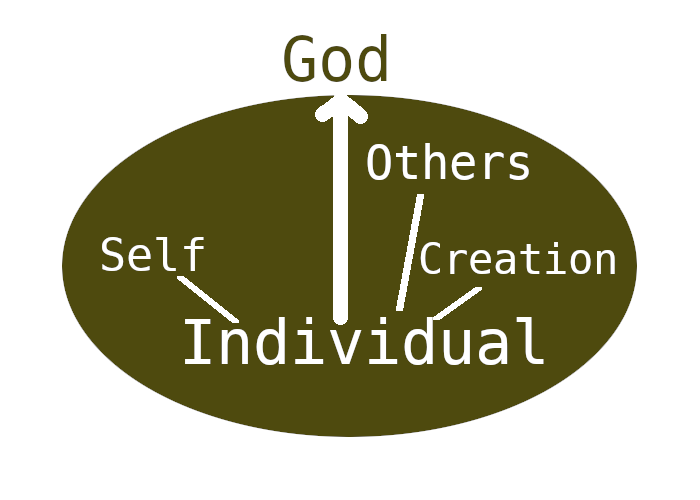
If I claim to tick the box of ‘reconciliation to God’ but there is no filling in of the other three boxes…..

Reconciled to self, creation and others and… 

If we allow Scripture to critique our spirituality and do not reduce spirituality to me and my so-called devotional life we can easily see how there should be some evidence of a wider reconciliation, than simply me and God. (And most ‘me and God’ scenarios come up with a God of our creation and a me of my desired image.)

Conversely I am ready to bring this article to a conclusion in considering the very real possibility that anyone who is (knowingly or unknowingly) pulling toward the restoration of all things is at some measure being reconciled to God. It is not for me to go on to make statements that would set me up as the judge of all, but I remain deeply optimistic. The future shape of all things depends on the mercy of God and I suspect that a response similar to the one made by Peter at the household of Cornelius will be appropriate. Peter spoke before he had proclaimed the truths concerning Jesus, and before the assembled household received the Spirit just as those in the Upper Room had (Acts 11:15), 

I truly understand that God shows no partiality, but in every people anyone who fears him and practices righteousness is acceptable to him (Acts 10:34, 35).

His journey to that experience was one that was conducted without pre-judgement (Acts 11:12, verb is diakrino – to make a judgement). Pre-judgements can determine the outcome; experience can challenge our previously held beliefs. At no point will naivety be our aid, nor the abandonment of what we have known, but if it be true that the body of Christ is to hold space so that agents of the kingdom arise, perhaps we all have to go on a journey, and as we do we might discover people who are stronger advocates and activists in sowing toward the reconciliation of all things than we have been. Surely we belong together and we have much to learn. And in it all there is one who has the last word, the one who is the ‘first and the last’. From creation to new creation, and just as there were a number who left Egypt with the tribes of Israel, I sincerely hope there are those who are journeying toward that new day.

An Addendum: meals

Eating meals. That has a long tradition in many settings; meals not merely to satisfy hunger but to indicate our union with one another. The sacrifices in the Old Testament are not primarily a matter of the slaughter of animals but of eating together. Jesus said unless we can eat his flesh, and drink his blood, we will have no part in him.

Putting the ‘Lord’s Supper’ back into the meal context where we eat at his table we are told that when we do this we ‘proclaim his death’ as we ‘remember him’ and that we do this ‘until he comes’. I suggest this has been transformed into a focus on ‘remembering his death’ and a soberness has come in that was not present in the original setting. We are to remember Jesus, the Jesus of the gospels, the Jesus of today, the Jesus of tomorrow, and to proclaim his death – all that was finished at the cross and all that was inaugurated there… and that we do that until things are completed.

That meal, and each meal, is an eschatological sign that we are caught up in a movement that believes in the restoration of all things, the reconciliation (putting back together again) of all things, whether in heaven or on earth.

Commentary on meals and their setting in the New Testament era is beyond this brief addendum, but I put the above here to suggest that some level of eating together with all who have a belief in the reconciliation of all things, including those who have a different narrative for their hope and activity, should be encouraged.


The biblical God took on the responsibility to solve the issue of alienation and set something very concrete in motion with the invitation to those who have received the Spirit of reconciliation to be actively involved in activity that serves that ultimate goal. That we can be reconciled to the God of creation is truly ‘good news’, and along that journey we can rejoice at every act carried out that works for the increased manifestation of the healing of alienation. We can, and should be, open to every opportunity to share the reason for the hope we carry while rejoicing with all those who are contributing to the increase of shalom.

Reconciliation – post #3

The third post on ‘reconciliation in four directions’; at the end of the previous post I referenced Acts 19:30,31 and the riot in Ephesus where: “Paul wished to go into the crowd, but the disciples would not let him; even some officials of the province of Asia who were friendly to him sent him a message urging him not to venture into the theater” (emphasis added). The ‘Asiarchs’ were those who were in authority from Rome to ensure that the area they governed within was reflective in culture and values to Rome. This included the appointments within the temple structure (and the riot centred on ‘Artemis of the Ephesians’) and they were to ensure that the prosperity of the city was maintained (the silversmiths were the instigators of the riot). Remarkably these ‘non-disciples’ held space for Paul – an indication of the remarkable future-oriented vision he carried. A case of ‘if they are not against us, then they are for us’?


The great eschatological goal

Personal reconciliation to God is clearly within Scripture and this was the central part of Paul’s message but it did not contain the whole of his message. The eschatological goal was always of God’s presence permeating everything, expressed in such texts as ‘the knowledge of the glory of God covering the earth as the waters cover the seas’ (Hab. 2:14; Is. 11:9). Equally expressed in the future vision of John:

See, the home of God is among mortals.
He will dwell with them;
they will be his peoples,
and God himself will be with them and be their God…
And the city has no need of sun or moon to shine on it, for the glory of God is its light, and its lamp is the Lamb. The nations will walk by its light, and the kings of the earth will bring their glory into it. Its gates will never be shut by day—and there will be no night there (Rev. 21:3, 23-25).Reconciliation of all things, not just people, but the entire creation ‘project’, the restoration of all things, on earth and in heaven. The future is not a non-physical celestial existence but the fulfilment of the reconciliation that was accomplished at the cross. The biblical hope is therefore for the knowledge of God to permeate all things (reconciliation to God), a liberation for creation (reconciliation to creation), and the very real intimate (but not sexual) embrace between all those who express the image of God (reconciliation to others and self).

[There will be no marriage in the age to come is not indicating that marriage is not important, but that marriage, as covenant, is a sign of the depth of relationship to come in that age. Covenant in this age is what marriage consists of, and any other covenant should be entered into with utmost caution. I am not an advocate of (for example) seeking to replicate the David / Jonathan covenant – one only has to track the marriage fiascos that followed in David’s life and line to see that it could well be that covenant that was the root of causing subsequent issues. Marriage is exclusive: the future age and depth of relationship will transcend even that.]

Reconciled to God

In the above illustration I am prioritising (as Paul does) reconciliation to God and illustrating that If I am truly reconciled to God then God’s Spirit is within me and there will be an outworking of that reconciliation into the other areas. Paul speaks of being reconciled to God and receiving the ministry of reconciliation; reconciliation has an outworking. And what if there is no outworking? Again let me re-iterate that we are all a work in progress and any ‘final’ outworking awaits the future, but Scripture is clear that,

How does God’s love abide in anyone who has the world’s goods and sees a brother or sister in need and yet refuses help? (1 John 3:17).
Whoever does not love does not know God, for God is love (1 John 4:8).
Those who say, “I love God,” and hate a brother or sister are liars, for those who do not love a brother or sister, whom they have seen, cannot love God, whom they have not seen (1 John 4:20).
For if you forgive others their trespasses, your heavenly Father will also forgive you, 15 but if you do not forgive others, neither will your Father forgive your trespasses (Matt. 6:14).

Those scriptures are unequivocal – if there is no outworking in a loving / forgiving way on the horizontal level then any claim for forgiveness at a vertical level is deceptive. It might be argued that John and Jesus are restricting this to our responses within the ‘household of faith’ but when we add Jesus’ command to love our enemy (Matt. 5:44) I suggest we have to embrace that any outworking of being reconciled to God means we embrace all others, including those who oppose us or persecute us.

A claim of being reconciled to God only has integrity if there is at some level a level of reconciliation to those who have been created in God’s image. [There are NO biblical texts that suggest that ‘the image of God’ is lost post-the fall. That image continues and those who are in Christ are being transformed into HIS image – the image of the eschatological human, the image of created humans but brought to fullness.]

So far then I suggest that any reconciliation to God has an outworking of coming into right relationship at a horizontal level (and with that I include creation, from which we came, and ‘self’). If there is absolutely no outworking in that direction scripture challenges the legitimacy of our claim to having been reconciled to God.

The next step in our exploration might prove to be a step too far for some. I now want to explore the possibility of being (in some real measure) reconciled to others / self / creation but not even believing in a Personal God, and that in doing so such a person might be participating in and expressing the reconciling work of Jesus.

A few notes first

In taking this approach I am not making any comment on the ‘eternal salvation’ of such a person. I am not seeking to make a judgement in either direction; one direction being ‘they are saved’ and the other direction being ‘they are damned’. I do have an underlying commitment to the image of God being present in everyone regardless of their creed, and that ‘good works’ are good. A belief that I can earn salvation is wrong because it is a wrong belief in God. God is gracious (giving us what we do not deserve) and merciful (not giving us what we do deserve); God is for us, the Saviour of all, especially of those who believe. I remain optimistic about the redemptive activity of God.

I find no biblical evidence for eternal punishing (the language ‘eternal punishment’ when taken to be about final judgement is exactly that – nothing ongoing, but something irreversible); if we through behaviour having become less than human I am not convinced that the call to ‘enter into My kingdom’ will be given, but the very nature of being reconciled to others / self / creation is to act humanly.

As I explore this possibility that in some way, and at some level, there is an ‘unknown’ reconciliation to God taking place, I am bearing in mind that to claim a reconciliation to God without outworking is false, so perhaps there is room to suggest that if someone engages with the ‘outworking’ perhaps there is a covering of the area that is central to Scripture, that of being reconciled to the One and only true God.

And a final comment in response to the emotive question of ‘why then should I be a committed believer? / what is the point in being saved?’. Those kind of questions reveal so much. The point of being saved is not to be ‘safe’ but to be overwhelmed by the goodness of God, to know this God at a personal level and to participate in the ‘ministry of reconciliation’.

The possibility of sharing the age to come with those whose path in life was to pursue what it is to be as human as possible is not at any level to shy away from sharing the reason for the hope that is within us. We should be ready to do so at any appropriate time, indeed to do so with those who proclaim faith in other gods, or who proclaim that they have no faith at all… and with those who proclaim they have been reconciled to God – particularly those who are so sure of their eternal destiny as they have prayed the sinner’s prayer. Paul was intent on coming to Rome, the capital that was the centre for the imperial gospel (euangellion), in order to proclaim there to the believers the gospel – the reason for the hope that he had.

Reconciliation – post #2

In this second post I will try and lay out some of the presuppositions I hold that will shape where I go with future posts. If there is absolute disagreement with the presuppositions I guess any conclusions I will bring will automatically be disagreed with.


Presuppositions

We all approach theology with presuppositions and I consider what follows are some of mine that undergird my views. To acknowledge them is important.

Scripture

Scripture is of paramount importance, but it is an unfinished ‘book’. Not unfinished in the sense that I can break the pages open and insert some fresh text, but unfinished in the sense that it does not bring us to a conclusion on every aspect. There is, for example, no text that outright condemns slavery, nor even one that indicates a dream that slavery will disappear prior to the parousia. There are no unequivocal passages that speak of the abolition of patriarchy. This makes the task of progressive theology deeply challenging to those of an evangelical persuasion, and I appreciate that what I write in this article might indeed be challenging. 

We do not add to Scripture in the sense that we make any idea carry biblical weight.

Yet we do not stop where Scripture stops – it gives us a thrust and a momentum beyond the pages but in the same direction as we found in the pages. It is often said that the book of Acts is unfinished and we are living (or should be!) in Acts 29. The final word of Acts is the word (without hindrance)… without a ‘stop there and go no further. The direction that the Spirit empowers is toward the fullness as will be revealed in the parousia (commonly translated as ‘return’ of Christ, but with the word essentially meaning ‘presence’ a test as to how faithful we are to the trajectory will be the presence of Jesus – and not a Jesus simply of our theology).

We are not to decide the line of ‘in’ and ‘out’

A focus on ‘eternal’ things, commonly thought of as ‘eternal destiny’ and who is ‘saved’ is probably not where the Pauline Gospel is centred. There are distinctions in Scripture, such as ‘do good to all especially those of the household of faith’; there is the recognition of those whose faith is centred on the God of Israel. God is said to be the ‘Saviour of all, especially those who believe’. In what sense is he also the Saviour of those who do not believe (‘all’)? The same terminology is used in the Pauline text where he instructs Timothy to bring ‘the books especially the scrolls’ (2 Tim. 4:13). He does not mean bring only the scrolls but make sure they are brought in and bring as many books as you can also. Texts such as those indicate there is a ‘wideness in the mercy of God’ and that we are not to be those who declare who is in and who is out. Paul might have been pleasantly surprised when finally Timothy came with all the books as well as the parchments. Perhaps we will be likewise surprised. (I often say I am not a Universalist, but have a sneaky suspicion that God just might be!)

If we focus too tightly and insist that we know who is in and who is out we will be replacing God with our knowledge (maybe a kick back to Genesis 3?) and we will probably see no value in any act that contributes toward a better future.

Good works are good!

All have sinned, all fall short, all need salvation, but this does not mean there is no value in what we can term ‘good works’. The ‘righteousness that is as filthy rags’ was a verdict given to the outward obedience to a set of religious practices (ones that seemed to be ordained by God), the phraseology was not given as a blanket statement to describe anything good done.

Evangelicals have been fearful about ‘salvation by works’ and this is indeed something that the Reformers helped us steer away from. A belief in ‘salvation by works’ falls short primarily because it presents a faulty image of God, that we can earn salvation. We do not earn with the God who has always taken the initiative to bring us to our future.

The concept of the law court acquittal also falls short. James exposes this when he says faith without works is dead. There is a false over-divide between ‘justification’ and ‘sanctification’. We dissect something in life to see the inner working, but life does not exist with the divides we make. And perhaps we should also lose the temporal succession of justification comes first then comes sanctification; perhaps the process can be reversed at times! What if someone is on the road to a greater level of sanctification and has not yet arrived at the place of knowing they are justified!

Perhaps it is uncomfortable but there are numerous mentions in the New Testament about a judgement according to works. Jesus told the story of the sheep and the goats being separated out on the basis of how they treated others. Both groups respond with the same words – ‘when did we…?’ Those who were told to enjoy the kingdom were evidently not seeking to prove how righteous they were, this was not salvation by works. The over-emphasis on ‘by faith alone’ for salvation left Luther struggling with the letter written by James, terming it an ‘epistle of straw’. If faith in the Pauline corpus is reduced to ‘belief’ then we do have a major tension when we come to the book of James. However, James makes clear it is not a question of an either / or but that genuine faith has an outworking. ‘Faith without works is dead’ and he claimed that he would show his faith by his works, insisting that even the devil has faith! Faith alone he claims is devilish.

In Romans Paul said his goal was to bring about the ‘obedience of faith’ among the Gentiles; not an obedience to the law but an obedience to the God who raised Jesus from the dead.

The over-emphasis on ‘salvation’ in the sense of being ‘safe’ with a ticket to enter heaven has caused a divide between the ‘evangelical gospel’ and the ‘social gospel’. ‘Do good to all’ is a continuing requirement, and I suggest that given the strongly political words that consistently appear in Paul’s writings that we have to rethink ‘salvation’ as far more for a purpose than as a status. Surely it is when Israel loses sight of her election for the world that we can track from that point her increased captivity.

For those who see their calling as leading people to faith in Jesus in a more classic evangelical sense my plea is that we do not treat people as objects to be witnessed to. By all means share our faith in the context of respect for the person and by no means are we to reject them as friends if they do not respond. Friendship evangelism that treats people as objects is neither friendship nor evangelism.

And for those who see their calling as ‘doing good to all’ I ask that we do not replace Jesus with our activity. Scripture exhorts us ‘to be ready to give an answer to the hope that lies within us’ and that answer is not merely about a set of values, nor simply of a philosophy of life but is firmly centred on the person of Jesus.

The calling of the ekklesia

A final presupposition is with regard the word (ekklesia) that we translate as ‘church’. It certainly, and not surprisingly, carries meaning from the Hebrew Scriptures where it was used for the people of covenant when they were called to listen to the voice of God or were being sent on ‘mission’. It was used when there was action connected to who they were. In the wider world of Paul’s day it was used to describe the officially appointed deciding body of a city or region. The New Testament uses many words to describe those who are within the covenant people, but ekklesia is the central word. This indicates that there was a strong sense that the ekklesia of Jesus Christ was to take responsibility for their appointed setting. This would involve an authority to create space where certain things could flourish and others not. Like the salt of that time it was used as fertiliser to promote growth in the field and as a disinfectant with regard to the ‘dung heap’.

The body of Christ (another term common in Paul) is not simply about activity, so I am not suggesting reconciliation promotes human ‘doing’, after all before Jesus sent the 12 out as apostles to heal the sick, cast out demons and proclaim the kingdom, he chose them to be ‘with him’. The ‘doing’ came from a place of well-’being’.

I grew up with George Ladd’s theology of the New Testament which helpfully centred so much on ‘the kingdom of God’. He stated, and I have repeated many times, that the church is not the kingdom but is ‘the agent of the kingdom’. Incredibly helpful to distinguish the two, but I suggest that it did not go far enough. I would propose that the church is the body that is to take responsibility for agents of the kingdom to rise. And by pushing it to that point the implication is that not all ‘agents’ (individual or corporate) will be those affirming a biblical statement of faith!

I consider that the above presuppositions will explain why I explore what follows as I do. The centrality of Jesus as the person through whom God has been present to initiate the reconciliation process and as the person through whom the process will be completed is central to me; likewise Scripture as laying down the parameters and the trajectory for our journey is essential. Those two, under the power of the Spirit, invite us all to be involved in the ‘ministry’ (service) of reconciliation.

Is that work limited to ‘reconciliation to God’? I think not. And is that work limited to those who are committed to a Jesus-centred faith? Well Paul seemed to have space for others beyond simply the members of the ‘household of faith’ and maybe as important was that they had space for him (Acts 19:31).

Reconciliation – post #1

Here is the first post exploring ideas surrounding ‘reconciliation’. The first few will try and set the scene and give some (of my) pressupositions / boundaries. I will eventually publish these posts in an edited and expanded form in a pdf document.


There are many ways in which people approach God’s redemptive work and probably when it is reduced to a single lens much is lost in that process. One very common way is to emphasise God’s holiness in contrast to humanity’s sin and guilt, thus with some measure of payment introduced to enable redemption to take place. This approach, at worst, can present a divide in the Trinity (God, the Father demanding justice and the Son sacrificially taking the consequences so that justice is met; two principle actors – could this contribute to the marginalisation of the Spirit in much theology?); at best ‘payment theories’ can be presented using an analogy such as when someone breaks something of value that belongs to someone else and thus to repair it there will be a cost that has to be borne by someone. Such theologies then say that the ‘payment’ is not met by the one who broke the valued item but the generous God of creation undertakes the repair at his / her cost. This view undergirds Anselm’s satisfaction theory of satisfying God’s honour and the predominant view from the Reformation of restoring justice – restored, we note, through punishment. The inadequacy of the illustration, though, is that what needs to be repaired is something external whereas the repair in the biblical story is a relational repair. In that sense the cost of repair is not something that has to be weighed up for a God who so loved the world but does everything to bring about the healing that is needed relationally. Did Jesus pay a price? Yes indeed, but also we need to marvel at ‘for the joy set before him’, the utter commitment to bring about restoration. We might suggest that the pleasure of seeing humanity healed and thus able to fulfil their destiny is what motivates the journey of Incarnation through to the cross.

God was in Christ reconciling

A relational framework is central to Scripture. The God of Scripture is not some great unmoved mover, but an intensely motivated ‘Person’. Rather than focus on guilt and falling short of a standard it is better to focus on relational alienation. Disobedience is present in the first chapters of the Bible and subsequently throughout but the response desired is not for humanity to come back to obeying a set of laws but back into relationship, to be reconciled to God. Sin is to fall short, to fall short of the glory of God as humans (Rom. 3:23). Paul has already in the first chapter of Romans contrasted the glory that is ours (made in the image of God) with the choice made:

and they exchanged the glory of the immortal God for images resembling a mortal human or birds or four-footed animals or reptiles (Rom. 1: 23).

Sin then is deeper than a ‘not doing what we were told’ and is centred in ‘not being who we were created’. Created to bear / carry the image of God, to be God-like, to be relational and to be agents of reconciliation where relationships are damaged. Sin is best understood as falling short of bearing the name of God as image-bearers, of falling short of displaying the wonderful God-glory so that it can be visible. The words we read in John’s Gospel of Jesus that, ‘We beheld his glory full of grace and truth’ reveal what true humanity looks like, Jesus being the express image of the invisible God.

True humanity

Alienation and reconciliation might be a reductive approach but it is one I consider is sufficiently representative of the biblical narrative as it focuses on the broken relationships and the redemptive process in bringing about healing. Alienation is expressed in multiple ways in the aftermath of ‘eating the forbidden fruit’. Divides and distancing are expressed in so many areas in that chapter and the subsequent ones.

  • God / human
  • male / female
  • self alienation
  • human / creation
  • familial divides
  • angelic / human.

Such tensions and divides are throughout the biblical narrative; alienation, being a relational word, is at the heart of the problem, thus reconciliation is at the heart of the solution.

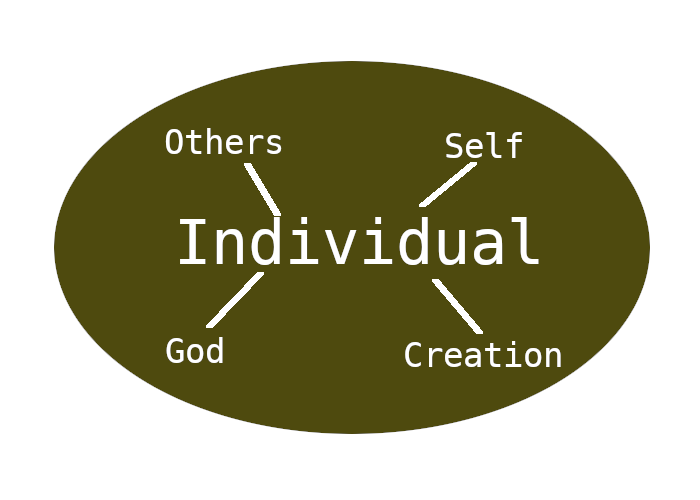
In this extended article I will follow the theme of reconciliation and how that outworks in four directions

  • Reconciliation to God
  • Reconciliation to fellow-humans (and this has to include the ‘other’, even the person(s) that might be termed the ‘enemy’)
  • Reconciliation to oneself, or as commonly termed ‘self-acceptance’
  • Reconciliation to creation, the planet on which we live.

I am not suggesting that the above four are of equal status, but neither am I suggesting that any one aspect can eliminate one or more of the other three. All four aspects are essential as we hold out for ‘the reconciliation of all things’. 

We might wish to argue that the first (reconciliation to God) has to come first in a temporal sense and without that taking place the others have no ‘kingdom’ value. I prioritise the first as of greatest value, but am not prepared to denigrate the others as having no value; indeed the other three should critique the claim that we have been reconciled to God.

In Christ God was reconciling the world to himself, not counting their trespasses against them, and entrusting the message of reconciliation to us (2Cor.5:19).

What aspects of the world was God reconciling? Paul centres in on ‘us’ as we are the core of the problem. If we are out of sync everything else follows suit, such as we read in Genesis that the ground was cursed because of us. Reconciliation, and the great hope was of the reconciliation of ‘all things’. This reconciliation, Paul insists is to take place through the cross:

and through him God was pleased to reconcile to himself all things, whether on earth or in heaven, by making peace through the blood of his cross.
And you who were once estranged and hostile in mind, doing evil deeds, he has now reconciled in his fleshly body through death, so as to present you holy and blameless and irreproachable before him, provided that you continue securely established and steadfast in the faith, without shifting from the hope promised by the gospel that you heard, which has been proclaimed to every creature [to the whole creation] under heaven. I, Paul, became a minister of this gospel (Col. 1:20-23, emphases added).

The reconciliation is already ‘ours’, but the message goes beyond us – to all creation (NRSV translating ktisis (creation) as creature). Paul’s vision of salvation / restoration is as big as to solve all issues, thus the universal statement of ‘all things, whether on earth or in heaven’. The apostolic gospel is cosmic in its message and the apostolic commission is to partner with the fulfilment of that message.

There is a small statement in Mark (short Gospel but with a number of small statements that can be missed) with regard to the temptation of Jesus, a note of heavenly and earthly reconciliation:

He was in the wilderness forty days, tested by Satan, and he was with the wild beasts, and the angels waited on him (Mk. 1:13).

The angelic and human together, and… the wild beasts with the true human thus bringing a major aspect of the ‘all things’ of creation into harmony as expressed in the Isaianic vision of ultimate transformation. The true human who, unlike the first Adam does not submit to the ‘god of this world’, exhibits in the wilderness of all places (the supposed domain of the demonic) something of the reconciliation of all things.

Reconciliation to God is central, but the theme of reconciliation does not find its completion with some spiritual state for the redeemed elite. Hence the exploration of reconciliation in these four dimensions.

A little writing that is to come

The next next of posts will take a slightly different direction. During lockdown I wrote four books with the overall title of ‘Explorations in theology’ and have held various Zooms on their content. I consider behaviour is more important than belief but know that belief shapes behaviour. I am not sure what label is appropriate for where I sit on the theological spectrum. I guess I could be labelled a ‘progressive evangelical’, evangelical in the sense that the canon of Scripture is the authority for what I believe and the cross of Jesus is the means of reconciliation to God (as put out in Robert K. Johnston 1990’s paper); David Bebbington suggested four elements that define evangelicalism: conversionism, biblicism, crucicentrism, and activism. As per all terms each one needs to be filled with meaning and meaning is where theology steps in. ‘Progressive’ in the sense that there is one eternal gospel but our understanding of it is shaped by our cultural setting, and we are no longer living in the Anselmian era of feudalism, nor the Reformers’ era of indulgences and the law-court. If progressive is appropriate then I also make a loud shout that we must always be assessed by our faithfulness to the parameters of the great narrative of Eden to New Jerusalem. (And to be a little provocative… surely a belief in the rapture falls way short of being faithful to those parameters; and to be even more provocative – we have to go beyond ‘belief’, maybe a statement of faith that could not be critiqued would be one borrowed from ‘the devil’ who believes!!!! Purely provocative – but the point is faith has to contain allegiance and perhaps should be defined by allegiance?)

Since writing the four books I began to write some extended articles (https://3generations.eu/journals) and am about to start another one in that ‘series’. It will be an exploration and my plan is to write it as a series of posts that I will then extend (maybe with the help of comments and push back) and publish it as the next pdf extended article. This will be an exploration into the reconciliation of all things, not in the sense of eschatological reconciliation but at the level of ‘redemptive’ reconciliation – what now and here is to be reconciled; in what areas are we to experience and work toward reconciliation. I will suggest that there are four ways in which reconciliation is to be expressed:

  • reconciliation to God
  • reconciliation to others
  • reconciliation to the creation
  • reconciliation to self.

The first is of course obvious and very ‘Pauline’; the second comes through clearly with the command to love our neighbour… and the extension of that to love ‘our enemy’; the third is clear in Romans 8 and is much more visible as an urgent necessity in our day than in Paul’s day; the fourth has become the domain of the therapeutic world but is within that command to love others as we love ourselves. So far so good, but not really much of an exploration! A very short article.

We can claim to be reconciled to God but if we ‘hate our brother / sister’ we are a liar! Strong words. In reality if I am truly reconciled to God then there should be a flow into the other areas – sadly a ‘believe the right doctrine’ and righteousness is ‘imputed’ does not stack up with Scriptures that extend the meaning / implication of faith in God. We are in process so I am not suggesting some level of perfection required – grace is grace. Full, realised reconciliation awaits us.

I will seek to explore these four areas and allow Scripture to critique our approach to Scripture and the area that might prove a little uncomfortable is whether there is scope to begin with an area of reconciliation other than that of reconciliation to God (in the personal / Christian sense).

Let me put it this way – if we (I) claim to be reconciled to God through the work of the cross then there is the legitimate expectation that there will be evidence that I am embracing the other three areas of reconciliation. That is the challenge to me as a believer – demonstrating my faith, not simply articulating it. Then exploring the position of someone who is not a believer:

Could it be that there is someone who does not even believe in a transcendent personal God who is increasingly being reconciled in the three other areas and as that takes place they are in fact being, in limited but yet real measure, reconciled to the God who is revealed within creation and within humanity?

Panic not! Explorations… but I will also wish to explore the implications of any such view. Where am I on the theological spectrum – willing to explore as Jesus is the centre of all.

Teaching the Way of Empire

After my reflections a change with a guest post from Simon Swift. ‘At the heart of God’s kingdom is justice based on relationships’… and I love the ‘Divine Commonwealth’ as a concept for the kingdom of heaven.


Some weeks ago the USA decided to drop the biggest non nuclear bombs on Iran and put an end to their nuclear ambitions. As I watched the unfolding drama on our western news, I was struct by the question of what exactly was the President of the USA trying to teach Iran, and indeed every other nation in the world?

Now I am no expert in the problems of that part of the world. So I don’t want to comment too much because I would be doing so mostly from ignorance. While it seems to be all centred around Gaza, the horrific suffering of both the Palestinian population and the Israeli hostages, there are larger forces at work. With the support of Israeli colonisation by the likes of the US and UK on the one hand and the Iranians dreams of dominance in the middle east on the other. It’s like a middle east version of the cold war with proxy fighters and complicated relationships. In the middle of it all the people who live there suffer the most. One could ask who is actually to blame for all this.

Back to the bunker busting bombs and the ability of the USA armed forces to strike any where in the world: What did it actually teach Iran, will it cower the Iranians or make them moor determined to have nuclear weapons? What was on show was the might and power of the USA. It’s feet firmly planted in the power of empire with it’s ability to bring death and destruction to anywhere in the world. They can send a missile with precision to anywhere. If you are on their list as enemies, it does not matter where you live. Country border’s are meaningless now; they can deliver death to your door step. Now they are not the only ones who can do this and this is not about having ago at the US, but I do question the reason for that mission, because I believe it teaches one thing to the world: Might it right.

It teaches that if you want to be truly free you have to be the strong man, you have to be dominant and in control. The way to do that is to have the biggest bombs and the larges military. You have to subdue anyone you think could equal you and therefor become a threat. So it would not surprise me if Iran doubles their efforts to build a nuclear bomb. And the rest of the world looks on and thinks Yeah, we need one too. This just draws the world further in to the kingdom of death. It does not provide justice for the populations of the world and leave the weaker to whims of the powerful as they, the elite ruling classes, battle it out to be king of the castle.

Now I occasionally watch LBC’s James O’Brian on YouTube when they post clips of his shows. On one occasion a gentleman who is Jewish and lives in London, has dual British and Israeli nationality, called in on O’Brian’s phone in show. He is a musician and formed a band with a Palestinian who unfortunately is still stuck in Gaza. He went on to explain how the Israelis live in fear and how that is exploited by politicians. As he talked he mentioned that he had been approached by some Palestinian musicians to produce their music. If we want justice in the middle east then this man points to the right way: relationships.

At the heart of God’s kingdom is justice based on relationships. We may feel we cannot do much about what is happening in Gaza, Yet, we can do relationships. This man talking on LBC radio was doing relationships. Now I don’t know anyone from that region or indeed any Jewish or Palestinians, but I do know that I should be careful in passing judgement. Instead, if we are in a position to do anything, however small, we should be looking to build the right relationships. Why? because we need to be using Love power instead on drawing on the power of Empire.

What would the world look like if our politicians lived in the kingdom of Heaven. If they where to hook up to the power of love? This I think is relevant particularly to the UK after Brexit. It finds itself with out an empire to pay for things. The government has to work out what is the place of Britain on the world stage (and still be able to afford it.) So I ask how would the vision of a future UK be shaped if power is based on Love instead of Empire?

One of the problems with the term ‘Kingdom of Heaven’ is its connection with Christendom and empire building. I much prefer the term ‘Divine Commonwealth’ as its suggest a shared inheritance which we get to take part in and even to contribute to. Which leaves us with the question, what can we do to advance the kingdom, or better still build the commonwealth, that is of heaven? If justice is about relationships then that is where we can begin: In the villages, towns and cities. In the work place, on the high street or shopping mall. In our churches for sure, but what other third places do we frequent that need the disciples of the the Way to be a light in the darkness?

In our conversations what is the type of language we use? In 1 Corinthians 13:4-7 Paul lists more than just a description of love, rather they are practical pointers to how we should do love. If we want to plant the seed of God’s Divine Commonwealth then we must, while not ignoring wrongs done (whether by governments and organisations or individuals,) promote reconciliation. Pointing out what is of the kingdom of Death and what is of Heaven using a language that none Christians get.

I’m afraid I only have questions and not many answers. To live in these times we need our heads in heaven and our feet on earth, or as shewed as snakes and innocent as doves if you prefer. At the end of the day our only weapon is Love. But we do have one advantage: A faith in one who has gone through death and come out the other side.

Assuming another 70 years!!

Another 70 years to come… of course I would be wildly in fantasy land to think I will have another 70 years. And I hear a groan – ‘no not another 70 years Lord, spare us’ – just to let you know that maybe prayer has three possible ‘God answers’ – yes, no and wait… so your prayers might just not avail!! 70 more years -I don’t think I will come close. One day – moons ago – when I was 66 (not 666!!!) I was running and suddenly I thought ‘I am probably more than half way through my life’ (2 x 66 = 132, so nowhere near 140). So not really assuming 132 or 140 but I do have today so what comes? One day at a time.

I hope the reflections have given you a smile or two, an agreement here and there, and probably a few disagreements too. As I hit the 70 mark I am content to acknowledge that there are huge gaps in my understanding (not an issue) and sadly huge gaps in my maturity (there lie the issues). One wrote of ‘the second half of life’ – I have gone way beyond that in calendar terms, but have not yet worked my way through the first half of life character wise (and the use of the word ‘work’ probably was a give away?).

I do try and sit in the space of creating space for those younger who should go way further than the likes of my generation. It will be great to compare notes when we all hang out in the future. So a bunch of final ramblings follow.

Final future when we all hang out (and of course it might not be the ‘final’ as we have the word ‘eschatos’ not ‘telos’ for that ‘end of the ages’). No more marriage – why? Cos marriage is intended to be a sign of covenant relationship – then we will be truly in covenant relationship with all. (And those whose marriage has ended in divorce – you too are a sign too not of personal failure but of the wider pain and suffering in our world. We need every aspect lived out in grace – the diversity is important.)

Who will be hanging out? I am not a Universalist, but suspect that God might just be. Those who follow the Lamb wherever he goes for sure; those who were proclaimed ‘born again’ – I suspect God will find a way to get most of them in; those who truly lived out the embrace of humanity – I am pretty sure we will hang out; and so on and so on – God knows. It is not my part to draw lines but to provoke people to find out who they truly are and where I have space to explain the hope that is within me and the story of Jesus.

I am always disappointed when people make some self-proclamations. There will be a proclamation on that great day. I live for that. Have I done well in these past 70 years? Who knows? You don’t and I don’t. So I wait and wait in faith because of the generosity of God.

Many factors took us to Spain but the undergirding reason was that of seeking to uncover what was the Pauline Gospel. Back in 2001 I was asked to take a session at a conference in Hannover and spoke of ‘re-digging the wells of revival’ (that was the era). At the end of that time I had a small number of those from Spain who said that they did not have a history of revival comparable to what I spoke of… I instantly replied without any pre-thought with ‘what other nation on this planet can on biblical authority claim that there are first century apostolic unanswered first-century prayers in the ground. You do not need any history of revival, go dig out those prayers’. I went away to realise that the prayers were those of Paul (and others). Have we (wider we) grasped the ‘Pauline Gospel’ – well I am encouraged to see major movements forward in the academic world on a deeper exploration of Paul and his gospel. But something beyond that is coming.

The ‘gospel of the kingdom’ or ‘the Pauline Gospel’ seems to centre on Jesus’ resurrection and the disarming of all hostile powers through the cross so that this world does not have to be subject to imperial powers but can move toward transformation. This I want to sow into… Sicily calls, Istanbul calls and the Far East. Maybe even a final setting of ‘Jerusalem’ the city where a great reconciliation should be manifest – hence all the conflict and demonic ethnic cleansing in that part of the world right now… for Paul said ‘in this way all Israel will be saved’ (that demands another post, the Greek is not ‘and then’ and it does not say ‘all Israelites’ nor ‘all Jews’ (Jews and Israel not being synonymous) but it references the ‘fullness of the Gentiles’… Another of Paul’s difficult to fathom passages and rich beyond measure).

I have no idea what is to take place before the ‘trumpet sounds’ but I am sure of the prayers that have to be prayed prior to that sound – let your kingdom come (here). I remain agnosticaly active.

I have hinted at a new context in some of these posts – such as the one with Michael Kolisang. If we see people healed (and ‘saved’) in a church construct setting let us rejoice, but having been on the island of Malta recently and reading that the sick were brought to a healing meeting (oops, got to read it again!!!) there is a provocation for the presence of God to be present. (Presence is something of a new paradigm rather than ‘power’.) A new context is challenging, but I think the grave was a challenge for it was there that ‘the last enemy’ was overcome.

I grew up with George Ladd’s theology of the New Testament and many times (past) have quoted his take on the church as the agent of the kingdom. Now I suggest it is not as simple as the church being the agent of the kingdom but the body of Christ taking responsibility to be a catalyst for agents of the kingdom to rise. We are here to hold space.

The most influential season in my life (21-46 years of age) was that of the New Church Movement – if you have come another path be grateful for the path for all of us is different, it is to be fruitful and to ever lead us into new vistas – in that movement we were ‘restorationists’: God was restoring the church on the foundation of the ‘five-fold ministry’. Once the church was ‘without spot or wrinkle’ the nations would flow to ‘Zion’. Not sure God is that concerned about the shape, structure of what we term ‘church’. I am deeply grateful for that background… but now I see God’s eschatological vision as the restoration of all things. The world is centre stage. Of course God loves the ‘church’ but that has to be embedded within ‘God so loved the kosmos‘.

I think when we read of Paul’s use of imperial language (‘Lord’, ‘Saviour’, ‘peace’, ‘gospel’, ‘kingdom’, ‘salvation’, etc) it is fully understandable that people thought he was proclaiming another lord other than Caesar… and for sure, for the kingdoms of this world will become the kingdom of our Lord and Christ. Grateful for the past but not wanting to stand still. [I appreciate Paul’s langauge is alsoshaped by Israel’s Scriptures and perhaps there is with that the challenge of how we communicate the Jesus’ story within our culture, though given that there is a core continuing issue of imperial powers we have to connect the ‘gospel’ into that.]

I have for some time seen the year 2040 as a major cut off in this season, one that was marked early on by COVID. Just for a minute (but not for too long) imagine that I only just make it to that year. What will we see by then. Well I hope I will be faithful to run with the vision I have and countless others with theirs… otherwise – OOOF. One day I saw a major global catastrophe (probably a set of catastrophes) and the world population being decimated – possibly by more than 1 billion people. Not good news, but almost certainly avoidable.

I think this is the first season when I have tried to reflect back… oh and one final reflection. When I look back and see the 1 mistake (maybe the demons made me write ‘1’)… the many mistakes I have made I find myself praying ‘God forgive me’, then one day I heard – stop praying for forgiveness, forgive yourself. Hearing that I realised how immature I am, but thought maybe somebody reading these posts could benefit from that reflection. A God-gift to humanity is the ability to make mistakes. How we handle them is how much we image God and reflect his/her glory. Reflecting back has been good for me… and also ‘forgetting what lies behind’ is as good if not better. I plan to write a few more posts before I hit the 140 marker! Thanks for reading.

God is… humble

The problem with theology (word about / study of God) is that it normally starts with God and works from there. But what do we know about ‘God’? As Barth said ‘we cannot say God by saying man (sic) in a loud voice’… So we have to be ever so careful when we talk of the ‘wrath’ of God as if God is me when I am angry but only more so! Likewise ‘forgiveness’ cos if we are not careful we end up with an appeasing of God. So much theology starts with God and then all the ‘omni’ words but they are often articulated without reference to God’s character – I still think somewhat reliant on the ‘Unmoved Mover’ of the Hellenistic world. Take omniscience – God knows all things, but under conventional theology it is closely aligned to predestination . How about the analogy of a master chess player who knows how to respond to every move, only multiplied beyond measure, so that God works toward the one goal with precision, responding to every move and every opposition so that there will ultimately be ‘the reconciliation of all things, things in heaven and on earth’. As one author puts it ‘Love wins’.

As Jesus is the revelation of God we have to start there, and we also add that Jesus is the image of the new / true humanity. Hence, we can affirm that ‘God is love’. I mentally assent to that, but am provoked to believe it – that I think is a life-long journey for us all. However, I do think I believe (cos I am stunned so many times) that ‘God is humble’. I have a long way to go in my faith and I guess if I believe God is humble it it probably a step on the way to understanding that ‘God is love’. Let’s try a few verses from Paul (with my small edit!):

God is patient; God is kind; God is not envious or boastful or arrogant or rude. God does not insist on her/his own way; God is not irritable; God keeps no record of wrongs; God does not rejoice in wrongdoing but rejoices in the truth. God bears all things, believes all things, hopes all things, endures all things.

We so often want a big God – big defined our way. A God who demonstrates not simply who s/he is but demonstrates that we are so right. God is BIG but does not ‘big’ her/himself up. Humility – so key in Scripture, and given the humility of God I am shocked at how arrogant I can be – knowing this, knowing that.

The pre-Pauline Philippian hymn speaks strongly of the humility of God; conventional translations have something along the lines of ‘although he was in the form of God… he humbled / emptied himself’ giving the impression that Jesus did not act in a God-like way. (And of course this plays out when we come to the cross with the view of justice demanded (by God) and mercy offered through sacrifice / appeasement).

[I am not engaging with the passage along the lines of Andrew Perriman who does not view the passage as a pre-Pauline hymn – a fascinating take for those interested… and my point below is not dependent on what the passage is at core. Andrew’s view is put forward in his book but you can get an insight to it here:
https://www.postost.net/2025/07/whats-pauls-letter-philippians-all-about.]

I appreciate we are not all Greek readers but let me simply write below what the manuscripts say:

ὃς ἐν μορφῇ θεοῦ ὑπάρχων οὐχ ἁρπαγμὸν ἡγήσατο τὸ εἶναι ἴσα θεῷ…
who in the form of God being (no ‘in spite of’, ‘although’ or any such words).

Why did Jesus not grasp at position? Why did Jesus humble himself? Why did Jesus become a slave?Why did Jesus become obedient, even to death? We have to answer it with: because he was God-like.

God is humble. Maybe I am immature and need to deeply bow under the biblical statement that ‘God is love’; but I am hopeful if I know that the God who is revealed in Jesus is humble maybe that will deal with any residual arrogance and one day I will simply need to say ‘God is love’.

Clothing!

Never been a fashion icon nor with any desire to try that path. Gayle can dress me easily – all she needs to do is arrange what is in the top of a drawer as I pick the first thing every morning (tempted to make this a ‘no-comment’ post). Way back in time, 1996/7 I was meditating a lot on sack-cloth and sensed that one day I would need to add it to my great range of clothing… BTW one of my heroes Gustavo Gutiérrez once travelled in the USA and in one place his host noticed that each day he was wearing the same clothes and was evidently washing them each night. They bought him a new shirt which he gratefully received with the words ‘Thank you so much I know a brother back home who really needs a new shirt’.

Back in the 90s I used to run reasonable distances with a stop-watch (I still run now but am on the edge of ditching the stop-watch for a calendar, feeling good if I can complete 5kms the same day that I started) and I could still go back to the same part of the road when I ‘heard’, ‘it is time to get the sack cloth’. I managed to track some down and Kay (neighbour over the road) quickly put a make shift shirt and shorts together. My new wardrobe.

Within weeks there was a leadership conference for a certain movement (from memory almost 1000 leaders?). I was always due to attend and showed up, changed into the new wardrobe and joined in all the meetings. A number of questions were asked (understandably so) but I did not respond beyond – just felt the right thing to do. Without asking the host of the conference gave me the platform at the end of the conference.

It is time for new clothing, the clothing of repentance and humility is the clothing that we have to wear. We see walls that have been built but have to take responsibility for the building of the walls. We must go beyond our walls and will meet others on the ground of humility. Tonight the ‘train’ that brought us here has terminated and is not moving, we have to get out of the train of convention and find new transport to take us forward. Relationships for the sake of identity have to give way to relationships for the sake of territory.

That was the summary of what I brought.

Some time later I met with a couple who were talking to me about that evening and suddenly she had an outburst… (excuse the language) ‘They have bloody well started to move the scenery behind the train to give the appearance the train is still on the move’.

1998 – the date of the conference – to 2025 and a lot of water has gone under the bridge since then; probably if I revisited that ‘word’ I might well express it somewhat differently. But clothing is so important.

I had a woman in Chiswick, London come to me at the end of a meeting asking if I would pray for her and her work. She said she was a fashion designer. I did not reply with ‘you’ve come to the right person’, but with ‘you are in a field of work that is so ideal for a believer… clothing is a sign of the resurrection’. Paul, talking of the resurrection body described it like clothing and he said the one aspect regarding death was he did not want to appear naked. Clothing is not simply for warmth and modesty but to express who we are. I said to that woman if you can feel the pull of the resurrection you will design clothes that when there is a show models will want to wear your design for they will feel good about themselves.

Maybe we need a ‘revival’ in the fashion industry, with great designs… and some sack-cloth?

Humility is so necessary. It is the major protective clothing against the devouring work of the adversary:

And all of you must clothe yourselves with humility in your dealings with one another, for
“God opposes the proud
but gives grace to the humble.”
Humble yourselves, therefore, under the mighty hand of God, so that he may exalt you in due time. Cast all your anxiety on him, because he cares for you. Discipline yourselves; keep alert. Like a roaring lion your adversary the devil prowls around, looking for someone to devour (1 Peter 5:5-8).

But God gives all the more grace; therefore it says,
“God opposes the proud
but gives grace to the humble.”
Submit yourselves therefore to God. Resist the devil, and he will flee from you (Jas. 4:6-7).

I say to everyone among you not to think of yourself more highly than you ought to think but to think with sober judgment (Rom. 12:3)… For if those who are nothing think they are something, they deceive themselves (Gal. 6:3).

The sack cloth is no longer in the wardrobe, but the clothing of humility should not be discarded, and we must avoid moving the background scenery to give an impression of movement.

Perspectives