Cause, purpose… or something different?

Definitely something different – from my perspective / objective truth (we all have the objective truth that can never be challenged, do we not?).

As he walked along, he saw a man blind from birth. His disciples asked him, “Rabbi, who sinned, this man or his parents, that he was born blind?” Jesus answered, “Neither this man nor his parents sinned; he was born blind so that God’s works might be revealed in him. We must work the works of him who sent me while it is day; night is coming, when no one can work (Jn. 9:1-4).


Maybe what I write today is a little technical and of course is a push back against the Calvinist / Reformed view of ‘sovereignty’ (just amazed that I could spell the word ‘Calvinist’). I do think that what I propose is totally defensible and on the right track, but maybe the final sentence is what it is all about.


The disciples reflect a common view of the day. Serious infirmity such as the man born blind indicated someone had sinned. The man himself (but born blind, so when did he sin?!!!) or the parents, that is the option. Their view then is concerning ’cause’ – what caused this situation?

Jesus apparently responds with a ‘no’ to cause but seems to says it was for a reason… or so many of our translators and those of a certain theological perspective would have us understand (born blind so that God can heal). Blindness so that God’s works might be revealed. (One day I need to get into Rom. 9-11 where we can read Pharaoh is raised up in a certain way without choice – maybe if we took a trip as Jeremiah was instructed to do to go to the pottery we might read that a little differently.) From my perspective if ‘so that’ is what Jesus said I am not sure it is great step forward in understanding – this happened so that God’s work might be revealed (the reason why the man is blind). If one is a fan of trumpeting ‘sovereignty’ and hiding behind ‘mystery’ maybe it works – but I consider that this is an extreme view of hands-on sovereignty and all-but making life something we can never understand.

So is there an alternative?

In virtually all translations we have a variation of the above option as I quoted at the beginning of this post; the Message (an interpretive paraphrase) does give a much softer alternative:

You’re asking the wrong question. You’re looking for someone to blame. There is no such cause-effect here. Look instead for what God can do. We need to be energetically at work for the One who sent me here, working while the sun shines.

The Contemporary English version likewise is much softer:

But because of his blindness, you will see God work a miracle for him.

I want though to go further than the ‘softer’ interpretations. So a little Greek…

ἀλλ᾽ ἵνα φανερωθῇ τὰ ἔργα τοῦ θεοῦ ἐν αὐτῷ (this is Jesus response with the first word being alla = a strong ‘but’ (reduced to all here as the next word is a vowel), and the first two words being ‘all hina’).

There is an acknowledgement that there are three uses of the word hina – as a cause or as an outcome; such as: ‘I worked so hard in order to pass my exam’ (purpose) or ‘I worked so hard and so passed my exam’ (result). This happened to the man (born blind) so that God might display his works is purpose, and the way many translations go; softer translations go along the lines of result – born blind, but the result is he is healed by God. I have mentioned two of the three uses – the third in a minority of cases is what is termed the ‘imperatival hina’ use – being used as a command. Still with me? Just read on we will get somewhere.

I lack a library here but as far as I can work out there are four other references to the two words (all hina) coming together in a clause in the NT: Mk.14:49; Jn. 13:18; Jn. 15:25 and 1 Jn. 2:19. (I use The Step Bible as the Greek text there and corresponding dictionary is very up-to-date.)

Day after day I was with you in the temple teaching, and you did not arrest me. But let (ἀλλ᾽ ἵνα) the scriptures be fulfilled (Mk.14:49). The translators have chosen the imperative use here (well done says Martin to the translators) – thus going beyond the idea that the Scriptures have predestined this to happen. (This is the interpretation that I will be pushing for in the text about the blind man.)

I am not speaking of all of you; I know whom I have chosen. But it is to (ἀλλ᾽ ἵνα) fulfill the scripture, ‘The one who ate my bread has lifted his heel against me’ (Jn. 13:18). Same phrase as Mark above but this time the translation is along the line of purpose. I would suggest this is better understood as an imperative so ‘but let the Scripture be fulfilled‘. Judas fulfilled the Scripture but not as if the Scripture was a prophecy – he and others have fulfilled that Scripture!

It was to fulfill (ἀλλ᾽ ἵνα) the word that is written in their law, ‘They hated me without a cause’ (Jn. 15:25). Again I think better understood as ‘but let the word that is written in their law be fulfilled…

They went out from us, but they did not belong to us, for if they had belonged to us they would have remained with us. But by going out (ἀλλ᾽ ἵνα) they made it plain that none of them belongs to us (1 Jn. 2:19). Here translated as a result, but if it was an imperative we would read something along the lines of ‘but let them be revealed as not belonging to us’.

All the above personal research and I alone have understood this? No… if ever I had an original idea it would have died of loneliness within 5 minutes… I first came across this in the research of W.G. Morrice’s Greek grammar and the various responses to that; the nature of the clause is not simply that it is the normal ‘hina’ clause but it is preceded by ‘but’ – there is a big pushback to what has gone before.

Morrice says:

In his reply, Jesus indicated that this was a question that should never have been asked. It was neither the man’s sin nor his parents’ that had caused his blindness. The concern of the disciples should be to try and cure him. “Let God’s power be displayed in curing him!” Jesus proceeded to do exactly that. “The hypothesis of the imperatival iva, therefore, releases the text from the fatalism which had obsessed it, and dissolves the picture which had become familiar through all our English versions, a man destined from birth to suffer for the sole purpose of glorifying God when he was healed

(For anyone interested here is an article that is based on Morrice’s work.)

So back to the verse we started with, now with my translation:

As he walked along, he saw a man blind from birth. His disciples asked him, “Rabbi, who sinned, this man or his parents, that he was born blind?” Jesus answered, “Neither this man nor his parents sinned; but let the works of God be revealed in him. We must work the works of him who sent me while it is day; night is coming, when no one can work.

Any discussion on who is to blame is knocked on the head and Jesus not only pushes past that or any related discussion to the responsibility of taking action for the intervention of God. I do think this is a consistent way to translate the phrase when we meet it in the NT and illustrative that philosophical / theological discussions are irrelevant – we have to work while it is day. Quit the discussion, get on with the redemptive work of heaven.


When? Or just get on with it?

So when they had come together, they asked him, “Lord, is this the time when you will restore the kingdom to Israel?” He replied, “It is not for you to know the times or periods that the Father has set by his own authority. But you will receive power when the Holy Spirit has come upon you, and you will be my witnesses in Jerusalem, in all Judea and Samaria, and to the ends of the earth.” When he had said this, as they were watching, he was lifted up, and a cloud took him out of their sight. While he was going and they were gazing up toward heaven, suddenly two men in white robes stood by them. They said, “Men of Galilee, why do you stand looking up toward heaven? This Jesus, who has been taken up from you into heaven, will come in the same way as you saw him go into heaven” (emphases added).

Such a disputed passage with regard to interpretation… the restoration of Israel or the replacement of Israel by the church… or something in between? And of course on this blog we only deal with the one and only valid perspective – mine! Anyway been thinking about these verses so here is a take on them.

(I am aware that what I am writing here in a post is shorthand for what should really be part of a fuller article so feel free to skim the contents… or read and fill in the gaps in what I write.)

  • Jesus spends many days with the disciples talking about the kingdom of God so I think we can assume they are not totally ignorant – though like us all they have not grasped everything. The central theme though, based on their Scriptures, has been the kingdom of God.
  • The disciples’ question is a straightforward time question – is this the time (chronos).
  • Jesus resists the time answer (and does not respond simply with chronos but with chronos and kairos). Then he picks up with clear allusions to Isaianic passages / Isaianic theme:

In response to the question Jesus highlights that the outpouring of the Spirit is necessary and as a result this small representation of Israel (12 disciples / sons of the true ‘Israel’) will be witnesses to the ends of the earth so that the tribes of Jacob will be restored. [In what follows I will quote the core Isaianic passages but it is the overarching themes from Isaiah that are important, and I also am distinguishing ‘Israel / tribes of Jacob’ from the term ‘Jew’ – this needs a separate post to follow that theme.]

The Isaianic passages

  • [Desolation]… until a spirit from on high is poured out on us (Is. 32:15, and other references to the outpoured Spirit bringing about restoration and a new day).
  • You are my witnesses, says the Lord,
    and my servant whom I have chosen,
    so that you may know and believe me
    and understand that I am he.
    Before me no god was formed,
    nor shall there be any after me (Is. 43:10, in reference to Israel / a remnant as ‘servant’.)
  • It is too light a thing that you should be my servant
    to raise up the tribes of Jacob
    and to restore the survivors of Israel;
    I will give you as a light to the nations,
    that my salvation may reach to the end of the earth (Is. 49:6).

So the time question is sidelined but the calling is centralised. Time is not relevant – an eschatological perspective, for the task is central; it is the task that determines the timing… and in a strange (to us) way the task seems to answer the ‘restore to Israel’ question. That last Isaianic quote where salvation reaches the end(s) of the earth does two things – it restores the ‘tribes / survivors of Israel’ (not ‘Jews’, nor those ‘of Israel who live in the land’) and light is finally displayed in the nations. OK, hang on…

In Romans 11:28 we read ‘And in this way all Israel will be saved’ (not a time phrase but a phrase indicating a process), and follows this up with a quote from Isaiah,

And he will come to Zion as Redeemer, to those in Jacob who turn from transgression, says the Lord (Is. 59:20).

A quote other than Paul changes it to

Out of Zion will come the Deliverer; he will banish ungodliness from Jacob’ (Rom. 11:29).

Will God restore the kingdom to Israel? Yes. In Jerusalem now? No. How – from Zion a redeemer will go to the ends of the earth gathering all up who respond, and in this way all Israel will be saved (‘all’ never meant each and every person for when the salvation of Israel was discussed in Rabbinic literature, there were always those who were by ethnicity ‘Israel’ but were excluded / cut off from Israel (‘this people’) – such as ‘not all Israel are Israel’).

The kingdom is restored to Israel, but not as excluding Gentiles for there is only one ‘olive tree’. Indeed by including Gentiles Israel is included! (Formerly the purpose was to include the seed of Abraham (Israel) so that ultimately Gentiles (all the families of the earth) could be included. Now if Gentiles are not included Israel will be excluded!) There is nothing exclusive in salvation; It is not about a great awesome future in the Middle East but an awesome future in and for the entire planet. Not only is there a change in direction (from ‘to Zion’ to ‘from Zion’) but the time is dependent on the job to be done, the witnessing to the entire world (and witness is much bigger term than the reductive term that has been colonised, the term ‘evangelising’). It is not an event in Jerusalem, it is a global vision. It is not about salvation in Israel but the promises of God that Paul contends for in his letter to the Romans is that God has to be faithful to his promises to Israel – including all the dispersed throughout the earth of the ’10 lost tribes’… as he says to King Aggripa:

And now I stand here on trial on account of my hope in the promise made by God to our ancestors, a promise that our twelve tribes hope to attain, as they earnestly worship day and night. It is for this hope, Your Excellency, that I am accused by Jews! (Acts 26:6,7. Emphases added – twelve tribes are bigger than the term ‘Jews’).

Where are those 12 tribes? Throughout the earth… Dispersed. Two tribes were in the land (Judah and Benjamin), but the majority of the others were not. It is not about the kingdom being restored in a place (which we call Israel) nor to a subset of Israel (Jews) but to the entire world (which includes Israel). In this way so we had better get on board with ‘this way’ rather than ask ‘when’.

So my take?

  • Time is not a relevant question.
  • Methodology through fulfilling purpose is central.
  • And the methodology that focuses on the global will be the means by which ‘all Israel’ (the fullness, pleroma: Rom.11:12) and the fullness (pleroma: Rom. 11:25) of the Gentiles come in, thus the kingdom will be restored to our world (and therefore in this way to Israel).
  • God’s calling has always been universal… and Acts sets this out – with the final word ‘unhindered’ (akōlutōs)… from Jerusalem to Samaria (with Philip) to the Ethiopian eunuch who asked what now ‘hinders’ (kōluō) him from being baptised… to Paul in Rome to Martin (and a bunch of similar ‘leaners’ who ask our irrelevant questions) in…
  • So Jesus’ reply is a both ‘yes’ and ‘not as you think’ answer.

Thus endeth the only authentic take on the passage in Acts.


Postscript: the Ethiopian eunuch is probably more central to Luke than might appear. He is reading from the prophet Isaiah and the catalyst ‘chapter’ is Is. 53… but keep reading (as I am sure Philip and the Ethiopian did) and then we might understand the question ‘what hinders me being baptised’ for he has been in Jerusalem but excluded from Israel’s core temple worship on two counts: a foreigner and a eunuch. Here is more of Isaiah:

Do not let the foreigner joined to the Lord say,
“The Lord will surely separate me from his people,”
and do not let the eunuch say,
“I am just a dry tree.”
For thus says the Lord:
To the eunuchs who keep my Sabbaths,
who choose the things that please me
and hold fast my covenant,
I will give, in my house and within my walls,
a monument and a name
better than sons and daughters;
I will give them an everlasting name
that shall not be cut off.
And the foreigners who join themselves to the Lord,
to minister to him, to love the name of the Lord,
and to be his servants… (Is. 56:3-6).

Samaria to one foreigner and a eunuch. Something has broken with the next chapter in Acts being the calling of the ‘apostle to the Gentiles’.

Reconciliation… a video & a date

A short while ago I wrote a paper exploring Alienation and Reconciliation as a suitable (the best?) way to summarise the ‘problem’ and the work of God to deal with the problem. I suggested that as it is a relational framework, not a legal one.

I am proposing an Zoom discussion on the evening of Wednesday October 22nd, 7:30pm UK time. The Zoom link will be: Zoom Link for evening.

The paper is here:

Reconciliation in Four Directions

[If you wish to find other pdf’s and the one that precedes this volume go to: Extended Articles]

Here is a short video (17 minutes) seeking to summarise what I wrote and opening up the possibility that perhaps there is scope for someone who is not reconciled to God, but is journeying along the path of reconciliation to others, to our world and to self, that in some way they are being reconciled to the God of Creation / the God of redemption. To suggest so is to go ‘beyond’ Scripture but is it to go beyond the trajectory set out for us. I plan to host an open zoom evening on this and I guess that might be the part where there could be push back and also exploration. A date to follow! If and when I host that evening please read the paper / watch the video prior.

Romans 23

No I am not about to write a few more chapters to correct(!!!!) Paul’s theology of the gospel. Rather I am going to make a few comments on the first two Scriptures that I was taught to use in ‘witnessing’ – Romans 3:23 and Romans 6:23

For there is no distinction, since all have sinned and fall short of the glory of God.

For the wages of sin is death, but the free gift of God is eternal life in Jesus Christ our Lord.

Everyone has sinned… so tell me you have never done anything wrong? Tick box. The result is you will die (= eternal punishing), however there is a way out of that situation. Tick box. With a few nuances we might be able to run with that, but as always we are reducing this to something individualistic. Paul has been working with a ‘Jew first, then Greek’ framework (makes some sense of chs. 9-11 and the Israel / Gentile material there and the final instructions how to relate together when there could be divides over food issues and ‘one day above another’ approaches). ‘All’ have sinned in this context is not as simple as ‘you + me + every other individual’ but all in the contextual sense of whether you are part of the covenant people or the non-covenant people – ‘all / both groups have sinned’. Paul has made that clear a few verses earlier:

Both Jews and Greeks are under the power of sin (Rom 3:9).

After the typical Jewish way of collating a set of verses (almost proof-texting!!) he concludes with 3:23 and defines sin as ‘falling short of the glory of God’. Coming from the guilt-heavy background of Western Christendom sin has been defined in relation to law / doing wrong, but Paul lifts it to a new level and with his opening chapter of Romans where he says that ‘they exchanged the glory of the immortal God for images resembling a mortal human or birds or four-footed animals or reptiles’. He roots sin with language that is deeply set in creation – where humanity is in the ‘image’ of God and was given stewardship with regard to creation – now the exchange is incredible, it is to fall from human identity and calling, hence to fall short of the glory of God. This is why I went with sin as a failure to be human when I wrote ‘Humanising the Divine’. (For an excellent article on sin, iniquity and transgression try https://bibleproject.com/articles/sin-iniquity-and-transgression-in-the-bible/)

A failure to be human surely puts into context the many community laws in the Old Testament. The Torah being a guide as to how to live, how to be the social beings that we were created to be. It is much more than a set of laws that are standards that we break… and when we come to the NT we have an elevation of expectation – we move beyond (e.g.) not lying to ‘not leaving a falsehood’ with everything set in the context for ‘we are members of one another’. Community; ‘in Christ’; ‘body’…

The result / outcome of sin is ‘death’ (far more the outcome than the punishment… the inevitable result / wages). When we (corporate ‘we’) fall short of being (truly) human the result is death. We can make that personal, but I think Paul is focused on the transformation of the world so we should not lose sight of death at every level, including that of society and creation. By contrast to be in Christ is to receive life of another age (eternal) as a gift (charisma).

The gospel is responded to individually but the framework is corporate; a humanity who has fallen from who they were created to be into ‘one new humanity’, a new humanity where ‘both have been reconciled to God’ (Ephes. 2:15, 16 – where the words ‘create… humanity’ are used).

The invitation of the gospel to one and all is to receive eternal life, to be created anew, to live within this world as if there is an eternal world in the midst of this temporary world (and this does not mean a ‘world set for being burnt up’!)… to enter the path of being truly human. Reconciliation to God, to others, to creation and to self.

A Culture of Repair

Adrian Lowe published this on Substack and with permission I reproduce it here. For those who are regular readers they will note that it continues a set of essays regarding ‘mammon’.


But old clothes are beastly, continued the untiring whisper. We always throw away old clothes. Ending is better than mending, ending is better than mending, ending is better… — Aldous Huxley.

My proposition in this collection of essays, that we are all in some way or other subject to the power, control and influence of Mammon, is one thing; offering a proposition of how we could live free from the domination of the Mammonic narrative is something quite different. It requires what the late Walter Brueggemann calls ‘prophetic imagination’—a God-given vision of an alternate reality to that which we see unfolding in the prevailing culture. He was right! However, the truth is that, at best, we are spellbound by the rewards Mammon promises, and at worst, we are slavishly labouring on Mammon’s treadmill. And so, it does indeed require divine imagination to begin to conceive of a life liberated from its stranglehold.

The good news is that the gospel inspires prophetic imagining and vision. It makes a way for us all to break free from the power of the ‘machine’, the god called Mammon. The declaration of Christ at the cross that “It is finished” lies at the heart of the gospel. The dehumanising and predatory powers of sin, along with the accompanying forces of darkness that enslave you, me, and the whole of creation, were defeated by the holy, self-sacrificing love of Christ at Calvary. We now, as the apostle Paul says, need to reckon ourselves dead to the ‘machine’, dead to those predatory powers that seek to enslave us again, and alive to Christ. Emancipated from the tyranny of consumerism’s liturgy, individualism’s mastery, and secularism’s unbelief, we seek the peace and prosperity of our neighbourhoods, cities, and nation.

So, what does this look like in practice? This is an important question! James, in his letter, tells us that, ‘Faith by itself, if it does not have works, is dead.’ (James 2:17). He alludes to a new form of labour (work) inspired and reimagined by the very faith we have in the labour (work) of the crucified Christ. What I hope to do in between my articles on Mammon is suggest that there are some practices and rhythms that enable us to take a stand and resist the powerful tide of Mammon and its plundering nature.

Modern life depends on the habit of discarding things

So, ‘What is the picture of the loo seat doing at the start of this article, and what has it got to do with resisting Mammon?’ you may ask. There’s a story attached to it! We’ve had this toilet seat for a number of years. Recently, I noticed that the varnish had started to flake on the top of the seat. Often, in circumstances like this, my normal reaction would be to say that it has served us well, I’ll throw it out and get a new one. That’s not unreasonable—or is it? As you may observe from the photograph, I decided to take this oak toilet seat apart, sand off the varnish, re-varnish the seat, and put it right back from where I’d taken it. I made a deliberate choice for repair rather than replace.

This was not simply about saving money but a very small act in which I was not just resisting our ‘throwaway culture’, standing in opposition to it, and resisting the powerful tide of Mammon. In some small way, it was also answering the call of God to steward the material world. Sound bizarre or even pious? Stay with me!

The history of a ‘throwaway culture’

Discarding the old and buying the new, along with built-in obsolescence of consumer goods, has been a cornerstone of developed economies for over a century. In his book Made to Break, the American historian Giles Slade suggests that 1923 was the year when manufacturers began to create a cycle of obsolescence and replacement as the mainstay of their growth strategy. Companies’ success in the previous century had been sought by building a reputation to produce durable and repairable products. Many manufacturers’ designs tended to reflect an ethic of stewardship. It was this ethic that guided Henry Ford in the development of his famous car, the Model T. He aimed to build a car affordable to the masses, engineered for years of use and easy to fix. His idea caught the imagination of Americans everywhere. By 1920, 55% of families owned a Tin Lizzie. Later, he was reported to have said his aim was to build a car that was ‘so strong and well-made that no one ought ever to have to buy a second one.’ Oh, how things have changed!

His competitor Alfred P. Sloan of General Motors had different ideas; he saw an opening in the market and took inspiration from the world of fashion. He trialled bringing out new car models each year, often just changing the shape or colour, so that the fashion-conscious could acquire their newest model of Chevrolet. His associate Harley J. Earl was frank and open about their intention: ‘Our big job is to hasten obsolescence’. In 1934, the average car ownership span was 5 years; now [1955] it is 2 years. ‘When it is 1 year, we will have the perfect score.’ It worked! GM became the world’s largest car manufacturer. Slade suggests that ‘Deliberate obsolescence in all its forms—technological, psychological, or planned—is a uniquely American invention.’

Soon, psychological obsolescence became the primary means of growing businesses. As the development of branding, packaging, and marketing became more sophisticated, this fuelled the growing throwaway culture as consumers increasingly made choices based more on trend than technical reliability. Slade remarks: ‘In manufacturing terms, psychological obsolescence was superior to technical obsolescence, because it was cheaper to create and could be produced on demand.’ Over the last century, the principle of designing in obsolescence in all its forms and speeding up the replacement cycle has become an immutable part of the manufacture and sale of goods around the globe.

Mammon and the material world

We’ve all fallen under the spell of the Mammonic Machine to a greater or lesser extent. Our collective ambitions for new, bigger, better, and ‘more for less’ come at a cost. The environmental impact of vast quantities of waste, some of it toxic, that are the result of our acceptance of obsolescence and disposal in favour of acquisition and consumption, are staring us in the face. These, according to the late Pope Francis’s 2015 Encyclical Laudato si’, are the symptoms of a ‘throwaway culture’—and he doesn’t mince his words! He writes: ‘The earth, our home, is beginning to look more and more like an immense pile of filth’. He addressed the many ways the ‘throwaway culture’, a by-product of an industrialised technological society, impacts the environment. More than this, he used the term as a metaphor for our broken relationships, including that of the natural world itself— ‘our common home’—and it as a symbol of the disposability of people, those he called ‘excluded’.

I believe that the architecture of both our individual and common life is profoundly misshapen in the hands of an alternative potter—Mammon. As the grip of commodification, commercialisation, and financialisation becomes even tighter, our four primary human relationships take on a different form and nature. Pope Francis makes this point too (although he talks of three relationships rather than four) when he writes:

[H]uman life is grounded in three fundamental and closely intertwined relationships: with God, with our neighbour and with earth itself. According to the Bible, these three vital relationships have been broken, both outwardly and inwardly.

Mammon’s powers to commodify, commercialise, and financialise radically change our relationship with the material world. In the process, we have exchanged communion—right relationship with the material world—that could be described as stewarding and guarding, for commodity—a wrong relationship with the material world—resulting in exploitation and profiteering.

God and the material world

I grew up as a new believer in the late 70s when evangelicalism had been intoxicated by an escapist eschatology popularised by books and novels like Hal Lindsey’s Late Great Planet Earth (The Left Behind series written by Tim LaHaye and Jerry B. Jenkins trod a similar path from the mid-90s). Most of us young believers lived in fear of The Day of the Lord. We were told stars were literally going to fall from the sky, the evil and corrupted earth would be consigned to some kind of cosmic dustbin, eventually to be replaced by a new one—a better model! Alfred P. Sloan of General Motors would like the sound of this eschatology! The gospel’s power was ring-fenced to the repair and renewal of a single relationship—that of ‘mine’ with God.

As I have written before, I now believe this to be a highly individualised and extremely narrow lens through which to comprehend the work and ways of Christ. Jesus’ death and resurrection signify not just His triumph over ‘my’ ‘sin’ but much, much more. He wins the battle over the powers of darkness and ultimately the power of death, both of which are at work in creation as a whole. This is captured in the famous ‘Gospel verse’ in John’s gospel: ‘For God so loved the world (Greek word: cosmos) that he gave His own Son…’ (John 3:16). Of course, it’s good news for every one of us that believes, but the significance of this world-loving act is registered cosmically. Jesus labours to make a way for the repair and renewal of all things.

A new relationship—with creation.

Tom Wright suggests in his epic book Surprised by Hope that the scene set out in Revelation chapters 21 and 22 presents the greatest images of cosmic renewal in the whole Bible. This is imagery that uses the relational metaphor of marriage. The new Jerusalem comes down out of heaven adorned like a bride for her husband. It plainly reverses the trajectory I was taught in my early years as a Christian—of a disembodied ascent to heaven to await with fear and trembling a type of judgement that also included the disposal of the once-good creation. Wright points out: ‘This [Revelation 21 & 22] is the ultimate rejection of all types of Gnosticism, of every worldview that sees the final goal as the separation of the world from God, of the physical from the spiritual, of earth from heaven’.

‘Behold, I am making all things new…’ (Revelation 21:5)

This promise offers hope and a vision of a restored and renewed creation—not a redundant old creation that requires replacement. It signifies a future where all things will be made new and free from the old, imperfect order. God will abolish death and decay forever. Heaven and earth are not poles apart needing to be separated—no, they are made for each other. It speaks of the restoration, renewal, and repair of all things.

Saying no to a ‘throwaway’ culture

So, back to my earlier question: what does this look like in practice? If the ultimate climax of the Gospel is not the destruction of the material world but its repair, then we are called to live in the light of this message. Perhaps we can resist Mammon and its accompanying throwaway culture by embodying a culture of stewardship through developing the new habits of repair and re-use.

We might not have a dedicated space, the tools, or the skills to repair our own stuff! There is, however, a growing network of grassroots organisations that are fostering a repair and re-use culture. Here are just two:

iFixit is both an online resource for those wanting to repair rather than replace or recycle consumer goods. They also have a growing network of repair shops. This grassroots initiative’s manifesto, among other things, suggests that repair connects people with things and makes consumers into contributors.

Repair Cafés have over 3,500 sites all over Europe, including the UK. They are free meeting places, and they’re all about repairing things (together). In the place where a Repair Café is located, they offer tools and materials to help you make any repairs you need for clothes, furniture, electrical appliances, bicycles, crockery, toys, etc. You’ll often also find expert volunteers with repair skills in all kinds of fields.

We may not all be able to fix a toaster or sew a torn sleeve, but we can all choose to value what we have, honour the work of others, and resist the tide of waste. In doing so, we not only care for creation—we reclaim our humanity. The culture of repair is not just about things; it’s about people, relationships, and the world we long to see healed.

In a world shaped by disposability and driven by Mammon, choosing repair over replacement is a quiet act of resistance—and a bold act of hope. Each time we mend what is broken, we participate in the divine work of renewal. Let us be people who imagine differently, live prophetically, and steward faithfully. The culture of repair begins with us.

Divided we stand

On one side or on the other? Some years back Gayle and I were advised (strongly advised = all but commanded) to get guns. The one who told us was a house-hold name in the Christian world. We waited for the punch line as obviously this was a joke. No punch line came, but an explanation for the advice. Apparently as we lived in Spain we were in mortal danger of Islam entering the land and bringing our lives to an end, hence the nation (and us) needed defending and we should be prepared to do this apparently as our Christian duty. I replied with that if this was connected to the ‘success’ of the gospel and this terrible vision of the future unfolded then no guns should be found in our hands and it is we who might have to lay down our lives. Not satisfied with this response the person with considerable exasperation in their voice said that if we would not enter into the fray that if they were any way close at the time they would undertake to do the necessary killings.

OOOOOFFFFF!

Defend the faith at all counts. Yet…

Jesus said, “My kingdom does not belong to this world; if my kingdom belonged to this world, my followers would fight to keep me from being handed over to the Jewish authorities. No, my kingdom does not belong here!”

My followers would fight… if.

There is a desperate battle currently not for the preservation of the Christian faith but for the preservation of Christendom (and the oxymoric term ‘Christian nation); Christendom which is centred on the use of power for ‘good’. I am not a reader of Lord of the Rings but in that story there is a very poignant character ‘Boromir’ who wants to use the ring’s power but only for good.

So deceptive. Imagine if we had the ear of the key politicians; imagine what we could do if we had an endless source of finances… or imagine if Jesus could have used the efficiency and reach of the Roman Empire of his day? [And that is one of the explanations used for Jesus coming at ‘the fullness of times’ – a reason that only a pro-Christendom reading could come up with a being the core understanding of that phrase!]

And…?

It is exactly that offer that Jesus turned down. The devil showed him the kingdoms of the oikoumene and was told that those could be his to use for eternal ‘good’. (For the use of oikoumene for Roman Empire see an earlier post.) Or in Tolkien language – take the ring and use it for good.

I do believe we are facing global crises; the hegemony of the West is coming to a close… but the biggest crisis of all is with regard to our faith. The path ahead is not an easy one but the biggest crisis now is whether the ring being taken for good dictates the future of our faith. The ring has to be rejected if we are to be the truly redeeming agent in the world. Challenged but also optimistic that we stand at the entry door to an amazing future – the end of an era or the beginning of a new one. Brave (and probably marginalised) vision for the future. Poets, artists lead the way.

In this season

I have been meditating over the past year or so on the Scriptures that refers to Paul being stoned outside the city (when I say ‘over the past year’ it really means from time to time over that period… my ability to ‘meditate’ is seriously limited).

Here first a summary:

They dragged Paul out of the city… he got up and went into the city. 

Out of the city –> into the city! That’s the part that I have focused on, the fuller reading is:

But Jews came there from Antioch and Iconium and won over the crowds. Then they stoned Paul and dragged him out of the city, supposing that he was dead. But when the disciples surrounded him, he got up and went into the city. The next day he went on with Barnabas to Derbe (Acts 14:19,20).

Paul’s mission was to go to the cities of the Roman Empire and there proclaim the change of era that had been initiated for the entire world in a relatively obscure province at the Eastern end of the Empire. He is removed from the context of where he was to be and to function (dragged out of the city).

Was Paul dead (I tend to think so)? He certainly was considerably worse for wear!!! There was a big need for a corporate healing meeting, but this is not what Luke says. No mention of prayer, just a bunch of disciples – and if that word is anything to go by (meaning ‘well capable of making a mistake’, like a learner driver) I guess those surrounding Paul were like us – some having no idea what to do, others convinced this is a major setback and the end, others with their Scriptures ready to confess, demons rebuked, praises sung and tears shed. Thanks Luke for the summary term ‘disciples’. ‘Not many smart people’ for sure.

After the remarkable turn around (understatement) Luke does not record that this was a time to testify, to praise God with some great gusto… we simply read that Paul got up and went into the city.

OK… in suggesting (as I am) that this Scripture is coming into focus in this season I am aware that we are body and when we think we have THE answer we will find there are breakthroughs and setbacks together; that even when many have a breakthrough it does not seem that many = all. However, when we don’t get our breakthrough I want to encourage us – we are body and my setback might just give someone else their breakthrough. There is not a ‘standard’ to be reached.

I have been with this Scripture and brought it to various individuals and also situations because many of us have found ourselves ‘dragged out’ of the city (place where we need to be – can be location, relational or understood in different ways). It might be sickness, financial pressure, relational breakdown…

I find it interesting that Luke does not record that every bruise had gone, that Paul had no more pain – all of that would be more than helpful, but the core focus is not on what might be helpful but on what was necessary – to get back on track. That is what happened – got up and went back into the city and in the following 7 verses Paul and Barnabas go to 6 more cities. Back on track!

As you read this post be a disciple and be part of that ring that surrounds others. They might be healed, they might get a breakthrough that they so long for… but the real issue is simply ‘back on track’. The core of what I need is not to be healed or life becomes easy… but to be back on track. What can I do today for I need to go back into the city.

An adventure

Gayle and I are deeply privileged, we have a roof over our head, food on the table, health to explore… and… and… I write that because we are set on an adventure and are beginning to plan. In November we plan to jump in our van and drive to a place where we have no connections and have never visited but plan to spend some months (six?) there. I hope this post will fill in some of the background without being (too) boring in the process!

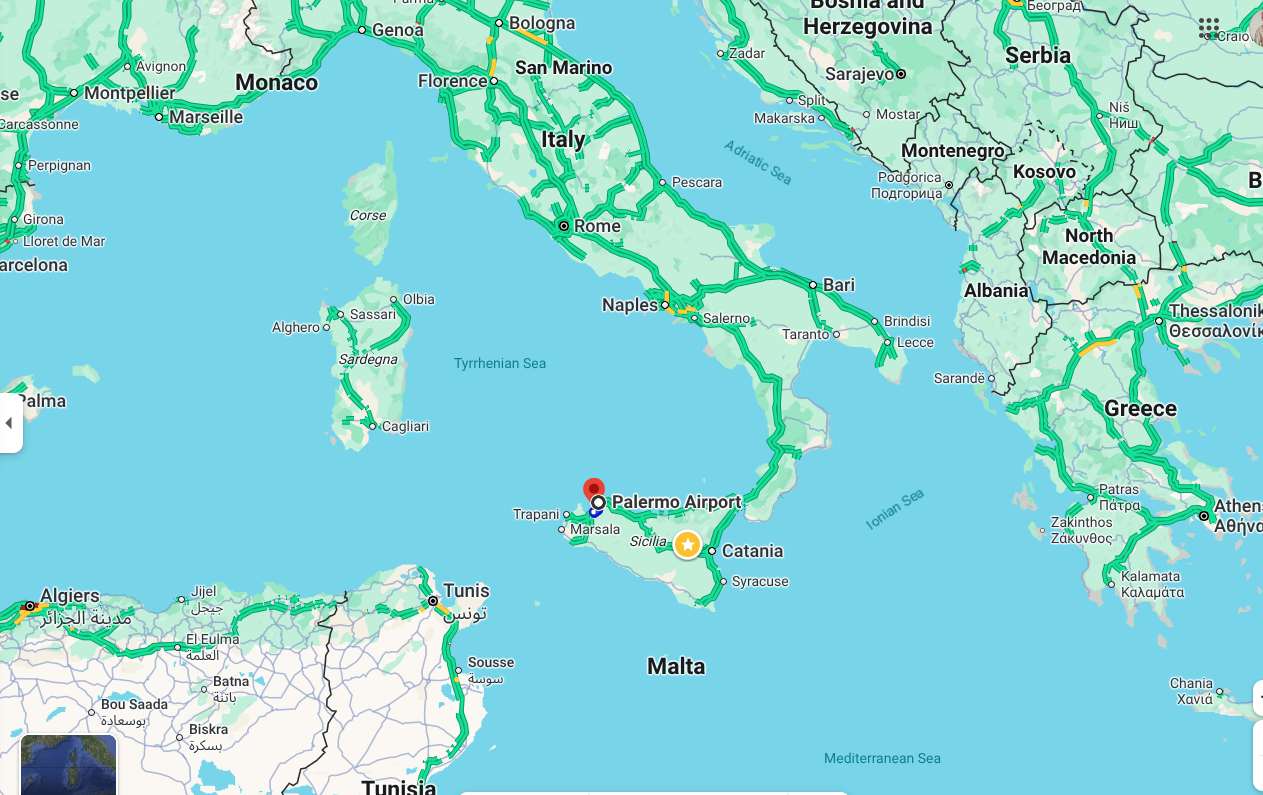
Cutting to the chase we are looking at arriving in Sicily early November.

We came to Spain with the overall invite to play some small part in uncovering the Pauline Gospel – neither of us are smart enough to know what that might be but hope as we play our small part something will be uncovered. The Pauline Gospel is of course deeply political, as the vision is of a new creation becoming visible (and I do think that at least merits a tattoo so wonder what that should look like, I digress!). The vision was so enthralling that even certain geezers who would not benefit from the fulfilment were significantly on board (look up Asiarchs).

In May this year we were invited to Malta and loved spending time with Adrian and Pauline Hawkes who had invited us there. We read Acts 28 numerous times as obviously Paul had been shipwrecked there and a little encounter with a snake, as well as significant healings – all on his way to Rome, where he of course had nothing to give account for, but a certain Caesar most certainly did (Caesar is ‘lord’… Paul did not think so!). Amazingly we read that on his way to Rome he moved from Malta (in an interesting boat, which is the same boat the ekklesia of today has to travel in) to Sicily (Syracuse).

Coincidentally we live in Oliva on ‘Calle Isla de Sicilia’ (Sicily Street – not sesame street!). We have often wondered if it meant anything.

In April – big month as Gayle increased her number of years on the planet, thus narrowing the gap between us – we were involved in rolling up an ancient map where Spain and Portugal were the head and within hours there was a total blackout across the Iberian peninsula. On that map we note that Sicily was the orb in the hand of the Queen of Europe – the orb, the symbol of the globe – with the cross over the top indicating subject to Christendom. So that has bugged us since that time.

Anyway in our small minds it has led us to focus on Sicily for a few months and give rise to the conviction that we need to get on our skateboards and get over there. It is unlikely we can do much if we do not stay for a number of months.

Much more to say – some of which might be made up in our heads (how can something so small make up so much?). And I guess as it develops over the next 7 weeks and then unfolds I will write it up here on this site. At a practical level our apartment in Oliva will be empty and if you – or a connection – might think they could use our apartment here that could help us somewhat with regard to rent we will pay in Sicily.

Perspectives