
Arrived home on Sunday, not only does it take time to reflect but also how accurate are any reflections, but I will give it a go! First though back in time!
We all (I think) have a framework within which we see life. That framework can be small or big and ‘big’ does not mean more important. I say that as mine tends to be big which probably means the only way I know what is going on at a ‘real life’ level is when Gayle gives me a kick up the proverbials.
A background
Some while back as I was praying (and I am not a great pray-er) a map of the world appeared before me and as it appeared two great land masses moved. South America moved to position itself under Europe and Africa moved east being positioned under China / far east. I noted that the Indian sub-continent did not move. Way back in the day when I was travelling regularly to Brazil I declared that Brazil would remove its currency from a dependency on the US dollar and relate to the Euro (I cannot remember if I said it would drop its currency and join the euro or not). Obviously South America as we have it was shaped by the colonising exploits mainly of Spain and Portugal. It has encouraged us to see that Spain has taken steps toward repentance for the genocides and colonisation – more has to come. Africa is invested into heavily by China, and with the Indian sub-continent not moving I suspect it will become much more of a global trade partner and have influence on the global scene.
China, and her relations in the far East, is set to become the next global super-power. I hold that when there is a shift of imperial power that the rising power has to ‘eat’ the former power. China – communist or not now? Or has it been eating gradually the capitalism of the West?
The big factor for me though is that of faith. Christendom, sometimes characterised as society that has ‘Judeo-Christian’ values, has shaped the West, and from the West to many parts of the globe. Christendom is more than an expression of ‘Judeo-Christian values’, but that which privileges ‘Christianity’ often with a state-church or even where government is supposedly Christian. I do not see that as the original setting for faith nor set as a goal to be established. This is why I have such high hopes for Europe. ‘Secular’, ‘post-Christian’ and many such labels are put on this continent. However, given that such culture as we now see developing – multi-faith for example – we are moving toward something much more akin to the context of the first century. Faith in Jesus was much more than the expression of a private religion but a declaration that there was an open invitation to join the movement that believed ‘new creation’ was breaking in already, and the days of Caesar and the like were numbered.
I am deeply grateful and full of admiration for the commitment to Jesus in the far east, but… yes there is a but! A Christendom-free, kenotically-shaped gospel is what Europe can lead the way in .
Spain became clear to Gayle and I as being ‘the only nation on the planet that can claim on the basis of Scripture that there are first-century unanswered apostolic prayers in the ground’ and that if they could be partnered with the possibility of the resurrection of the ‘Pauline gospel’ could begin. (That perspective in no way suggests that we have found the keys nor that we will ever be the custodians of such a gospel. We all have a part to play and everything anyone does, small or big, is done in the name of Jesus for the sake of the body of Christ.)
Sicily became clear as a place, based on its history and geographical setting, where there could be a leverage point to pray and push for the future. From there we got sight of Istanbul – a city of 15 million in the land (Roman province of Asia) where Paul worked – as a follow on from Sicily. Located in Europe and Asia; history of (Orthodox) Christianity and Islam; formerly known as Constantinople (new Rome) as capital of the Eastern Empire… with so much more history and significance.
Anyway I put the above here to try to give a context, realising that even when we have sight we see in part.
A merry band of 7
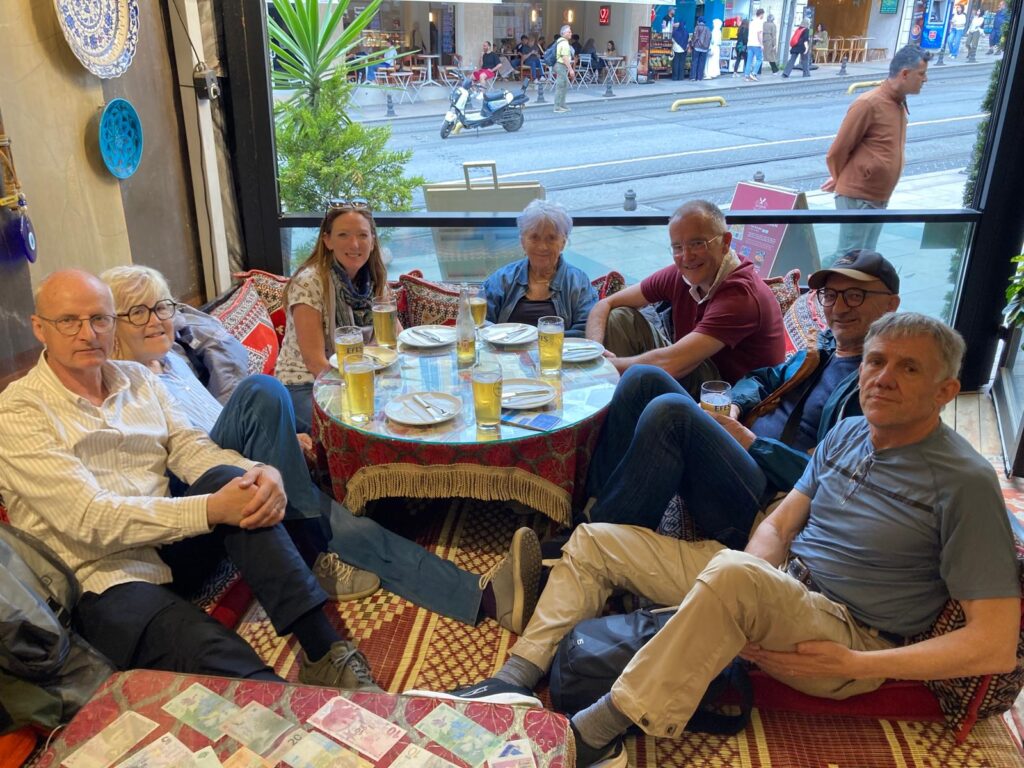
Bjorn & Maria – from Sweden. A wonderful couple who have given and given again at great cost into the marginalised who have come to Sweden, many fleeing for their lives. Huge respect to them.
Next is Gayle – awesome person!
Then Kathy and Steve. Huge commitment from them both into the holding together of the far east (with two wonderful daughters from China as well as two older daughters born in the UK). If you look closely you will notice that Steve’s legs are very short due to walking from Whitby to Rome and then on to Saudi Arabia! Then me coming along for the ride. And finally Paul who has heavily invested into the Middle Eastern world, and from my memory, this time was the 6th time he had been in Istanbul.
We leaned heavily on Paul for guidance through the city physically (15+ million people) but more importantly through the layers that are present. Steve held this ‘magnificent seven’ all in place. It really was easy and a pleasure being together (always helps when there are no ‘egos’).
The background to coming there was the months that we had spent in Sicily where the (very tangible) layers of Imperial domination and historical oppression and incarceration of the feminine was clearly visible through both myth and story. Sicily being the centre of ‘middle earth’ / first colony of Rome / centre of the then Empire / first place ‘conquered’ to form the modern Italy, she gave sight to what lay beyond and Istanbul as ‘the new Rome’ (Constantinople through Constantine); headquarters of the eastern Empire / displaying the contention and divide between Islam and (Orthodox) Christianity; meeting point and divide of the two continents of Asia and Europe… so from Sicily Istanbul ‘called’.
It is so hard to pull out points that answer the question of ‘and…?’ but here is a small attempt.
We were very aware that the beast (Jewish writers used the term ‘beast’ or drew on undomesticated animals to represent imperial hostile powers) can appear to be obliterated but that a head can resurrect (Rev. 13:3) and we are seeing this very clearly at this current itme with the attempt to resurrect / keep alive Christendom. It does seem that the original seat of ‘Christianised’ faith in Istanbul (Hagia Sophia) was taken over by Islamic faith and once Islam took on the clothing of that brand of Christian faith Islam was able to expand. In reality there is a deep resonance between those who claim Christian faith but want it expressed through dominance over; an Islamic faith that is expressed through opposition to all other faiths and the claim to pull on the God of Israel as we see within Zionism. Those three ‘Abrahamic / monotheistic’ faiths when they are used to empower dominance over eventually submit to the same ‘god’ – that ‘god’ not being the God of Israel and the parent of our Lord Jesus. Violence and killing is what Jesus attributed to the ‘devil who is a murderer from the beginning’.
So one strand was into the untwining of the threefold ungodly cord – at the surface those three faiths might not be seen as aligned but I have a deep conviction that they are… and the challenge therefore remains of – regardless of ‘faith label’ – being a Jesus-aligned person.
Jumping ahead in our time-line in Istanbul when we crossed to the Asian side and got off the boat we were immediately met by a very oppressive call to prayer coming from the Mosques (much heavier than on the European side). And immediately in front of us was a shot-out car – either taken from Gaza or replicated from a car that was shot out there – complete with over 300 bullet holes and the occoupants left murdered. It was alongside a highly sobering display of the ongoing genocide that is taking place in Gaza. The history of faith being used to legitimise killing. Trauma, trauma, trauma.
Painful to wak through but ever so necessary.
The divides were where we were focused – the faith divides; the divide between Asia and Europe (so much more could be said about the need for Europe to find an identity, not simply for Europe’s sake nor simply for now. Without it China / Far East will simply eat the current Western hegemony and there will be no real shift); the feminine space – the lack of it being seen so clearly in a city dominated by the toxic masculine.
Prior to going I had had a conversation with Rowena who had considered coming with us to Istanbul and she had talked about her desire to put Jasper into the city, into the spaces. This we did – naming each Jasper that each of us put into the various ‘cracks’ – including into the Bosporus.
Jasper is the first stonein the new city:
It has the glory of God and a radiance like a very rare jewel, like jasper, clear as crystal.
And the results???? What a smart question that we have such a tendency to want ot ask! Who knows, but prayer sows into the (open) future. The day we left the news carried that Erdogen’s government had put the squeeze on the opposition with violence against their headquarters. Of course those things happen (and not just in Turkey!!!) but perhaps the timing indicates it was a sign that as we sought to press into the ‘cracks’ that the pressure made some impact.
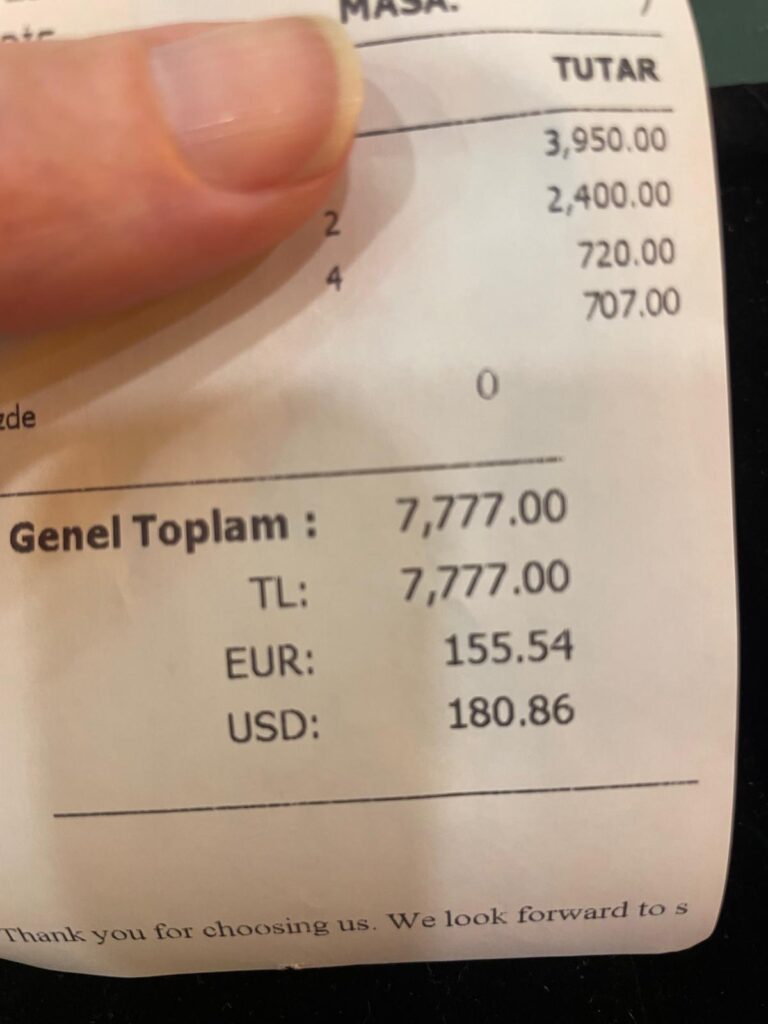
We did have a very nice sign indeed at the last meal we had together. Throughout the time we encountered the number ‘7’ – on the wall of the apartment where we stayed, on the wall of the blue Mosque where we prayed and at numerous other points in the city. The last meal came to exacty 7777.00 Turkish Lira. Four 7s – a hugely significant combination of numbers in Revelation – symbolic of the completeness for the sake of the entire creation. Maybe we should not assume we have sorted out all of creation(!!!) but that what we went to do is our small part into that ‘reconciliation of all things’ or now. I am sure a very small part, but deeply encouraging.