
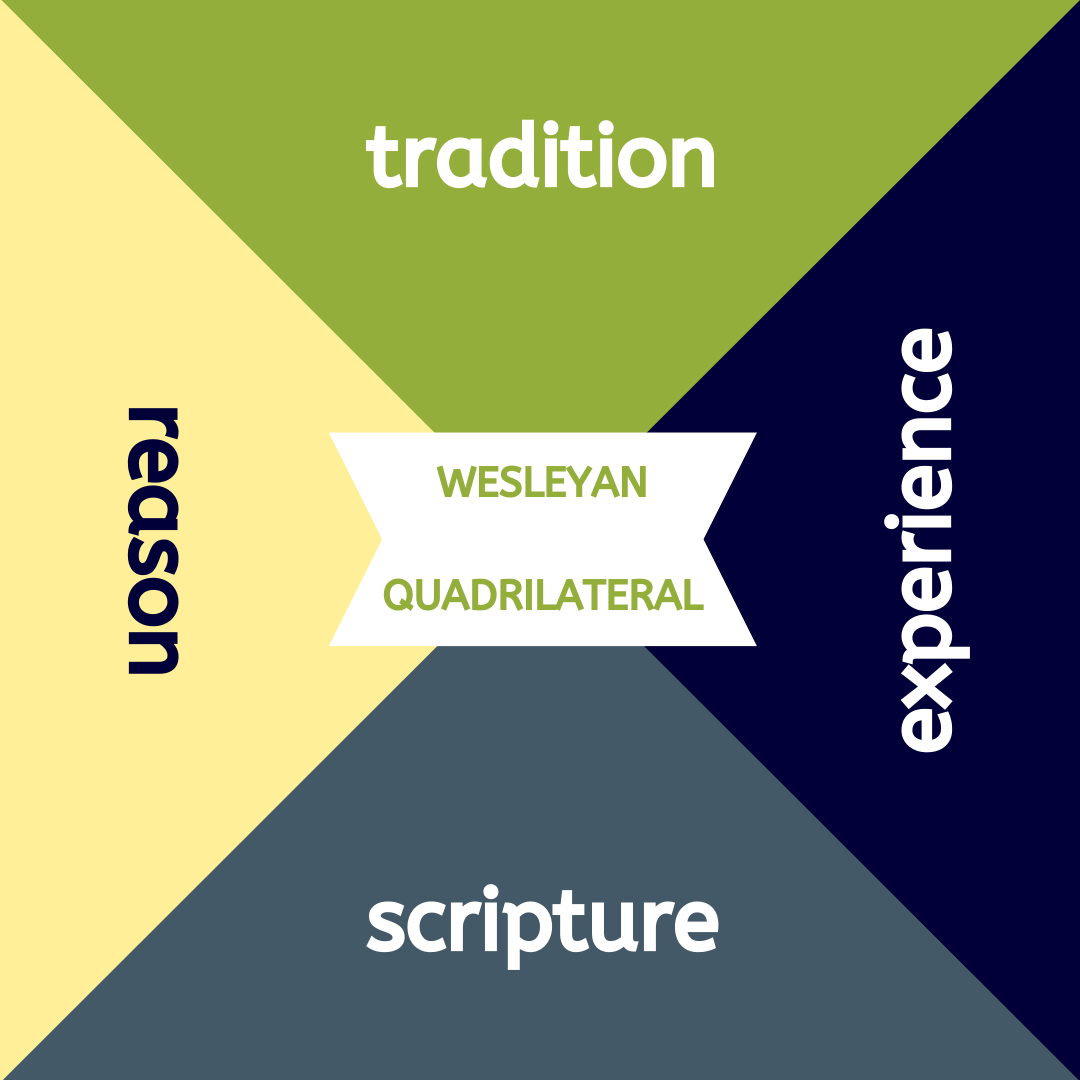
Mr. Wesley (the John variety) was quite a practical person but also somewhat of a theologian. Although he did not himself use the ‘quadrilateral’ language he has been analysed as using four bases as a foundation for his (practical) theology. The four are: Scripture, reason, experience and tradition. Scripture was always taken as primary with the other three enabling an understanding and a practical application of the Scripture.
I like that enormously – gives Scripture precedence but does not simply quote texts in a way that seeks to apply them in a wooden way as if there are no other factors involved. Sola Scriptura has been badly used and applied – though I suspect never done consistently. Reason – oh yes. What we consider is our reason of course is not infallible, but God is not unreasonable. Reason is a God-gift to us. I remember pushing a ‘Reformed’ professor to the point where he had to admit that he accepted that God wishes something (all to be saved) but chose something different (only the elect). At that point there was a contradiction that does not rationally stand up. We might not know how to resolve it but at least it should shout ‘caution’. Experience – not infallible but even within Scripture we see how texts are re-interpreted as a fresh experience comes along. (I am currently working on ‘Israel, Jew, Gentile’ mix – seems some fresh interpretations when we come to Rom. 9-11… another day). Tradition – OK I might be the weakest on this aspect as it is not my centre, but recognise that how things have been wrestled with in the past can help us process such issues in our day.
But… but… how about we add one more element to brother John’s approach. We might be able to slide it under one of the previous four, but given that it is central to Scripture I think I can legitimately add it:
Eschatological
How things will be… that has to shape our theology. We move from two points – as it was in the beginning… and how things will culminate. Marriage and gender are two interesting aspects when we go from both points. Dualism at the beginning (although if we take it as a merism we have a spectrum, and not a binary) to the end of dualism / binary in the eschaton. Such an approach has to impact also the atonement (why Jesus does not embody the binaries of Jew and Gentile / male and female) – and as an aside why does the Hebrew writer suggest something, not present in Paul, that the heavens needed cleansing?(!!)
I think at every point we cannot simply read the Scriptures as a flat book – challenging if we do and we get to Ecclesiastes with the best human basically being a dead one!!! – not to mention the old chestnuts of slavery and ethnic cleansing. But beyond not reading as a flat book we have to move beyond a narrative-historical approach into the future. We have to both read forward – the onward movement of the narrative and also we have to read back – from the end into the text.
The resurrection brought about two time-zones. Sometimes we have to ask when thinking about a call that crosses time zones, ‘what time is it in xxxxx?’. ‘What time is it?’ is a question we have to ask concerning how we are to respond to issues theological… and then practically how we bridge the ‘time zones’ is important. In the eschaton / new creation this is the time… now we live in ‘this age / time zone’ so how do we apply that time zone into this one so that we can communicate.
In a very real sense Scripture takes precedence but has to be scrutinised by reason, tradition, experience and the eschatological state of things. Sin coming into this world distorted so much and strangely the eschaton entering our time zone also distorts for a clash takes place. If we can increasingly adjust our time to heaven’s we might feel out of sync…
OK the above was intended as a ‘what on earth would that mean then’ kinda post, and the next post I need to get back to an update on Sicily – here in our fourth month and back in the place where the one called Paul stayed for three days – Siracusa.