Community is in the heart of God. Trinitarian belief, the corporate ‘my people’, ‘it is not good for the man to be alone’… all point to community as not simply beneficial but healthy existence. When community is denied a person there is loss and pain. Given the norm of community and the lack of it that many experience I write cautiously what follows. I also write from our personal context here.
We have a strong conviction that over these next couple of decades many will find themselves uprooted from their former setting. We believe that thousands will re-locate to the cities and regions across Europe as the continent is re-seeded not simply with a gospel of words but an incarnated gospel of people (Mk. 13 parable #1 ‘seed’ = ‘word of the Lord’; parable #2 ‘seed’ = ‘people of the Lord’). In the relocation some will go with distinct purpose and vision, others will go by ‘circumstance’. If we come from a background of (Christian) community there are a few surprises waiting for us.
‘Clubs’ give us ready made friends. Many believers do not need to connect to others, the construct is what provides the context where they find the friends. This is not a bad thing in itself but all clubs by default insulate, they separate, and more so when we have no need of connecting external to that club. This is also accentuated if one held a measure of leadership within that club context. Friendship-making outside that context and with those who do not share the same world-view is a challenge – Paul, even with an incredibly developed world-view, achieved this (Acts 19: 31).
Appreciating beliefs that are different are wonderfully challenging. A gospel that is insulated can make sense when one is also isolated… but against the context of other beliefs can be deeply challenged. This, from what I understand, is what brought Steve Chalke to describe penal substitutionary atonement as ‘cosmic child abuse’. Our gospel is ‘foolishness to the Greeks’ but this does not mean there is no coherence to it. To re-examine the gospel is no bad thing. And certainly when one realises that the Western Protestant versions do not have a monopoly on interpretation opens up a few healthy doors.
Separation from the known, entering the liminal spaces, are so necessary for growth. Richard Rohr apparently recently described fundamental evangelicalism as ‘religion in its early phase’. He, being a Catholic, might indicate where development should take such a fundamentalist, whereas I would go in a totally different direction!
In transitioning into adulthood in many tribal scenarios there is a commonality to many of the rituals. What is in common is the removal of the known surroundings and boundaries, and the entering into a disorientating world. This is necessary for growth.
Yesterday we (Gayle and I) speculated that perhaps there is now the possibility of a fresh (Christian) movement, not one simply based on guilt and forgiveness at a personal level though probably with deep roots within that, but one focused on the body of Christ as the ‘soul’ of the world, the priesthood in the earth. If so I think that isolation will be one of the gifts from heaven to act as a catalyst for the conversion that is needed. Maybe Christian community will have to become (for a period, or maybe permanently) less of a defining element? Community, acceptance and accepting, is vital for healthy human existence, but those who have a vision for healthy community probably need to experience some measure of isolation along the way. To those much further down the road than I, thank you.

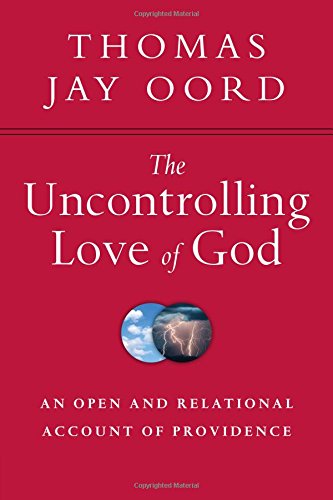 Not everyone enjoys what I enjoy, but read this book and of course you will love it! Oord is one of the leading ‘relational theologians’ and this is the first book of his I have read. It is well written and easy to read – I read it right through in a few hours. I have been heavily influenced by Open Theology, ever since having a connection with YWAM and the teaching of Gordon Olson, then the works of Clark Pinnock and Greg Boyd (and… and…), and of course the main sticking point for those who come in the opposite direction is that of ‘but God has absolute foreknowledge of all things’.