 I would love to have the ability to write a novel. However, writing like that would not come easy for me, and I think I would get a whole story out in about 3 pages. It might have a beginning, a middle and an end… but sadly no gripping detail and background! Not destined to be a best-seller. All kinds of books carry a world view. I have long maintained that there were two big blows to a decent understanding of eschatology. First the Scofield Bible. Stick notes in the Bible and effectively I no longer need to read the book, as soon as I come across something I do not understand, skip to the notes. Effectively the notes become the Bible, and ‘but they are only notes’ ceases to carry any weight. Secondly, novels about the end-times.
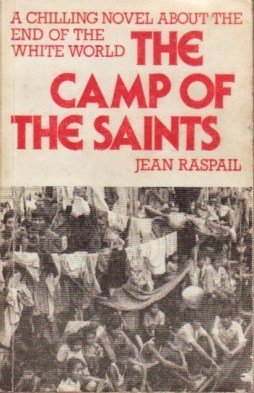
The book highlighted here was written by a French author in 1972 and first translated to English in 1975. The plot of The Camp of the Saints follows a poor Indian demagogue, and the deformed, apparently psychic child who sits on his shoulders. Together, they lead an ‘armada’ of 800,000 impoverished Indians sailing to France. Dithering European politicians, bureaucrats and religious leaders, including a liberal pope from Latin America, debate whether to let the ships land and accept the Indians or to do the right thing — in the book’s vision — by recognizing the threat the migrants pose and killing them all.
The non-white people of Earth, meanwhile, wait silently for the Indians to reach shore. The landing will be the signal for them to rise up everywhere and overthrow white Western society.
The white Christian world is on the brink of destruction, the novel suggests, because these black and brown people are more fertile and more numerous, while the West has lost that necessary belief in its own cultural and racial superiority. The Camp of the Saints — which draws its title from Revelation 20:9 — is nothing less than a call to arms for the white Christian West, to revive the spirit of the Crusades and steel itself for bloody conflict against the poor black and brown world without and the traitors within. The novel’s last line links past humiliations tightly to its own grim parable about modern migration. ‘The Fall of Constantinople,’ we read, ‘is a personal misfortune that happened to all of us only last week.’
Talk about a world view, and when quotes from advisors to a certain government have said:
It’s been almost a Camp of the Saints-type invasion into Central and then Western and Northern Europe, (October 2015).
The whole thing in Europe is all about immigration. It’s a global issue today — this kind of global Camp of the Saints.” (January 2016.)
It’s not a migration. It’s really an invasion. I call it the Camp of the Saints.” (January 2016.)
When we first started talking about this a year ago, we called it the Camp of the Saints. … I mean, this is Camp of the Saints, isn’t it?” (April 2016)
(See source.)
I appreciate that political responses to crises are not simple. Yet it seems to me that an intercessory one is vital. The huge people movement of today is in the main because of a crushing economic crisis, the effects of which have been brought to the tipping point we are at through the war(s) in Syria and beyond. I am shocked by the response of believers at times to the fear narrative, and the view that the only response is to shut the doors, and to use military force if necessary.
We are seeking in this year to engage in a prayer journey of repentance through Spain. Repentance for what was done and culminated in 1492, a year that saw the final capitulation of Muslim rule (Granada), the edict to expel the Jews, and the sending of Christopher Columbus across the waters in the name(s) of God, king & queen, and pope. Strangely we see a connection between all three events.
Repentance? And repentance for the Christian ReConquista? Yes. Not repentance because Islamic faith should be restored to Spain (!!) nor because Christians were more evil… but repentance because we are called to a higher level. What is / was done in the name of Jesus is indeed taking the name of Jesus in vain. Those who do that claiming his blessing are certainly not releasing a blessing on the land, far from it.
There are values at threat with every huge shift that comes to a culture from elsewhere. Good values many times. However what is more at threat is desire to be at the centre, to maintain the status quo of privilege. The true camp of the saints is one that is on the move, many times without a fixed abode, through the wilderness, a bunch of nobodies desiring a better future for those who are yet to be. That is the calling of the saints. Have we lost that destiny…? And could it be that we should be expecting Jesus to show up among those who exhibit more of that than we have?


 ‘Semana Santa’, Holy Week is quite something in Spain, particularly in Andalucia. Penitence features big time, and emotions relating to mother and Son are high. A school teacher told me that he had a close friend who is an atheist but every year is one of the many thousands who offer themselves to carry the ‘pasos’ on their shoulders and process through the streets. ‘Why does he do it?’, I asked. And the reply was it was a deep and privileged experience to see the tears and emotions on the peoples’ faces.
 The first Easter when we were in Spain (2009) I was not happy seeing all of this, and Gayle with her wisdom quickly pulled me across the street while I was standing in the street to confront the procession… I have moved on from those days – after all I was way young back then! The shock though of the alien scene is what was provocative. I am sure there is also genuine faith among some who are attracted to the tradition and procession – same as with the Camino to Santiago.
 My first time in Spain – early 2000’s my prophetic input to a land I knew nothing of any depth about was that two major signs would take place when Spain was turning. Bull fighting would be banned and the British flag would not be flying over Gibraltar. I should have added and ‘pigs will fly’ but held back on that one. A few days ago article 50 was actioned. Negotiations regarding a ‘soft’ or a ‘hard’ Brexit will now unfold. The ramifications, the complications, and certainly the rhetoric will at times be soap operish. There will be some good reads to come from the pens of journalists.