Come back Peter, come back Paul

The conflict in Galatia

A right old conflict. For you enneagram lovers surely that Paul chap was a ‘no. 8’. He seemed to like a good old conflict, and I enjoy reading the public conflict of Galatians 2. I start with that in LifeLine. The conflict was incredibly strong… and I think remains incredibly provocative in our world – maybe even more so today.

It is easy to quickly side with Paul. He was right after all. But hang on a few minutes. Why did Peter pull back from eating with the Gentiles. Not because he jumped out of bed one day and thought ‘I know what, enough of all that Cornelius’ conversion stuff, from now on I will simply be a hypocrite.’ I don’t think so. And to make matters worse, dear Barnabas gets himself into a right old two and eight in the midst of it all, he also pulling back. Generous, ‘I only see the best, I am the original encourager’ Barnabas withdraws.

For Barnabas to draw back you have to suspect there was a convincing case going on. And I am sure there was. A good solid MISSIOLOGICAL case at that. So Peter and Paul – both acting out of missiological, ‘for the sake of the Gospel’ convictions.

That’s what makes the conflict deeply relevant today.

The outcome was that of (presumably) a relational holding together, but two separate ‘fields’ to work in, and we remain the beneficiaries of the ‘freedom’ strand.

Seems maybe we need greater diversity, apostles to the… (filling in the many blanks that are calling from our world) risking following their convictions. Result will be untidiness, otherwise known as ‘mess’ and ‘unsatisfactory’. On the positive side, diversity, multiple incarnations in all kinds of strange and shadowy places. In short the Gospel of freedom.

The Lifeline

The fourth in the most dynamic series ever written is out… (Disclaimer: by dynamic series I obviously mean written by me over the previous few months – how could I ever make a bigger claim that that?) Copies – hardback and eBook available from:

https://bozpublications.com/explorations-the-series

What a smart title I hear you all say with one voice. ‘Yes’ I reply cos when I was thinking about a title I thought I would do something very clever and tie the end of the book to the first volume. First volume tries to start with the real division is not about right and wrong, but regarding life and death. The tree of life… in the day you eat of the other one (the ‘infallible guide to right and wrong?’ tree) you will die… death enters into the human race… who were created to live forever (no, and not that the soul is immortal; wrong book being read to come up with that novel idea)… choose life that you may live… Israel chooses the other path… Jesus takes the consequences, tasting death for all… so that all may live… the lifeline.

In the book I try to dig in to the Pauline Gospel some, and suggest that there is a radical feminisation of creation, and the word ‘new creation’ is a much better term than that of a ‘new world order’. Last chapter, God does not require sacrifice; we are the ones who needed the death of Jesus. Root issue is the cleansing of the heart / conscience, that it is not ‘without the shedding of blood there is no forgiveness’ but that verse puts in another step along the path… Blood is not necessary for forgiveness but the author does suggest it was necessary for the step that leads to forgiveness.

I was going to (maybe will) write another three volumes (eschatology – drawing on the call of Israel, hence no ‘Promised Land’ promised, past nor future; the traumas of 66-70AD, hence no expectation of antiChrist future; prophetic utterances that Scripture records as not coming to pass, hence the difference between promise and prediction, blah de blah…), but maybe I should consider that the issues that are more important are the ‘so what’ with regard to the trajectory from creation in the way distant path, of course not being a scientist I am not qualified to use the word ‘evolution’, to the close of the New Testament (pre AD70 with a one-book spill over that helps further guide us in our world). So using provocative language, our relationship to ‘mother earth’ (settle down I am simply ramping up slightly the ‘the first humanity was from the dust’ perspective, that I am pretty sure is there in the early pages, and repeated when taking a look back from the future – 1 Cor. 15); relationship to gender (drawing on the already / not yet, implications of the Ascended Christ for gender, what wisdom we might be able to hear from the market square; pre-Pauline issue of ekklesia and post-Pauline approaches; and of course our relationship to the ‘state’ and the creation of money and a redemptive economics.

If the last paragraph sounded as if I know what I am writing about… apologies. Explorations in theology can lead to explorations from theology, and also to the discovery that one of God’s many gifts to humanity is the ability to make mistakes.

Wrath…

Wrath and the cross

In the penultimate chapter of Humanising the Divine I make a quick stab at the ‘cross’ and what it means. To accompany it, for those on zooms I put up a video today.

Here are some bullet points:

  • The idea of a transaction taking place is not the most ancient (post-NT) view(s).
  • Transaction begins to gain traction with Anselm (approx 1060AD) with his view that we owe God a debt that we cannot pay, this moving from the feudal system to the law court with the Reformers… hence today our penal substitutionary view; we are guilty, Jesus pays the penalty.
  • Human anger is never called righteous anger, so we cannot extrapolate what is the wrath of God from anything human. God’s wrath is not personal.
  • The cross does not deal with God’s anger issue!
  • God did not turn away from Jesus on the cross, ‘unable to look on sin’. It is not so much a mis-reading of Scripture, but of not reading enough verses!
  • The major thrust of the New Testament is to do with the ‘when’ of the cross. If we do not answer that we will not be able to line up an answer to the ‘what’ takes place there and the ‘why’ of the cross.

It is a first stab… I come back to it in book 4 which will be out in the next few days!!

Should be a good read

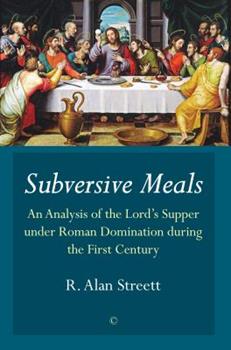
I was given a copy of this book (Thank you Keith) and have just opened the pages. It seems an original piece of work that firmly places the Christian meal in the context of the Imperial world of the first century and a subversive act of resistance.

I have only just started but a choice few paragraphs that Gayle and I read this morning are sufficient to get us ready for the day!

When the Lord’s Supper is placed within the historical context of a Jesus movement that nonviolently opposed the tyrannical practices of the empire, it becomes clear that it was an act of resistance and took on political significance. Believers not only gathered to eat and satisfy their appetites, they engaged in various kinds of anti-imperial symposium activities that included prophetic utterances, singing protest songs, and lifting a toast to a man whom Rome deemed worthy of a criminal’s death.

And so the text continues… Makes one hungry for a protest meal and a toast to our ‘criminal’ Lord.

Inside Out

Gayle and I met Michele Perry 10+ years ago when we had just moved to Cádiz. She carries a spirit of adventure and was working at the time in South Sudan. As she says many were quite surprised at this 4ft 6inch (1.37m) tall woman who had arrived… and to top it all a woman with only one leg and at times her transport being on a motorbike kind of was not the norm!!

She has also made huge transitions and never afraid to pioneer. I decided a while back that she would be a great conversation partner to add some videos for those who are involved in Zoom groups.

[Zoom Groups – I am contemplating starting a day time group in the next month or so… if interested go to the page ‘Zoom Discussion Groups’ from the menu and have a look to see if a Zoom Group would be of interest.]

The first interview resulted from a throw-away comment that I am still mulling over when I interviewed Michele on ‘The Seven Mountains’. She said it is not to be ‘top down’, nor ‘bottom up’ (and how many times have I said that it is ‘bottom up’) but it is ‘inside out’.

Jesus offered Caesar’s throne

The devil led him up to a high place and showed him in an instant all the kingdoms of the world. And he said to him, “I will give you all their authority and splendour; it has been given to me, and I can give it to anyone I want to. If you worship me, it will all be yours” (Lk. 4:5-7).

Quick acknowledgement: I picked up the consistent use of the Greek word ‘oikoumene’ as being a reference to the inhabited world of Rome in Andrew Perriman’s writings, then began to look at Luke’s use.

Skip the next part if you wish… it is simply the background as to why this word ‘oikoumene’ is not simply a synonym for ‘world’ (kosomos), but is more concrete… and in the Lukan context is referring to the Roman Empire.


All the kingdoms of the world (πάσας τὰς βασιλείας τῆς οἰκουμένης): the kingdoms of the oikoumene. This last word can be used (at times) interchangeably with the term ‘world’ (kosmos) and Matthew uses this term (kosmos) in his account of the temptations (Matthew 4:8), where Luke uses the term oikoumene.

The two terms can be used interchangeably, the kosmos term is certainly global and the term oikoumene is rooted in the verb oikeo (to dwell), and although it can carry a global sense, being simply synonymous to the word kosmos, many authors choose to use it in a more restrictive way, to refer to where people dwell, the inhabited world, the civilised world. This then opened it to something even more specific: the boundary of a specific political entity.

Luke is one of those authors, and given that he is writing his two volumes for the world of the Roman Empire it makes sense that he uses this word oikoumene in the restrictive sense of the ‘Roman world’, the ‘Roman Empire’. Before coming to Luke’s use a few other examples.

Josephus (Jewish aristocratic Jewish historian, 37AD-100AD (approx datre of death)) uses the term oikoumene to refer to the geographical extent of the Roman Empire, recording that Agrippa had said to Caius that he hoped one day Caius would be appointed ruler of the world (oikoumene), in other words that he would become Caesar over the Roman Empire.

Likewise the Old Testament uses it to describe territory within a political boundary.

  • Babylon, for her sins, will experience an armed nation coming and destroying the whole oikoumene (Is. 13:4,5,9,17,18,19). The Medes come and destroy the Babylonian empire, they destroy the whole oikoumene, not the whole world.
  • In Daniel we have Nebuchadnezzar ruling the whole oikoumene (Dan. 3:2), he is the ruler of the Babylonian Empire.

Luke seems to consistently use oikoumene to carry this meaning of territory ruled by a political entity, and that entity being Rome.

  • The whole oikoumene was to be registered (Lk. 2:1), the whole ‘world’ being the world that Caesar ruled over.
  • Agabus warns of a famine that would come on the whole oikoumene (Acts 11:8), this famine came during the reign of Claudius (Roman Emperor).
  • The Gospel proclamation turned the whole oikoumene upside down, the order of Rome (Acts 17:6-7).
  • Artemis was ‘worshiped throughout the province of Asia and the oikoumene‘ (Acts 19:27). The claim was that she was worshiped throughout the Roman province of Asia and beyond throughout the whole Roman Empire.

Luke is therefore using the term for the Graeco-Roman world, using it very concretely.

Back then to the temptations of Jesus. It is not too far a stretch to push Luke’s account of the temptations to being a concrete offer of the Roman Empire to Jesus. That fits with his consistent use. The offer of being the new Caesar: Jesus appointed as anti-Christ!

Luke 3 begins with the setting, not simply historically, but concretely and ‘spiritually’ in terms of the dominating powers:

In the fifteenth year of the reign Tiberius Caesar.

Replace Tiberius… bring about the change you want!

In Mark’s Gospel we have the intriguing extra that Jesus was in the wilderness with the ‘wild animals’. A truly eschatological scene fulfilling ‘the wolf will lie with the lamb’ (Is. 11:6 and Mk. 1:13), but perhaps given that Israel was the counterpart to Adam who is given responsibility for creation, for the animals, it was not surprising to have Israel as ‘son of man’ and all opposing kingdoms to be presented as beasts (wild animals, hence the description of political powers opposing heaven’s agenda as ‘beasts’). In Mark then there is probably also a hint of true shalom to the nations, even to the nations that opposed the direction of heaven.

He does not rule over the nations as per Rome; the Rome that brought peace through war! Jesus brought peace, but not peace as the world gives (woe to you who say ‘peace, peace’ fits this context). There is a shalom, true peace, the wild animals were with him.

Peace on earth, being the announcement from heaven (Lk. 2:14) then takes on a strong anti-imperial sense.

Perspectives