Render to Caesar

Give therefore to the emperor the things that are the emperor’s, and to God the things that are God’s (Matt. 22:21).

A nice neat verse to keep my spiritual life and my relationship to the powers separate. Be a good boy and just do whatever the powers ask because the two are ever so separate.

Really?

The context for the ‘render to Caesar / God’ reply is toward the climax of the ministry of Jesus. It is centred in occupied Jerusalem and the compromised Temple. The revolutionary has come to town. He has made his entry into Jerusalem on a donkey coinciding and contrasting with the military parade coming in from the west (see: https://3generations.eu/posts/2017/03/provocative-or-what/). The whole city was in turmoil as ‘the prophet from Galilee’ had arrived (Matt. 21:10, 11). Soon after this he makes the very dramatic (and deeply prophetic) act of turning over tables in the Temple, calling for it to be a house of prayer for the nations.

So the scene is set. Tension is high. How dangerous is he? What kind of revolution is he likely to spark? What will be the event that provokes the start of something that will be hard to stop?

The Pharisees with Herodians look to trap him. He is being set up to lose. They pose the question about the legality (from the Torah point of view) of paying taxes to Rome. Pay taxes (the Herodian view) and how ineffective Jesus will appear. He will be seen as lacking courage and selling out. However, refuse to pay taxes and he can be arrested on the grounds of sedition.

Jesus first asks for a coin. They produce the coin, and he deliberately asks them about the image and title on the coin. These ‘holy’ questioners are able to produce a coin with an image on it that is an affront to their own religion, even blasphemous. The image is of Tiberius and the wording is ‘high priest’, ‘son of the divine Augustus’.

In that world the coin (or any such article) belonged to the person whose image appeared on it. The coin therefore was Caesar’s – or so he claimed. Here they (religious Jews) are with pagan coinage, image and titles proclaiming the Imperial myth. ‘Give it back, have nothing to do with that system’ is certainly how Jesus’ response can be understood. (We might well argue though without money we cannot buy and sell… and we might wish to object in one less that 667 ways!). Further you (Jews), as a sign to the world, are image bearers, you bear the image of God (as do all humans). Indeed the whole world belongs to God. The coin belongs to Caesar – that is his claim – but you belong to God. So there is a simple transaction that is to take place. (Caesar’s claim was also false – thus complicating the response required.)

The question started at the wrong end. If the second part is not worked out in totality how can the first part ever be answered? In the light of 100% to God now what are you going to do with the first part, the demand for taxes by Caesar?

There is probably another aspect underneath the passage, a strong allusion to 1 Maccabees 2:29-41 where the dying Mattathias says to his sons:

Judas Maccabaeus has been a mighty warrior from his youth; he shall command the army for you and fight the battle against the peoples. You shall rally around you all who observe the law, and avenge the wrong done to your people. Pay back the Gentiles in full, and obey the commands of the law.

The result of ‘paying back the Gentile in full’ was the armed revolt, the Greeks were defeated, the Temple cleansed and a royal dynasty that lasted 100 years was established.

The instruction was to ‘give back to the Gentiles what they deserve’, and do it within the boundaries of zealous observation of the law.

The texts and the events of the Maccabean period were well known as part of the context in which the people understood the Roman occupation. In the light of that Jesus response is not a clever division of state over here and faith over there – one public and one private. His answer is revolutionary. Give back to Caesar what he deserves. Pick up arms as per the former rebellion against the powers? Maybe some understood it as that.

In the context of being an image bearer how do we respond to the state? The state is not ordained from above. All powers are relative, none can command absolute obedience.

Allegiance to Jesus? Revolution with Jesus.

Self-publicity?

‘Never believe your own publicity’. Wise advice, and imagine a world where someone with limited vocabulary did not have to claim via Twitter and all forms of social media that no-one knows more than them? Thanks then to Leif Garrett who is credited with the phrase… but it raises a question. One’s own publicity?

From time to time I get a request, send a photo and a blurb about yourself. The photo part is not so difficult but the blurb? What to write…

I normally send two blurbs, one that ‘works’ (or is a piece of self-publicity) and one that is honest. I appreciate the need to publicise so as people know what they (think they) are coming to. I was once advertised in a certain country as being the ‘President of Sowing seeds for revival and of Company of Prophetic People’. President? Presiding over what? Of course one can spin almost anything, but when Scripture does not simply tell us not to lie but to ‘not speak a falsehood’ the spin becomes very dangerous indeed. I can spin something and not lie. But not leaving a wrong impression (a falsehood)? Very hard to do that and hype things up.

Just thinking about the quote, maybe the time is now to stop all self-publicity. So here is an attempt when I am next asked to present at the ‘heaven will DEFINITELY come down and all lives will be transformed within a two kilometer radius’ conference.

Martin Scott has had it pretty easy in life so has not learnt so much. He often thinks he knows better and so can be somewhat stubborn. Maybe it is reasonable attribute not to be overly-impressed by the opinions of others, maybe he is just a reticent learner. Many times quick to try and give an answer, can be guilty of pontificating beyond his understanding. (Photo can accompany the above publicity when the invite comes.)

Following Tim Suttle

I get a number of feeds each day of blogs that I follow, and have just begun to follow Tim Suttle at Paperback Theology: https://www.patheos.com/blogs/paperbacktheology/

Today he wrote, with reference to Stanley Hauerwas’ book Resident Aliens under the title of Christianity Shouldn’t Be Infused With Politics—It Is a Politic. Ever since the late 90s when I was involved in prayer teams to cities I have been strongly convinced that the Gospel is political – the language of ‘church’, ‘repent’ and all other such language is deeply political, and the exposure of the spirit of empire that comes to a sharp focus in Revelation, so of course in reading the article I am already biased toward it. Here though are a few quotes:

Christianity is a whole new way to be human that requires a complete reordering of the way we organize our lives both personally and communally—or politically. Christianity is a politic.

That’s where we are. I mean, nobody who begins with “Greater love has no one than the one who lays down their life for a friend,” could ever end up with the American brand of radical individualism. Nobody who begins with “Consider the lilies…” could ever end up with present day consumer capitalism. Nobody who has taken seriously the story of the Good Samaritan could end up with nationalism.

He writes as an American so of course critiques Christianity in that context, but the application is certainly not limited to the USA. Here is the link:

PaperBack Theology

Goodbye, friend

I have just returned from a few days in the UK, travelling over for the funeral of one of my earliest and longest standing friends from my days in Cobham / Leatherhead (1977-2008). I worked for many years with Derek, learned so much from him at many levels. Strangely (?) we live just a few miles from where he found the Lord on the east coast of Spain many years ago. His impact on many lives was very marked and the days in the UK were very special. Too many to note all the aspects that made an impact.

I met people again who I was with some 10, 20, 30 and even 35 years ago. I am sure on many aspects we might be on different pages (maybe in different books?), but the connections were so deep. I am deeply thankful to Gerald and Anona Coates who in the late 60s began the unmapped journey that eventually contributed to the new church movement, a movement that shaped many values that I still hold dear today. Here at the funeral were people, whose contexts and expression of the Gospel varied enormously, some 30+ years later, but the passion for Jesus, the appreciation that non-religious relational Christianity is at the centre was so evident. Remove church politics and WOW!! Thank God that in his house are many mansions – some of them way to structured for me, some way to loose! I left Jude (daughter) and Joe’s house at 12noon and returned at 10.15pm. Just meeting people from forever ago.

In the funeral a number of people referred to Derek as their best friend. He was friends to so many. Of course at times in a funeral the person referred to never had any faults (!!), Derek like you and I of course had some… but for sure what I was left with was that what we say and what we do is very important, but ultimately those that spoke of the impact he made on their lives it was not in the final analysis what he said, nor what he did but how they felt when with him that stayed with them. That is a lesson to me – that people might feel accepted, believed in and strengthened when with me. I have a long way to travel on that road.

I, and sure that many other would echo this, thank Sandra, Anna, Lisa and Cara for allowing us also to benefit from his life. After he passed away his family found this on his computer, written a few days before he died. I leave that here:

Humour, and mostly inappropriate humour, has gotten me over most obstacles in life, but for each of us there will be at least one insurmountable step, so high that it can never be scaled. Some of us never get over it – whether it was the loss of someone who was our very life, or a betrayal, an addiction, or the darkest depression. Sometimes, when it is the loss of someone dear to us, we never want to get over it. It has to become part of us. Maya Angelou, if she were here, would say that the insurmountable step defines us. Wounds, damage, heartbreak, failings or addictions, it is how we cope with that step and the choices that we make which make us a bigger or smaller person. Whoever you are, and whatever circumstances you face, don’t let your insurmountable step destroy you. Embrace it and let it define you.

Derek Thomas Williams, 2019

Protests – wisdom

Just over a year ago we participated with a core Czech group and a number of colleagues from UK and France. Two of those were Lee Ann Thompson and Annie Bullen who have (and continue to) invested themselves into the land. Both travel and have lived there – not ‘on’ but ‘in’ the land for sure. One of our last acts there was to go to Wenceslas Square in Prague and call for wisdom to rise from the street:

Listen! Wisdom is calling out in the streets and market places, calling loudly at the city gates and wherever people come together:

“Foolish people! How long do you want to be foolish? How long will you enjoy pouring scorn on knowledge? Will you never learn? Listen when I reprimand you; I will give you good advice and share my knowledge with you. (Proverbs 1: 20-22).

There have been growing protests and today huge crowds. The voice of heaven on the streets… And while on the theme the huge crowds in Hong Kong have been singing ‘Sing Hallelujah to the Lord’.

Come on body of Christ – we can make space for the voice of the Lord, sounding as the sound of many waters in the public space!

Protesting crowds in Wenceslas Square – 23 June, 2019

Living in or on?

Some of us have little choice about where we live, others do have a choice. Some have no choice, and I should really write ‘many’, having no home, fleeing violence, war, persecution, hunger or desperately searching for some work. It is ever so easy to pontificate when one is part of the top 10% (probably more likely top 5%) wealth-wise in the world. There are luxuries we have that others do not have. We turn a tap on and drink the water; we go to the fridge and can put something together to eat. I am aware of our luxuries as I write.

Land has been an important part of my life for as far back as I can remember. Maybe being born on a farm gave that to me? I recall back in 1991 receiving a prophetic word about moving geographically. It impacted me greatly and the seeming imminence of it felt as if it was immediate. At 5.30am the next morning I got up walked the area, and can remember stopping at one of the corners saying to the town – don’t worry someone will come and look after you, considering your interests before their own. One Christmas I was in Paris, and in a dream I was taken to the bottom of the Eiffel tower. There Paris came to me and said, ‘People come here from all over the world. Romantic words are often spoken, engagements take place. But when will someone come here just for me, to love me for who I am?’ A short while later I woke with a tear-filled face, the pain of the land being very real.

So many conquests have been to possess land, to change the civilisation. Even a lot of tourism follows suit. Plant restaurants that cater for our taste buds, our culture, buy a second home… The result is an enjoyment of the land, but a living ‘on’ the land. I could go on and comment on financial investments in countries that profit us but long-term impoverish others. I realise we live in a complex world (though the drop-out culture does appeal at times) and our feet certainly get dirty whatever direction we walk in. I am not knocking those elements per se, but simply relating the above examples to indicate that so often we see it as our right to something, and never connect with the land, other than as an observer. Sometimes that might be all we can do.

But, if at all possible, we need to live in the land. At this moment of time Gayle and I are immigrants in the land of Spain, but we are seeking to be in the land. To be in the land does connect one to the voice of the land, the cry of the land, the history, the pain, disappointments but also hope and destiny. To marry the land does bring about a phase of receiving from the land what is in it. It can affect one’s finances, even one’s health. But the long term issue is for the land to be affected.

We cannot – God does not and we cannot – control outcomes. We cannot override peoples’ choices but we can stand in prayer and stand in attitude and stand in humility and stand in persistence and stand, so that there is an interchange to the land, so that the land begins to gain the benefit of who one is in Jesus. The land begins to change; (bad) fruit that was once fruitful no longer grows; good fruit begins to appear, small at first then in greater measure.

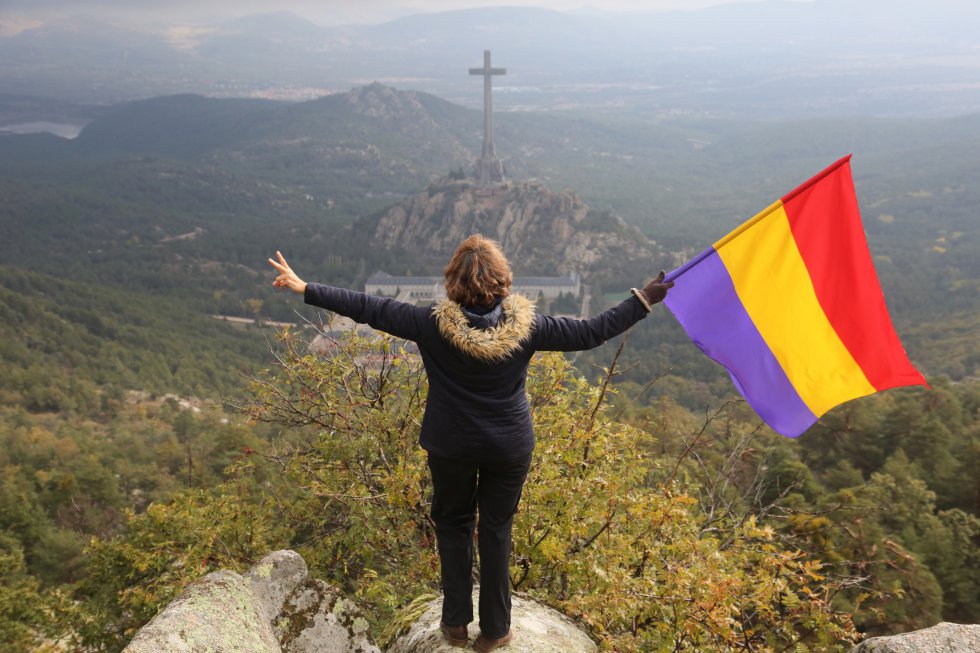
We have had some major setbacks these past weeks. We have stood and drawn a line. The line has been walked over. The very words we have used (they shall not pass here) as we have stood have been literally spoken back on TV news – the ‘conquerors’ saying publicly ‘we have passed’. Even after 2015 and the incredible shifts noted by every newspaper after we prayed at the Valley of the Fallen; after going to Franco’s birth home in 2018 (11 hours away) and the government passing the next day the edict that they will move his remains from the Valley of the Fallen – we are back with the governments edict being stalled and resisted. I could enter a few other such examples, and truth is we are very sore indeed.

I could also outline other positives, some of which have been recorded even in the press beyond Spain.

There will be setbacks. But to live ‘on’ and not ‘in’ the land is something we have to resist. We have to stand but the standing is in the land.

I am not looking to trample on anyone’s convictions, but I consider that we all have to regularly ask if we are simply ‘on’ or are we ‘in’ the land.

And to those in the land. Stand. The day of evil does pass, even if not as soon as we would like.

Reconciliation – how?

The second question that Johnson’s article presented was how we answer the question of how is a person reconciled to God. Through the atoning work of Christ on the cross being the answer.

Good answer… and the ‘sub-‘answers?

Well they can really vary. He died for all and all means all and all are saved / reconciled. He died just for the elect, those predestined by God. He atoned for sin in the sense of paying for our debts… he appeased God… and so the answers go on.

So given that I am responding to the article and so cannot be put outside the box as unorthodox here are a few pointers as to where I am at.

  • A first and very important point for me is that God did not need to be reconciled to humanity. The issues are not on his side! He was in Christ reconciling the world to himself. There is no sense of God being appeased, his ‘wrath’ is not some sort of mega-anger!
  • The death of Jesus is for all, not for a few. Fully understanding how his death accomplishes this might finally evade us, evidenced by the variety of metaphors used in Scripture. In some way his death is for Israel, he is their representative, so that the curse if broken off them. The chosen people then are all those who are in Messiah – first the remnant of (natural) Israel who respond to Jesus and those grafted in of Gentile disciples. This does have implications for who are ‘the chosen people’. Messiah is chosen and all in him are chosen. The death of Jesus makes a difference to all previous divisions. There is literally a new humanity whose task is to prepare the materials for the new creation.
  • All those who by faith receive this Jesus as Lord are part of that redeemed community. Those who knowingly reject this Jesus (and not simply a Jesus presented to them theologically) are lost.
  • The warnings of Hebrews are not theoretical as there has to be a continuance in the faith. Those who persevere to the end will be saved.
  • Getting ‘saved’ has been reduced to a prayer and a pronouncement that the person who has said that prayer is now ‘born again’ (using a phrase that Jesus only used once!). Salvation in Scripture is far more than being safe. It is about moving from one dimension to another, living out what is seen – living as though there is already a new creation.
  • There should be clear evidence of reconciliation. The ‘sinner’s prayer’ might be a good starting point. It is certainly a very bad end point. The evidence of reconciliation has to affect every aspect that the falls damaged. This includes human inter-relationships, care for the creation (‘mother earth’ is not too big a heresy – humanity came from the earth, but creation is not divine, nor was my mother!). We are rightly appalled at the appeal for abortion on demand, yet the way we are happy to pollute the planet and rob future generations of life seems OK. That is not how it should be.
  • Will all be reconciled to God? Will there be those who lose their salvation? We’ll find out one day.

I am convinced that there will be some major surprises when this creation is transformed by the appearance of Christ. Surprised how far the death of Jesus reached and to who. No one will have made it there through their own self-effort. Even for those who ‘fear God and do what is right’ in every nation (regardless of faith) will make it because of the death of Jesus.

A narrative going somewhere

How do we read Scripture? Many decades ago I came across an early lecture by NT Wright where he suggested that the authority of Scripture lay in its narrative. This probably should not surprise us, after all so much of Scripture is narrative. It is certainly not laid out as a systematic theology. Even the books of the law are mainly narratival, and where we have laws they are in the context of being given to a people on a journey.

An aside: the image is of Derek Flood’s book ‘Disarming Scripture’. I am not covering the material he covers here and it is more than worth a read. He says we can have an approach that is a blind obedience to what we read or a faithful questioning. He suggests that the Bible itself demands the latter, and in approaching the violent texts of Scripture shows how both Paul and Jesus selectively quote passages and ‘delete’ parts. I suggest this is not a cop out and challenges us to read, ‘be read’ and place Jesus at the centre of all things.

The narrative takes us from Creation to New Creation. It travels through a series of ‘falls’, the calling of Israel, the failure of Israel, the beginnings of a faithful remnant as marked by the baptism of John, centring in on the baptism of the only true human / remnant of Israel (Jesus). It is inevitable that once he is baptised John must decrease, the one who was the ‘greatest born of women’ prior to that watershed, for from then on the least in the kingdom of heaven would be greater than John. The watershed is marked and huge. The NT, and indeed Jesus himself does not give us the option of being faithful to the narrative of Scripture by equalising all things. With Jesus there is a seismic shift. This is why he has to be the lens that Scripture is read through and critiqued, and in that sense parts of it ‘rejected’.

From Incarnation through resurrection and outpoured Spirit the narrative follows those who have responded to the ‘Gospel’ and are collectively known as the body of Christ: those caught in the in-between, already having received the firstfruits of the Spirit but not yet living totally out that fullness, nor living in the fullness of what is yet to come. A new humanity on a journey, a narrative pushing for a fitting end, with a new heaven and new earth (a merism for all of creation being renewed).

Now when I read Scripture I kind of have that overview. Texts that come from an earlier part of the story are from that part of the story. They might not be relevant as is for me today. How to treat slaves might not be what I need, but there might be principles there that apply in the ‘chapter’ of the story that I am living in. Not harvesting to the full extent of the field might or might not be a good principal in an agricultural society, but surely the ‘deliberately not maximising profits’ and making sure that we make it easy for those who need to get something of ours even though they have not worked for it, could well make those earlier instructions to continue have relevance in our current chapter.

I am not so interested in was there an historical Adam (I don’t think so), or where was the Garden of Eden. I could even on a certain day be convinced that the devil does not exist (in the sense of a personal devil) – though whether he does or not I am committed to cast out demons and seek to confront demonic powers where I see them! It is quite easy being an agnostic on such things when there is a conviction that God is the author and he will be the finisher of the story that we are living within. On some issues I am not ‘orthodox’. In spite of living for two years in the Tarshish where Jonah was headed for, I think it is a made up story. But one with such a point. And a narrative worth referring to as if were ‘true’, for the (point of the) story is so true. Nineveh never took three days to cross, but always our Ninevehs take 3 days to cross (https://3generations.eu/posts/2018/04/the-third-day/)

I could go on with other examples. And with great joy I realise I could be quite wrong on some of my readings. What seems more important to me is that there should be growing evidence that Jesus, the God-human, is reflected in who I am, what I say, and how I act. To continue that journey I will need to go back to Scripture, read and re-read the various parts of the narrative, regardless of what ‘chapter’ they are of the story. I will have to let those texts ‘read’ me, while I keep an eye on where God is taking it all. To a New Jerusalem that can only come from another dimension, but can only be assembled from the acts of kindness and love carried out in this dimension.

Reading and being read

Understanding Scripture is a life-long challenge. What was once obscure can become clear, and vice versa! Johnson’s lecture sits in the context of a shift from ‘if you are orthodox you will tick the infallibility / inerrancy box’ to ‘so you accept the authority of Scripture so explain to me how you read it’.

There are die hard 7 day creationists, not because of compelling scientific evidence, but because of a prior commitment to a biblical view. There are also convinced evolutionists who are evangelical believers, e.g. Francis Collins who led the Human Genome Project that was at the forefront of mapping DNA. His book ‘The Language of God’ ties together his work as a scientist and his firm belief in God as the author of life.

There are (really there are) those who believe in the priority of male over female as part of creation and redeemed order, and there are those who refute that. That was a disputed area some 30+ years ago and although the discussions rumble on there certainly is not the same strength that suggests anyone who explains ‘man as the head of woman’ in a non-hierarchical way is denying the authority of Scripture. The same arguments abounded a few generations earlier with the debate on slavery where one well-known evangelicals of the day said that slavery was one of the clearest tenet of Scripture! Now issues of sexuality are centre stage, with evangelicals on both sides of the many divides.

I have become more agnostic on certain issues, realising how we can use Scripture to defend us, reading there what we want to read. Dare I suggest God is more interested in my ability to reflect Jesus than he is in my doctrinal set of beliefs. Orthodoxy (right doctrine, though one could argue that the word should mean giving right glory) and orthopraxy should go hand in hand. The Pharisees knew the Scriptures but…

The challenge that the shift Johnson outlines is how do we read Scripture if we are not simply finding a set of textual evidences that back our view (and sometimes either ignoring ones that don’t or doing them a disservice by squeezing them into our already formed box). There is a challenge beyond how we read the Bible – it is allowing it to read us! That’s when the ouch can hit our rightness. More tomorrow.

How long is the cord?

I wrote yesterday about how Johnson’s article presented two questions; one concerning authority and the other concerning reconciliation to God. The former relates to Scripture, the second to the atoning death (and resurrection) of Jesus.

In the old days, particularly when the authority of Scripture was being challenged, doctrines such as infallibility and inerrancy developed. Those terms took a belief beyond inspiration. Of course even with those terms there were added terms such as ‘as originally given’. The original manuscripts of course we no longer have, so in all very hard to prove. What also were we to make of statements such as ‘the mustard seed being the smallest of all seeds’ – not scientifically accurate.

I understand the desire to make the Scriptures incredibly strong and therefore totally trustworthy, but to strengthen them in that way I am not sure is warranted.

I like to talk of the authority of Scripture and how we are to live (faith and behaviour) as followers of Jesus in faithfulness to the narrative of Scripture. So terms such as authority, truth etc. fit comfortably for me. However I also have to accept that even the term ‘Scriptures’ are somewhat problematic. Which canon? And please do not exclude the book of Revelation (or even call it a ‘disputed book’ as Luther did), the surest exposure of the politics of empire that exists!

There are elements of faith with any approach to Scripture – I am very happy to accept what I read (66 books) as the canon. That means I have to exercise some measure of faith in the process the church was involved in that eventually formalised a canon (or different canons). The work was not unlike that of the formation of the Jewish canon. They used the law, the prophets and the writings, and eventually made sure some books were excluded, seemingly to make sure that ‘Christian’ writings were not used. The canon were, more or less, the books in use (found useful, cf. 2 Tim. 3:16) that were formalised. In the same way the Christian canon developed, hence the different canons.

By what authority – for me the 66 books of our old and new testaments are that authority. I cannot prove they are the right ones nor necessarily the only ones, but by faith in the work of God within the historic Christian community that I identify with those are the ones.

Inspired – for sure. Inerrant – not ready to tick that box. Contradictions within the books – maybe I would rather use the word ‘conflicts of views’. I don’t think we are to iron them all out so as they disappear, but rather with a Jesus-lens we let them argue it out, and we seriously have to raise the volume of the texts that carry a Jesus-revelation. Ultimately Jesus is the revelation of God that Scripture bears witness to. We cannot place Scripture above Jesus, nor can we create a Jesus of our own making that Scripture does not bear witness to.

In the next post I will amplify a little on the adjustment of the volume of the text so as some are louder than others. We have to ask ourselves ‘how do read that text?’, ‘what does it say to me / us?’, and also ask ‘how are we being read by that text’. We might not always get it right, but the Scriptures point to Jesus, not simply with a historic meaning, but primarily in the sense of calling us to identify with and follow the only embodiment of the Godhead in human flesh.

Perspectives