
 ‘Semana Santa’, Holy Week is quite something in Spain, particularly in Andalucia. Penitence features big time, and emotions relating to mother and Son are high. A school teacher told me that he had a close friend who is an atheist but every year is one of the many thousands who offer themselves to carry the ‘pasos’ on their shoulders and process through the streets. ‘Why does he do it?’, I asked. And the reply was it was a deep and privileged experience to see the tears and emotions on the peoples’ faces.
 The first Easter when we were in Spain (2009) I was not happy seeing all of this, and Gayle with her wisdom quickly pulled me across the street while I was standing in the street to confront the procession… I have moved on from those days – after all I was way young back then! The shock though of the alien scene is what was provocative. I am sure there is also genuine faith among some who are attracted to the tradition and procession – same as with the Camino to Santiago.
Wright’s wonderful title ‘The Day the Revolution Began’ is of course all about the Easter event and its context. What kind of revolution is portrayed by the processions complete with statues, huge crowds and those hooded to mark the penitence surrounding the whole event? Certainly, for me with my background, it only portrays a cross that affects the spiritual, or maybe religious, part of life. But what about a narrow ‘evangelical’ gospel understanding of Easter? What kind of revolution is indicated in that message? Beyond that gospel we can have the ‘seven mountains’ of influence with its reliance on Kuyper and Reconstructionism, and of course a strong reformed theology of the sovereignty of God. At what point are we able to suggest that those are all ‘sub-‘gospels. Of course if I were to suggest that I would also have to accept that any understanding of the gospel I have is also ‘sub’.
I have had two provocative conversations in the past couple of days. One via email, where the issue of the Western world and how it is falling apart, with the cracks becoming ever more visible, raises the inevitable question of how much can we prop up, redeem the structures and how much are they simply to fall? I might not be representing the brief email conversation well, but the questions are vital ones for those of us who believe a revolution for the world began in Jerusalem that Passover time, and that the cross was not simply about making sure there is ‘a going to heaven ticket’ available from then on.
The second conversation was with Gayle who challenged my language that the body of Christ is to take responsibility for the world. I don’t think she was challenging the concept but the language. (Any volunteers to help me get her to a more compliant place????!!!!!) Language is so important. We might never get the right language and ultimately language is always co-opted by the powers to nullify what the language originally meant. So these two aspects have provoked me and in the light of the ‘sub’ nature of our understanding I will return to these elements in the next few days. I don’t plan – as if I could – to give anything definitive in response, but if there was a revolution that began, and we are in the midst of some of the greatest paradigm shifts, both in the theological / ecclesiastical realm, as well as in the world as a whole, I will at least give some attempt to some responses.
So on this great day… Blessed are the revolutionaries!!
 My first time in Spain – early 2000’s my prophetic input to a land I knew nothing of any depth about was that two major signs would take place when Spain was turning. Bull fighting would be banned and the British flag would not be flying over Gibraltar. I should have added and ‘pigs will fly’ but held back on that one. A few days ago article 50 was actioned. Negotiations regarding a ‘soft’ or a ‘hard’ Brexit will now unfold. The ramifications, the complications, and certainly the rhetoric will at times be soap operish. There will be some good reads to come from the pens of journalists.
 In a short break from Blood and Faith, but almost completed it. A tough (emotional) read. The author does not suggest it is simply bad ‘Christians’ and good ‘Muslims’, but given that those professing Christian faith were the ones with the power the responsibility has to come down on that side. It does seem a number of the Muslims had found faith in Jesus and found themselves in a particular hard place. Thrown out and then not welcomed where they went. There is a report of a group sent to Tetuan who refused to enter a Mosque as they were now Christians and were subsequently stoned to death. Thrown out of their land to their death.
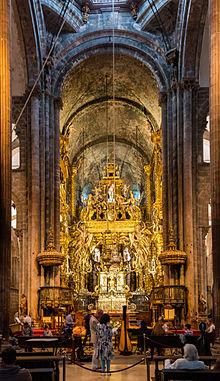 The ‘camino’ (pilgrimage) to Santiago de Compostela is over 1000 years old and has been increasing in numbers. In some recent years over 1/4 million pilgrims have been on that path. For many it is a path of faith and they find a renewal of their faith. We have locally a friend who went on it last year. He confessed to not having personal faith, but was convinced that there was great value in journeying where others had found what they were looking for. So a mix of people go on the journey. We have even talked about whether we should make the journey to connect with people who are seeking faith… then Gayle said in one of her responses – maybe we should walk away from Santiago, do it in reverse! That quite appealed.
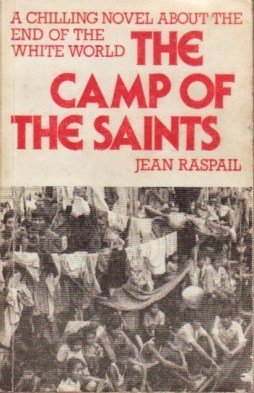 I would love to have the ability to write a novel. However, writing like that would not come easy for me, and I think I would get a whole story out in about 3 pages. It might have a beginning, a middle and an end… but sadly no gripping detail and background! Not destined to be a best-seller. All kinds of books carry a world view. I have long maintained that there were two big blows to a decent understanding of eschatology. First the Scofield Bible. Stick notes in the Bible and effectively I no longer need to read the book, as soon as I come across something I do not understand, skip to the notes. Effectively the notes become the Bible, and ‘but they are only notes’ ceases to carry any weight. Secondly, novels about the end-times.