Yes a little odd the spelling above but to make a point as I consider a few reflections on the gentleman named Paul (a ‘gentle’ man???).
There is always a section on ecclesiology in the books that seem to try and systematise everything; Thomas Finger said that of all areas of theology it is the least innovative, and suggests that money, reputation and sustaining what gives careers are the driving factors in this. Paul is a pragmatist – more to come on that in a later post – who is willing to compromise today with a view to compromising redemptively, with the plan that tomorrow will be better than today. On that basis I also try to be pragmatic, but it is helpful to push into what might lie at a more foundational level so that we continually push forward. I also suggest that as I hold to the conviction that in the context (particularly) of Europe we are at the end of a long cycle and can imagine a different tomorrow.
Ekklesia – not a word made up by Paul (and on the lips of Jesus twice in Matthew), but a common word understood within the Graeco-Roman world. (Acts 19:39 in response to the riot in Ephesus the town clerk said that if there was any ongoing complaint that it would have to be settled in the ekklesia – not the ‘church’ but the legal body, maybe we would term local council.) Each of the major Roman cities had an ekklesia, made up from the competent males who were responsible for the framework of the city and to plan for its future. Their goal was to make sure the city was shaped according to Roman principles and vision, in short they were to ensure that the city was as close to resembling Rome as possible.
Paul uses that term (ekklesia) to describe those who had found faith in Jesus and were aligned to heaven’s agenda. He could write, for example, to the ekklesia in Corinth, only the ekklesia he was writing to was the ekklesiain Christ. (This post is too short to go into the use of the term ekklesia in the OT Scriptures – but in short it was applied to the people of Israel when they were actively responding to the voice of God: Stephen uses it that way in Acts 7 also concerning the ekklesia in the wilderness.)
We have become accustomed to adding the word ‘local’ to ekklesia and in doing so have weakened what is in the mind of Paul. He was convinced that every locality needed a group of competent people (females definitely included at all levels) who would take responsibility for the locality and seek for that place to be as close to heaven’s reality as possible. A BIG task! And a big task for a small group of people – maybe less than 100 in cities of 200,000+ people. A big task and big faith.
Of course there are other aspects to ekklesia – particularly that of inner care and nurturing one another, but the overall purpose was a group who prayed and acted so there might be some measure of ‘on earth as in heaven’. (Maybe we fall short as we often represent ‘in ekklesia as in the world’???)
Back to Finger who said all that is written is so predictable and lacks innovation. If we moved away from ‘pure church’ and toward ‘here to change the context / locality’ we might be astounded what things might look like. I put the word ‘context’ in there as we are no longer defined simply by localities.
The ekklesia that Paul helped established did have a significant inward activity – with a focus of when they came together they ‘ate’. Inevitable as the Master they followed was an ‘eater’ and part of his offence was to eat with the wrong people. Also eating was a strong prophetic act in both the Jewish and Graeco-Roman cultures. In those cultures – particularly the ones more aligned to the Imperial rule – who came to meals was a major re-enforcement of hierarchy. Where they were seated was all part of that, and the invitations were sent to those who would reciprocate. So subversive the teachings and practices of Jesus… and Paul.
Do not invite those who can invite you back.
Do not give the seat of honour to the wealthy.
Honour the least honourable.
Those commands can be multiplied for the ekklesia of Jesus was ‘upside-down’. That meal – and Jesus had meals at multiple levels – was to a) remember Jesus, b) proclaim his death and c) until he comes.
It has been reduced to something less than a meal and to focus on his death. Remember him – outrageous, disturbing him! Proclaim his death – a new era is here; the powers are defeated and they (earthly and heavenly) do not have the final word; they are but temporary; a new era is here and one day will be consummated. Maybe that is more in line with the ekklesia in Jesus Christ?
Let the meals – at whatever level – be outrageous!
Vincent Brannick (A Roman Catholic! – exclamation mark in the light of what he says from that background) wrote in response to the council of Laodicea (365AD)
The prohibition of Laodicea completes a critical cycle. The Lord’s Supper had changed from evening meal to stylized (sic) ritual. The assembly had moved from dining room to sacred hall. Leadership had shifted from family members to special clergy. Now the orginal form of church was declared illegal.
The original form of ekklesia declared illegal. I might substitute the word ‘purpose’?
The importance of the cross cannot be overemphasised for Paul.
For the message about the cross is foolishness to those who are perishing, but to us who are being saved it is the power of God… but we proclaim Christ crucified, a stumbling block to Jews and foolishness to gentiles, but to those who are the called, both Jews and Greeks, Christ the power of God and the wisdom of God (1 Cor. 1:18, 23, 24). I decided to know nothing among you except Jesus Christ and him crucified (1 Cor. 2:2). May I never boast of anything except the cross of our Lord Jesus Christ, by which the world has been crucified to me and I to the world (Gal. 6:14).
The life of Jesus was vital for Paul for his life was in contrast to ours (Adam’s); his being one of obedience, of humility and that obedience being even to death, death being death on the cross (Rom. 5:19; Phil 2: 7,8). A call to imitate Paul was a call to imitate Paul as he imitated Christ. ‘Justification by faith’ was not justification by faith alone – we should not simply subsume James under Paul to erase the supposed divide between them. James said we are not justified by faith alone! And I am sure Paul would have agreed. Neither Paul nor James are suggesting ‘salvation by works’ any more than their roots (‘Judaism’) did. Judaism talked of the ‘works of the law’ – behaviour as outlined in the law in response to God’s grace and acceptance; if Israel was ‘saved’ it was by grace; Paul might well have been happy with the term ‘works of faith’ (‘the only thing that counts is faith working through love’ – Gal. 5:6); certainly works (but not to earn salvation) by the Spirit, his helpful term being ‘fruit’. The contrast for Paul between the former way of life and the new way was that of ‘law v. Spirit’. Led by the law as a guardian (his former expression of faith) gave way to being led by the Spirit (Gal. 4:1-6; Rom. 8:14).
The brutal death on the cross. The cross was a political statement to mark those who rebelled against Rome’s rule; the death of Jesus on the Roman cross was fuelled by religious jealousy. He was charged with being a blasphemer and the sentence was carried out by the Imperial powers of the day – that in itself would be tragic and make Jesus a martyr and a hero, but Paul was convinced that something much more was going on. Jesus was a martyr but more; martyrs inspire but Jesus saves. Probably no ‘theory’ of the atonement will suffice though (no surprise) the populist theory of ‘penal substitution’ in order to display God’s righteousness and satisfy his wrath simply does not resonate for there is no divide in the Trinity. The angry God (Father) and loving Jesus is not Pauline, for God was in Christ reconciling the world to himself. It is the ‘powers’ feature highly in Paul. Demonic as in spiritual beings? Earthly powers / systems? Demonic as in ‘beings’ that come into ‘existence’ as a result of corporate power entities? Take your pick! He disarmed all powers:
He disarmed the rulers and authorities and made a public example of them, triumphing over them in it.
Any theory that does not take in this aspect I think falls short of being Pauline. The transfer from one realm to another necessitates the defeat of powers hostile to humanity; the captivity has to be broken.
Paul’s gospel is not just the cross, but the cross and the resurrection. The crucified one is the resurrected one, and he insists if Jesus had not been raised then we are still in our sins. The resurrection is the affirmation that a former age has been ended, or perhaps it might be better put that a new age / era has begun as the two ages now run in parallel.
Freedom, deliverance, and a very real experience is what takes place. Paul’s gospel goes beyond a ‘faith’ response to a reception of the Spirit and that is appealed to in experiential terms.
The only thing I want to learn from you is this: Did you receive the Spirit by doing the works of the law or by believing what you heard? Are you so foolish? Having started with the Spirit, are you now ending with the flesh? Did you experience so much for nothing?—if it really was for nothing. Well then, does God supply you with the Spirit and work miracles among you by your doing the works of the law or by your believing what you heard? (Gal. 3:2-5).
‘Did you experience so much’ could be understood as ‘suffer’ as being something external and unpleasant but given that he goes on with present tense verbs as to the ‘supply of the Spirit’ and working miracles among he makes an experiential appeal. Faith resulted in the receiving of a tangible animating presence, the reception of a life-source that resulted in God-activity.
The cross does much more than show us a way (‘moral influence’ theory of Abelard and in part René Girard’s presentation of the scapegoating narrative that he uses). The cross stands at the end of a doomed pathway; the resurrection stands with the stone rolled away and an invitation to a new path. The possibilities are endless and this is why I like to talk about transformation,
[A]nd through him God was pleased to reconcile to himself all things, whether on earth or in heaven, by making peace through the blood of his cross (Col. 1:20).
I am agnostic (and I think that is the best faith position!) on what transformation will look like because once touched by the Spirit it is the imagination that is ignited to ‘see a new creation’. Paul might have thought there would be an imminent return (in his lifetime) of the Lord (‘we who are alive at his coming’) but he continually worked for the future. That has to be our framework. Agnosticism regarding the future is the framework, but focusing in the present so as to invite the future to manifest.
Once we move away from the narrow framework of ‘saved from hell’ (ticket to heaven) to a Pauline vision for the world (his world and now ours) we do not negate personal salvation but understand it to be a salvation from captivity to the realm of sin and death to participating in the liberation movement of reconciliation. To quote another movement that understands that salvation is to be measured by the extent to which we are liberated and become liberators. (‘[Jesus] who gave himself for our sins to set us free from the present evil age’.)
Paul is silent as to what happens between the two events of crucifixion and resurrection. I am also somewhat curious on that time. Do we choose the rather ‘mythical'(??) descent into hades (harrowing of hell: 1 Peter 4) or do we go for the cleansing of the heavenly tabernacle (Hebrews…and what would that indicate)? Or is there truth in both without either needing to be pressed literally?
The cross ends a domination that had erased all true hope (not erased the possibility of ‘individual’ salvation); the resurrection opened entry to the realm of Spirit inspired imagination. Truly, the era of ‘I have a dream’.
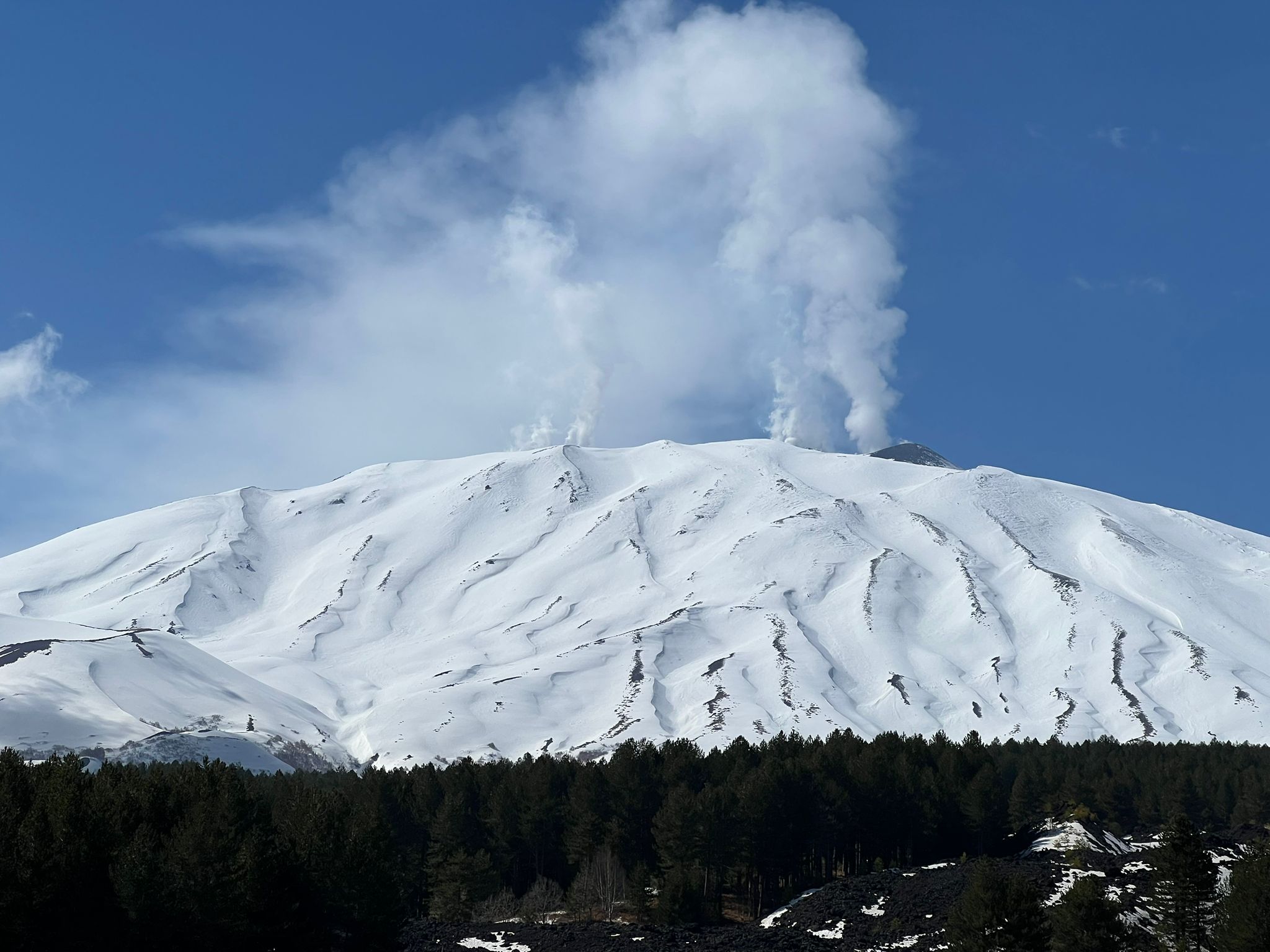
An impressive site – above the clouds Mt. Etna stands. Each time we came to the mountain or spoke to it we had a response – the most significant was when a vent that rarely ‘vents’ called ‘New Mouth’ expressed itself. We would have loved for there to have been a proper eruption while we were there as a ‘sign’ but anticipate that might occur fairly soon as Italy takes her position. Let’s see!
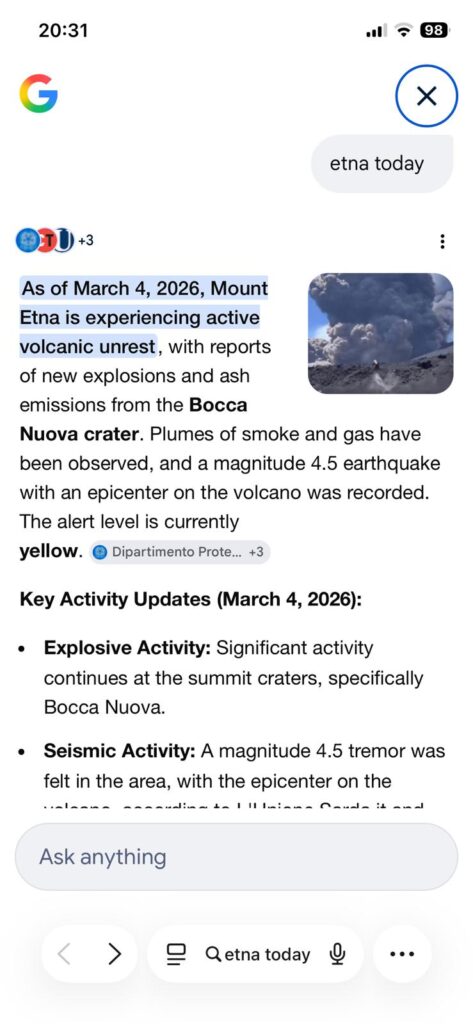
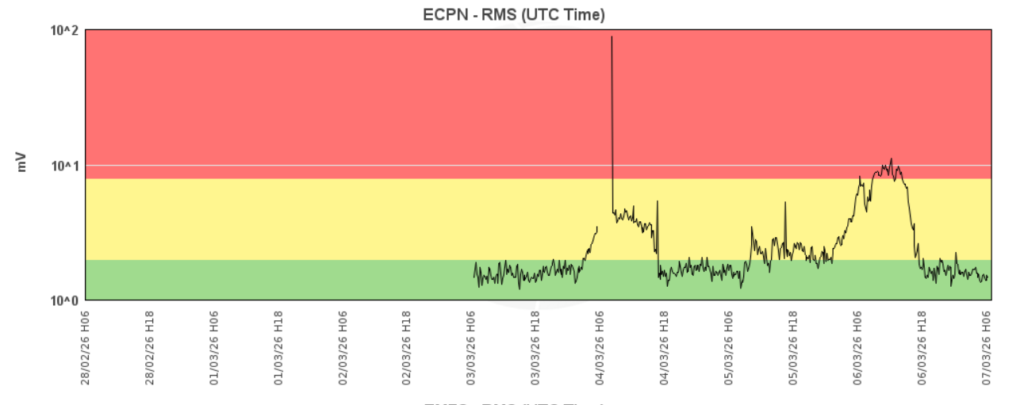
A little shout from ‘Bocca Nuova’ (had not ‘spoken’ in a long time but did when we first visited the volcano) and was accompanied by a reasonable sized earthquake – 4.5) screenshot below:
The reflections that follow will be selective (4 months in one post?) and likely not to be short. Some of this might have been read in a post or a WhatsApp but I hope to keep your interest and that some of it will be helpful, but I acknowledge it is virtually impossible to give a report that gives a total representation of our little adventure.
Plans
We thought that we would be based in 1 (maybe 2) situation(s) and then travel from there. We also anticipated that we would be able to camp as the beloved search engine said ‘camp site open’ but open they were not. This meant practically in the 126 days away from home we were in more than 30 different rentals; some good…others… including one we had to leave after one night due to consistent sewer smells… ah well not all plans work out!!!
Second aspect that we had not calculated was that the island is BIG – for UK people 25% bigger than the size of Wales, so the idea of being based in one place was not practical. We crossed on the ferry and then we were looking at each other – ‘do we go West or do we go South?’ As we got off the ferry – ‘let’s go West.’ West we went to Marsala. Although I had read 2 books on Sicily before arriving we had not clocked that this was where the unification of Italy began in 1860 with the arrival of Garibaldi. This was to be key.
On the way to Sicily we had input that invited us to consider a border en route. As we weighed that input we considered it was an ancient border – and settled on one south of the papal states (between Rome and Napoli) called the border of ‘the Two Sicilies’. We spent two days there before continuing south. This was important and Marsala connected with this as Garibaldi came to conquer the ‘Two Sicilies’ from there.
Input and guidance
We are very grateful for every encouragement, ideas, suggestions and prophetic insight that people gave us – invaluable.
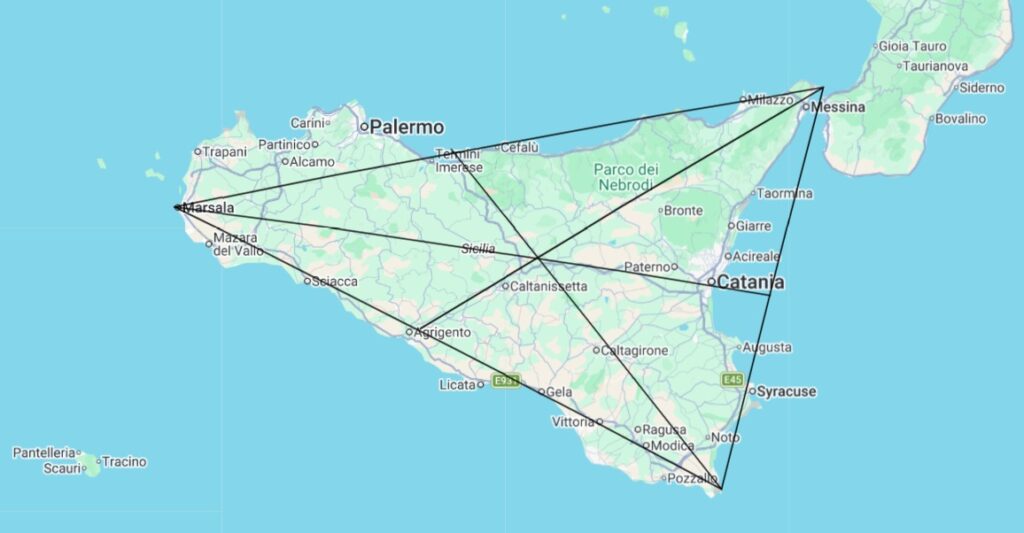
When in Marsala – the place where Garibaldi entered – I had a dream where an angel came bearing a huge and very heavy book. Struggling to the point of exhaustion to deliver it I thought that if I were that angel I would have given up. As I thought that the angel assured me that having come thus far the task would be fulfilled and with that managed to heave it up on a lectern so that it could be read. The book had been carried, supported at three corners, pressed in to the angel’s stomach and then with two arms extended to the limits. Later we understood that to symbolise the three extreme points of the island that have been recognised from ancient times. The book symbolised the story of Sicily – thus far – with the final pages blank calling for us to come and write about the future. The persistence of the angel proved to be a major energising aspect in keeping us focused and moving forward as we became more tired toward the end.
Two days after that dream Garibaldi showed up in a dream to simply say ‘what I have done cannot be undone’. True at one level but at another level the past cannot simply dictate the future.
The map indicates the three recognised points of the island with the meeting point being the city of Enna in the centre of the island.
The book the angel brought was reflective of Sicily but we also carried with us that Sicily, being physically in the middle of ‘middle earth’, also represented in some way the wider world of Europe and perhaps beyond. As one author described Sicily:
The stepping stone between Europe and Africa, the gateway between the East and the West, the link between the Latin world and the Greek, at once a stronghold, clearing-house an observation point. It has been fought over and occupied in turn by all the great powers that have striven over the centuries to extend their dominion across the Middle Sea… Sicily is probably less unhappy than she has been for many centuries, but though no longer lost she still seems lonely, seeking always an identity which she can never entirely find.
Europe – the centre of the world!!
No not really!! Timelines are important and different parts of the world are on different timelines. (Personal convictions shaped by experiences and dreams have developed what follows.)
The gospel came within the Hebraic culture and world (with a big affirmation of humanity, the planet, creation and redemption… redemption of the world / all things); it then spread throughout the ‘oikoumene’ of the Graeco-Roman world (oikoumene being the oft-used term for that which was within an Imperial boundary – this is what Jesus was offered: in short bow and worship and he could be the next Caesar – no better position from which to spread the good news!!! Hence the huge dangers in Christendom – and of course for us a very denial of Paul’s gospel).
The importance of Europe is not that it is the centre of the world but that we have a wonderful opportunity to see truly the end of Christendom and find a way to recover the Pauline gospel, a gospel set in a multi-faith context of conflicting ideologies concerning the transformation of the world. A little task?
Other portals… Monotheistic faiths
From Europe it is this non-Christendom experience that has to travel and it was not too long before we realised that the next portal has to be Istanbul with a focus on the Hagia Sophia mosque. Originally a Christian / Christendom house, once Islam was able to inhabit that house it was able to spread more rapidly; hence Istanbul calls (a visit in May?).
There are three monotheistic faiths that claim Abraham as their ancestor: Judaism, Islam and Christianity. Christianity in its Christendom form linked to those others only strengthens their expression (we were not insensitive to the current war while in Sicily, nor unaware of the current contest to see where European nations will land). Into those three religious expressions Jesus-aligned followers become essential in breaking open that three-fold cord (appreciate that is shorthand and expresses our ‘world-view’). The middle east is a powder keg as its destiny is to be a place of reconciliation, reconciliation not based on the domination of one over another but of togetherness amidst difference.
Prior to coming to Sicily we saw what was to take place in that island was to sow fresh seed that needs to enter the portal of Istanbul and then to travel east. That view is only strengthened since being there.
Power out
In previous communications we have written about the ancient map of Europe with Spain as the head and the rolling up of that map with the consequent major power outage in Spain & Portugal. Signs are important (I pause to consider Etna one more time!) but we really want to see not simply signs but substance. So to the heart of our prayers in the land.
Colonisation
Words do have (in part) intrinsic meaning (do cringe when the preacher says the Hebrew / Greek means… without showing how it is used) but the key is in the usage. Colonisation manifests in the classic sense of a power taking a piece of land that was previously under another ‘flag’, but the core of it is that of taking a gift / sphere / territory that was not yours to take (we might be able tor eplace the word colonisation with one of the three ‘sin’ words of Scripture: trespassing). Colonisation can be subtle and can even use truth to take, colonise and disempower. A classic example in our current world is that of the self-evident truth that ‘all lives matter’. No one can deny that… but by replacing ‘black lives matter’ with the phrase ‘all lives matter’ is to disempower the original phrase and the necessary rebalancing that is being called for. ‘All lives matter’ is true as a phrase but has colonised the original phrase to simply maintain the status quo of oppression.
Sicily has a literal history of colonisation, from the earliest time – 1 original tribe, then from some 3000+ years ago a second that takes land to a third that pushed the original indigenous people into the centre of the island; then we can travel through the successive empires (at least 10) right thorough to the colonisation of Sicily to create the modern Italy (Garibaldi’s invasion of 1860)… as so often happens the resources (gifts) of the land were taken and Sicily moved from being highly prosperous to experiencing widespread poverty in a very short period time (25% of the population had to leave in a 10 year period due to poverty).
Yes we prayed into that… but we discovered other stories. Not unique to Sicily but that of the abuse and subjugation of the feminine. (Gayle would be much more eloquent in expressing this but she is getting ready for Malaysia so you got me…) Prior to touching on the specifics – back to Paul’s gospel. (I use this phrase for two reasons – the resource we have in those letters, but also that he is outworking the implications of the life, death, resurrection of Jesus in the context of Imperial power – our setting.) He is clear that the only thing that counts is ‘new creation’ to such an extent that there is no ‘Jew/ Greek, slave/free’. He saw a world (as did John in Rev. 21) that was transformed by the resurrection. It was a world of creation that had come to an eschaton but was more than a restoration of the supposed original – in the same way Jesus was the ‘second Adam’ but also he was the ‘eschatological Adam’. He became a life-giving Spirit – he became an expression of humanity beyond Adam (male and female) – who was a living being. This is the task of the body of Christ – prayer and action and context coming together to move this world toward the coming world where all divides (dualisms) end… and at the heart of it is Paul says and ‘no male and female’. This is central and core. The realignment of the current dualism (and spectrum) – has to be done because ultimately the divide of ‘heaven and earth’ is to end when there is a glorious coming together.
Saints. Not my world! We encountered some female saints – notably Lucia and Agatha. All with the same story. A young woman being preyed on by a male figure. Abused, raped and even in one situation placed in a brothel to punish her. Protected by a superior ‘female power’ but with a horrendous loss of life and even when protected experiencing a total loss of identity; then later in history held up as a saint and protector and then honoured as such today in the various cities.
Anyway to cut it all short – the stories gave us leverage to pray. (And vitally we were joined in this phase by three wonderful women.)
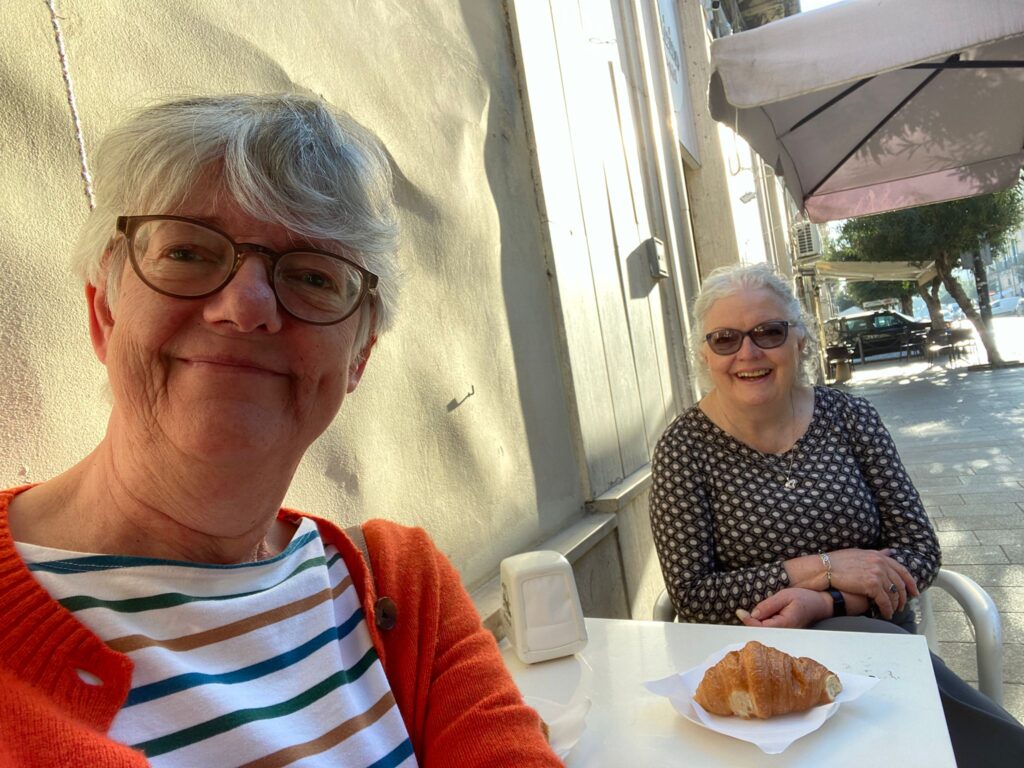
(Annie Macintosh (Scotland) and Elizabeth Coveney (Wales) – 2 of the 3… Jenny Rettig also was with us a few days – sorry somehow have no photo of you, but your input was invaluable.)
The need to pray to remove the toxic masculine… and the toxic feminine was vital, and most importantly the sowing of personal stories into the land was a big part of it. Important for Sicily, and as Sicily is focused for Europe not a small side-act…and as the coming together of heaven and earth awaits the ‘no male and female’ aspect of new humanity this whole phase was enormous.
‘Not male and female’: central to that of undoing colonisation.
Wider Europe
We have been and continue to carry a focus on Spain; we do not have a naive belief that politics are the answer – the vision of Revelation is that Jesus (as Lamb) overcame the powers so as to open the seals to unlock the book of human destiny… but we are deeply supportive of Pedro Sanchez and the leadership he is giving within wider Europe. (Long story would unfold how Paul’s vision was wonderfully infecting those who were not believers with a vision of ‘new creation’. A great part of the unfolding future is Jesus-aligned people in partnership with those who can ‘see’ humanity.)
Our prayer in Sicily / Italy was that there would be a following of Spain’s lead… Italy to follow… then others within Europe. We also prayed into the northern lands – the two arms of the ‘queen’ map of Europe were Italy and Denmark. We have noted the response of Nordic lands in these recent days.
Little interlude… and connecting to the previous newsletter to charismatics
I think Paul’s gospel and also tracking the past 20+ years suggest that we should expect and look increasingly to those who do not have faith to be those who speak (prophesy?) concerning the future.This ties with how I understand where Paul positions the ekklesia – to take responsibility for the future, not responsible to bring it in, but to hold the shape so that it can manifest. Exciting days – so we are looking and expecting that the voices for the future will be in the mouths of the artists and politicians.
We noted that Rosalia, a Spanish singer, named after one of the female saints of Sicily (Rosalia – patron saint of Palermo) won a major award at the BritAwards for her album. In it she sings in numerous European languages, including Italian and Sicilian…the comments in the chat said ‘this is Europe, baby’. Indeed the call is for Europe – different languages, but the same song.
I just got to now include the tattoo I had put on my shoulder in Marsala, the place where Garibaldi landed is the place I wanted to mark as new creation – with the sun rising and ‘I saw a new creation’. Surely that concept is more than enough to get one out of bed in the morning.
As well as the three women joining with us, Steve and Kathy Lowton joined us December 26th into January for some key days – we initially stayed in a city where there were numerous concrete benches cast as open books (a nice reminder) – and Steve came back with Noë Limiñana (from Calpe) for the final phase into the north east in March. All who came gave us a major boost.
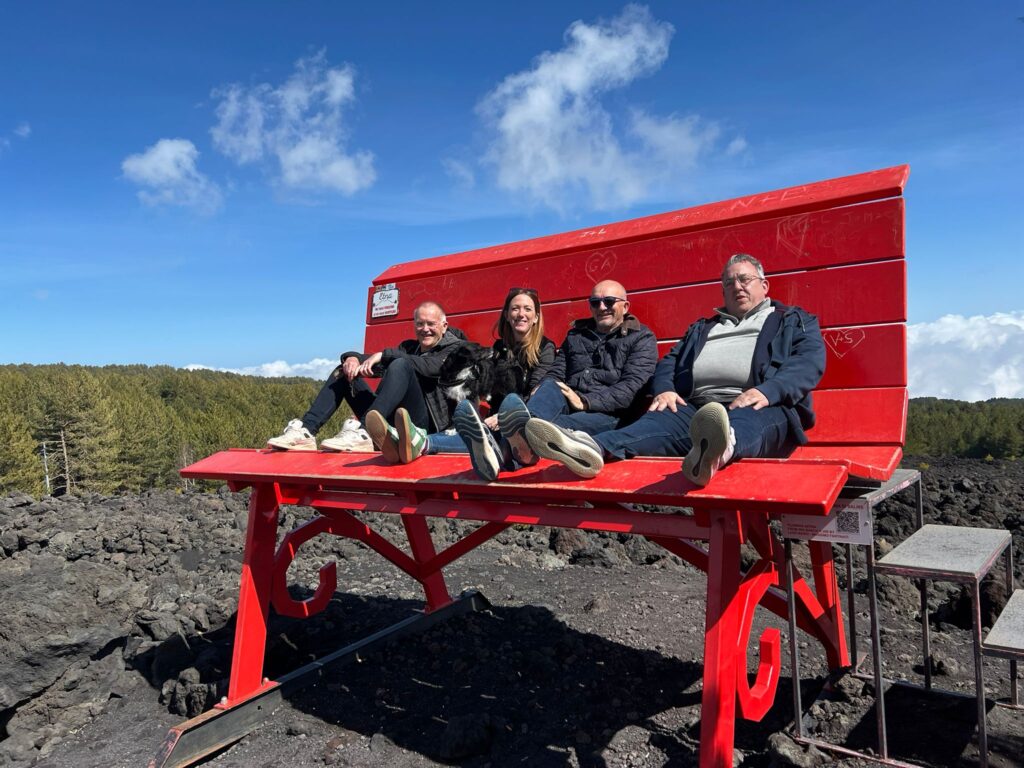
Here is a photo of the final gang sitting on a ‘big bench’ looking at Etna:
Got to become as children! And a dream Gayle had some 2 years back we continue to carry – it ends with a plea to the economic / banking world – to get rid of the suit, the shoes and to play with the children in the grass… and if this can be done then ‘everything else will follow’. We continue to pull for a new economy – not a tweaking of what is here (the foundations of which taps into the spirit of Moloch and increased exponentially with debt as a foundation… historically to fund war). I saw a new creation!!!???? Who knows what we will see, but if we ‘see’ something then perhaps we can redemptively move in a direction.
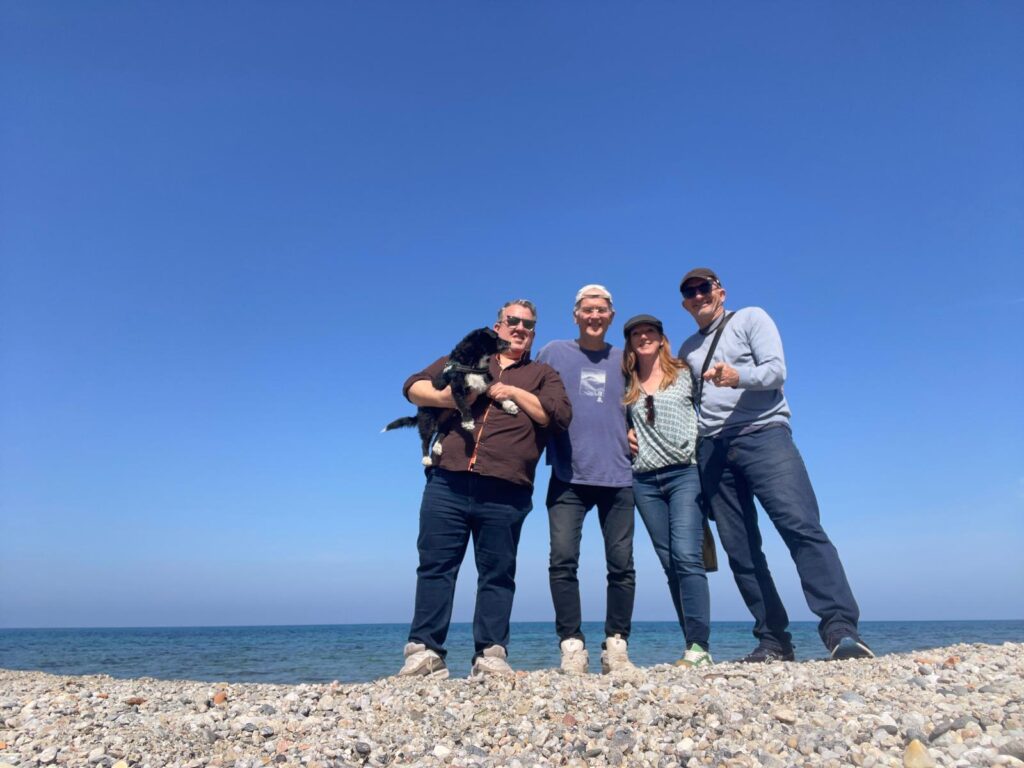
The final photo is of us overlooking the strait to mainland Italy. In that place a major pylon is on the Sicilian side and one on the mainland side, the pylons connecting power lines connecting the island and the mainland… so, yes, power outage was our prayer. Our final act as we ate together was again to roll up the map.
What did it all achieve? The wonderful aspect of our faith is simply that – we walk by faith and one day will find out! I close with – we… and you… will never know what effect we truly make. But by faith we do whatever it is we are convinced to do – small or big. One sows, one waters, BUT GOD…
Some of you might have already received this by email. If so ignore. For some of you this might be of no interest… ignore! For others maybe adds to your own thoughts?
I have a few posts to complete and also to give a response to our time in Sicily. I will (maybe spelt ‘hope’?) to complete what I started on Jew, Israel, Gentile (with a slant on eschatology) and my thoughts on the Pauline gospel, but given the heat that is on some recent exposures on prophecy within charismatic circles I thought I should in this interlude comment on that first.
Well this is not really to charismatics, but a few responses to some of what is unfolding.
While away in Sicily I have sought to follow the scandals / exposures in the past weeks that Mike Winger has documented. I have not watched all the hours (and hours and hours) of videos but I have seen enough and experienced enough disappointment. Of course I have my take on it as many of you do, and wanted to give my response here – particularly to those of you who want to align yourself with the ‘charismatic’.
For those not in the know, in short, the scandals are focused on a number of individuals who have data-mined social media so that they can then present details (names, addresses, specific contexts) as words of knowledge… a kind of ‘Is there a Martin Scott present who lives in Oliva, does Isla de Sicilia mean anything to you?’ blah, blah. Impressive and spectacular. (Interestingly the prophetic that follows is often at a much lower ‘level’ of revelation or simply continues with an affirmation of what was presented on Facebook etc.!)
A little personal history
There are three personal experiences that will also shape where I am coming from / where I am headed.
1) Not knowing anything about what was to come I wrote to someone (first in 2021) whose feet have been held to the fire in these past days that a major test was coming and that he would need the spirit of wisdom when it hit. I had a further 3 pieces of communication with him over the following years.
Then around 2 years ago I had two dreams that seem very relevant:
2) The first dream I was present in a discussion among European believers who were discussing as to what protocols should be foundational for a healthy prophetic to rise in the coming context and season. Into that dream a USA prophetic person (who passed away some years back but was one of the best known names from his era) materialised as a 40 year old. He was intently focused on discovering what we would come up with and his face showed clearly that he knew now that what they had put in place in their era was now proving to be sadly defective.
3) The second dream was of one of the best known and ‘stable’ prophets of today holding the platform in a large auditorium. He acknowledged my presence and said ‘we need to hear from Martin later’… however he filled the whole time and when he ran out of any meaningful content he jumped off the stage and simply began to dance around and shadow box! I said to Gayle ‘there is nothing for us here, let’s leave’. As we left by a side door I realised there was another back room and so I said ‘let’s go in here and see what is taking place.’ We did this and inside was someone dedicated to raising the next generation of prophetic voices. He had clearly been (apologies and I do not want to be crude) stimulating himself and now (fully clothed) he was demonstrating how significant his male package was – this being a point of pride. I said to Gayle – we are out of here and so we left that whole scene: the best of the current was shadow boxing and the next generation was being developed in the setting of male pride and performance.
After those dreams speak into the public space with the exposures of the abuse of the prophetic, and sadly with a comment – ‘we all do this’. I am grateful that that is not totally true (‘all’) but the data-mining and other abuses seems more widespread than just with a few.
The discrediting of the prophetic is clear as a result.
Some 6 months back I said to Gayle the prophetic is about to be shaken but once that is through the same will happen to the current healing move. That is just ahead of us.
So what now charismatics? (And I write as one.)
1) The spectacular – who to impress?
I had a call with David Shadbolt a few weeks back who brought up Philip’s visit to Samaria and in that village was Simon who with his ‘magic’ had deeply impressed / mesmerised the people.
The platform (problematic in itself) has facilitated the impressive. Truth is I do not need someone to give me my name nor my address but do need help to better align my character to fulfil a purpose for others while I am on this planet.
The spectacular lifts the so-called ‘messenger’ up. That is always the vision of all imperially-driven constructs and the total opposite of any Pauline vision for gifts and calling. We have to see the current exposure as a wake up call to being sadly unaligned in direction.
There are remarkable words of knowledge (‘you have had 5 husbands and the one you are with you are not married to’). A friend of mine who passed away in 2001 I often witnessed him bring revelation that even that person’s closest friend did not know – his gift and character impacted me deeply. He once turned up late… reason? ‘Sorry mate, I had to pull over, I was having such an acute panic attack’. He brought freedom to many and yet…. Maybe he should have been through the personal trauma by that stage… maybe… but his weakness was his strength. He was human with flaws. Humanity with flaws is closer to God’s image than the spectacular on a platform.
2) Healing – a new context
I have read through many of the stories of the ‘healing revival’ of 1948-58 where many of those involved came from backgrounds of poverty (and through the difficulties of the 1930s). Seeking God for power (and significance?) they sought to manifest healing power. Two flaws: power does not heal a heart… love does. I remember meeting one (from a slightly later era) healing evangelist who held crusades with 100s of thousands globally. He came from an orphaned background, but was by the time I met him incredibly well known and it so happened that for around 10 minutes only he and I were in the same room. It was like talking to boy who was 12 years old. Only a conviction of love brings healing, being valued because of reputation does not heal.
Power – we will demonstrate God’s power, thus impressing people about God… (and maybe about us?). Second problem – God is not impressive!!! Insecurity needs to impress… God is not insecure!
We do not have a responsibility to show the world the power of God. There is a shift from power to PRESENCE. Jesus first chose 12 to be WITH him and then he commissioned them. He was known as ‘Emmanuel’, God WITH us. To be with Jesus is not simply to go away on a retreat, it is to be where he is.
There are three helpful prepositions – TO, FOR, and WITH. We can do something TO people – colonialism; we can do something FOR people – better and sometimes a necessary step… but WITH is the God-way.
There is a healing wave to come, but it first requires that we move to be WITH those who are marginalised. It is not about moving into the top 3% and then having power to change what is around… but being with. To be with is to listen. God’s bias is to the margins. I, male, have to LISTEN to those of a different gender / those who express gender / sexual orientation differently to me if I am to disrobe my ungodly status.
There is a total ‘disrobing’ of status. Jesus ‘got up from supper, took off his outer robe, and tied a towel around himself’. This is what lies ahead. Only then will we have presence. Presence is not a style of worship, but a discovery that there is nothing more significant than being simply a ‘person in Christ’ as Paul described himself.
In summary
The heat is rightly on now. Change is being called for. A loss of power is required; power that comes through social status or pulled on through insecurity. Significance is to be found in being insignificant; anointed in being disrobed.
And a final note as a convinced charismatic. I am aware of thousands who in the past decades have received words of prophecy concerning their lives. They received them (as I did) in the context of ‘four walls’ and the platform. Those words are not dead, but the fulfilment is in a different context. The platform as we have had it is problematic; the four walls are deeply restrictive… The fulfilments are waiting to be connected with… the path to the place of fulfilment is the preposition ‘with’.
Given the title above I have set myself a challenge! What is the centre of Paul’s gospel? Fundamentally it has to be focused on ‘Jesus Christ and him crucified’. He has a conviction that the hoped for Messiah – deliverer of Israel, God’s agent, had come and was to be identified with Jesus of Nazareth, and that he had been crucified; that the death as a criminal (political enemy of Rome?) that he had undergone was the means by which not simply Israel was to be delivered but that the world would be transformed.
His vision was bigger than that of ‘personal sins’ forgiven; it was bigger than a focus on the land known as Palestine; it was bigger than a freedom from an earthly power (Rome); it was bigger than a freedom for an ethnic people who were descended from Abraham. The power of sin (and death) could no longer rule; the power over nations (τὰ στοιχεῖα) could no longer shape (and he seems to suggest that the law functioned in that way for those of Israel – Gal. 4:3, 9); the God of Israel was the God of the cosmos; Israel’s Messiah was the Saviour of the world. Bigger… bigger than a specific people; bigger than a piece of land; bigger than personal. A cosmic vision – a new creation persepctive.
New Creation
Twice Paul uses that phrase – 2 Cor.5:17 and Gal. 6:15.
So if anyone is in Christ, there is a new creation: everything old has passed away; look, new things have come into being! (2 Cor. 5:17).
There is an outside chance at translating it as ‘they are a new creature’ but the abruptness of Paul suggests otherwise… if anyone is in Christ, new creation (καινὴ κτίσις)… old things have passed away, new things are (he uses the neuter adjectives for ‘old’ and ‘new’). The context is of sight / perception (2 Cor. 5:16). The transformation is future but for those in Christ it is present now! Already we have been (Gal. 1:3) delivered from one age to another and the result is that we can no longer use human categories with regard to others. There is a major challenge, but this gospel is not tame and is beyond ‘me and my life’.
In Galatians he uses the term again:
For neither circumcision nor uncircumcision is anything, but a new creation is everything!
Ethnicity (Jew / Gentile = non-Jew) nor adherence to the Torah has value! That is a bold statement from one who was (and continued to be) a Jew… In Christ that fundamental way of dividing the world was gone.It belonged to a former era. He finishes his ‘neither… nor..’ with (again) an abrupt phrase, ‘but new creation’ (ἀλλὰ καινὴ κτίσις)… the ‘but’ being strong.
The cross is central – the central part for Paul – though we must not dislocate it from the resurrection, but the effect of the cross is a major irruption into this world to such a level that there is new creation.
This brings me to a text that goes to the heart of the outworking. Gal. 3:28.
(But now that faith has come…) There is no longer Jew or Greek; there is no longer slave or free; there is no longer male and female, for all of you are one in Christ Jesus.
Ethnicity / ‘chosen nation’ has gone; economic / class divide is no longer legitimate… and as translated above Paul changes the structure in the third part of the verse from no…nor to no… and… (οὐκ ἔνι Ἰουδαῖος οὐδὲ Ἕλλην, οὐκ ἔνι δοῦλος οὐδὲ ἐλεύθερος, οὐκ ἔνι ἄρσεν καὶ θῆλυ). He does this to quote Genesis, God creating them, ‘male and female‘, but there is something very deep going on here. Creation is ‘good’ but creation had within it dualisms (not ethically) but binaries such as ‘heaven’ and ‘earth’ and the very fundamental human one of ‘male’ and ‘female’. Binaries that defined the spectrum but the ‘spectrum’ in the new creation is one. No longer ‘male and female’. The most fundamental divide in our world has gone. The implications are enormous.
Paul’s gospel pushes into how we inter-relate. It is not primarily about a community who are more holy than others (if we define ‘holiness’ by we don’t do x,y and z) but a community who relate differently to others because their conviction (and experience) is that a new creation exists now. I added the word ‘experience’ in the previous sentence because we are not there yet. Maybe we can accept the word ‘conviction’ but I think Paul pushes for ‘experience’ far more than we are comfortable.
The cross ends the domination by powers hostile to humanity; it ends binaries that categorise so that hierarchies continue.
We make our final move of accommodation today. I think we have had in excess of 20, maybe 30 moves. We had initially thought we would find a long-term rental and make day trips from there but the sheer size of the island prohibited that. We also thought about camp sites but they have not been open in spite of web sites saying ‘open’. Winter but also the excessive storms have made a difference to all that – hence the (probably) 30 different rentals.
The final move is north east. This is to the third (and final) point on the island. It will (or should!!) bring through the past and push into what is to come (and of course we are so smart the ‘should’ and the ‘will’ have to come together!!!). We are not looking to take quick steps but half-steps – this came to us from two different sources a couple of days apart. Christendom is now in sight – the cross over the orb on the map of the queen of Europe is clearly in focus and we will now be in the geography of the Crusades (particularly the sixth crusade). Connected to Christendom and the crusades Istanbul at some level is to follow… probably in April. And in the current global scene we are mindful of Christendom / USA and Israel – Zionism / Zionist lobby as we travel.
The feminine (and masculine) has been the previous phase. We have had an eye on Etna – a couple of days ago there was a significant earthquake in the morning and we went up Etna to about 3000 feet. An hour after being there she ‘responded’ with an ‘out of the blue’ explosion. Maybe we go back one more time to Etna? It would be 2 hours from where we now are.
The spike in the chart was the ‘response’ – an hour after we were there – best after and not during!
In the north east we will again confront Colonisation – the history of the successive empires in Sicily right through to Garibaldi. He entered in Marsala where we began and left via Messina where we finish. So there is something there that is pointing in that direction.
Loads to process from our journey thus far… do we tackle them one by one – or they are a pack of cards together?
OR…
The various issues are all bonded together in ‘illegitimate power’. When we reflect back to April last year – when we rolled up the map and power outage resulted in Spain / Portugal, the power outage went from the head of the ‘queen’ on the map. Now Spain is leading in Europe without the crown over the current shape vis a vis power – Pedro Sanchez (the PM – a politician, not perfect, but leading without a crown and with some measure of grace) is refusing to roll money into arms (stating that to do so would damage those on the margins even more) and refusing to allow US to use air bases in an ‘illegal war’.
We think that this is all leading to is a phase of ‘power out’?
Finally I was encouraged a few weeks back to enter the strategy room of heaven… when I went there the door of entry was not global (my expectation) but on the door was ‘strategy europa’. Inside there was an angel who a) was not dressed in armour, not large and not pouring over maps and b) invited / waiting for partnership so that together ‘we’ could deposit small pieces of strategy (seemed they would be written) into portals across Europe.
So in some way we must deposit into this ‘portal’ something for the future – the writing in the ‘book’ the angel brought back at the beginning of this journey.
We will be joined for a few days by Steve Lowton and Noe Limiñana. Last phase we had 3 women with us – they were brilliant… so the pressure is on!!!
All the above can sound as if we know what we are doing!!!!! But probably better we don’t know?
Our time in Sicily is coming to an end – another 10 days or so to go. When it is over I will try to put something of a summary in here – summarising 5 months, numerous locations, 20+ different beds, response to a few thousand years of history? An inadequate summary, but I will try.
It is hard to say what underlines why we came here but I guess it has something to do with one from the tribe of Benjamin called Saul of Tarsus. I consider him a bit of a friend – pure fantasy on my part and revealing that I think it is easier to relate to someone who won’t kick me up the proverbials than someone alive in my era! But enough of exposing any inadequacies I have, moving on…
Life seems so accidental at one level – who would I have been, what would I have done if I had been born in another era, another culture? And yet if we walk humbly (by that I mean accepting our stupidity) it does seem the Lord guides (when I do summarise Sicily I hope I make that clear as to the journey here). 2001 Hanover and the launch of ‘Target Europe’, which marked some great partnerships and some clear divides, I was asked to address a session. I took as my theme Isaac re-opening the wells of his father Abraham so my theme was to ‘re-dig the wells of revival’. At the end of the session I was met by a handful of Spanish believers who said that there was not the same history in Spain as I had referenced (Wales, Hebrides, Wesleyan etc.) so they asked what were they to do. If not 100% accurate I can substantially remember my response – a response that was not premeditated and one I did not fully understand:
Tell me, what nation on the planet can claim, on the basis of biblical authority, that there are first century unanswered apostolic prayers in the land. You do not need a revival history in Spain, go dig out those prayers.
I left thinking what on earth does that mean but soon concluded that Paul prayed for Spain. He was not looking for a beach holiday, nor a villa with a pool, but for the gospel to finally get to the end of his world – the western edge of the Roman Empire. Prayers for the land were sown deep into the ground. (I don’t think Paul ever got here in spite of the legend that he made it after his imprisonment in Rome, but there are first century apostolic prayers in the land – literally in the land.)
The Pauline Gospel. Bigger, much bigger, than the ‘gospel’ that I grew up on, the one defended as the ‘evangelical gospel’. (I first studied theology at under-graduate level in the 70s – an era when evangelical theology was defensive and still very narrow in scope.)
In the last 40 years or so there have been many shifts in Pauline theology – and I am way from being up to speed. Some still defend the ‘old perspective’, there is the ‘new perspective’ (such as NT Wright, Jimmy Dunn, and pre-them EP Sanders), ‘Paul in Judaism’, ‘Apocalyptic Paul’ and variations of the above and also a host of others. I am deeply impacted by the new perspective and see the NT context as the Imperial world. A well known inscription from 9BC shows the common language from that Imperial world to the world of the New Testament:
It seemed good to the Greeks of Asia, in the opinion of the high priest Apollonius of Menophilus Azanitus: “Since Providence, which has ordered all things and is deeply interested in our life, has set in most perfect order by giving us Augustus, whom she filled with virtue that he might benefit humankind, sending him as a savior, both for us and for our descendants, that he might end war and arrange all things, and since he, Caesar, by his appearance (excelled even our anticipations), surpassing all previous benefactors, and not even leaving to posterity any hope of surpassing what he has done, and since the birthday of the god Augustus was the beginning of the good tidings [εὐαγγέλιον] for the world that came by reason of him,” which Asia resolved in Smyrna.
Saviour, gospel… ‘secular’ words, and we can extend that with other terms used such as ‘lord’, ‘kings of kings’, ‘prince of peace’… Such a crossover of terms alerts us that the good news of Jesus is not primarily about a private response of faith that was to be demonstrated in religious activity. It was deeply ‘political’ and about an alignment that affected the whole of life. The concept that ‘Jesus is Lord’ and ‘declared to be the Son of God by the resurrection’ had (has) profound implications for our world.
The entrance of Jesus – born of a woman, born under the law – as a human and as a Jew was central to Paul as well as the Gospels, with the Gospels recording the ministry of Jesus within the context of an oppressed land; Paul takes all that was presented there and works it out within the context of that oppressive imperial power. This has led some to say he is the founder of ‘Christianity’ and for some the one who distorted the message. My take is he faithfully applied the message.
Anyway I will begin to post inadequately on Paul over the coming days, concerning the few insights I have into the ‘Pauline Gospel’. But back to Hanover and beyond.
The core focus that took Gayle and I to Spain was to dig into the land to play a part in the re-digging of the Pauline gospel. Maybe it has an impact on Spain, but it certainly has brought about shifts in us. Fast forward and in May 2025 we responded to a very generous invitation from two of our heroes and friends (Adrian and Pauline Hawkes) to come to Malta. Aware that Paul was shipwrecked there we thought maybe there will be some stimulus for us regarding Paul. (There is a possibility the shipwreck was not there, though the term used of the people was βάρβαροι – not a term likely to be used of some of the alternative suggested islands… so probably Malta.) We read Acts 28 on numerous occasions and then saw that from Malta he went to Syracuse (Sicily):
We put in at Syracuse and stayed there for three days (Acts 28:12).
We literally live on ‘Island of Sicily street’ in Oliva and have often wondered if there was anything beyond it simply being an address… And, short story long, we left Malta with a conviction that within weeks was firmed up that we should head to Sicily. Two history books later and in November 2025 we left in a van we have always seen as transportation for Europe.
Many aspects have come together for us and we have been convinced that there will be a ‘before’ and an ‘after’ related to our time here.
In short it has brought us to the conviction that the biggest element in our world today is the ending of all abusive uses of power. Could it be possible? Well that takes me back to what I will be posting on – the Pauline gospel.
Back in January I put the following as a ‘postscript’ on a post with a focus on India:
Separate to the above and I might post on this separately at some point. Around 3-4 years ago I was praying and had in my vision a map of the world. It looked standard the same as one could buy. There are 3 major land masses on the bottom side of a map – South America, Africa and India. In one instant South America relocated underneath Europe; Africa under China – that surprised me as it happened simultaneously. But India did not move. India is the dark horse of this next era (through to 2040). An old world order is not going back – Mark Carney spoke of a rupture. The importance of the ekklesia is in focus. It is a governmental word but NOT to be understood as governing over (as per seven mountains of influence) but taking responsibility for a shape to be held so that what is healthy can grow up within it. It is not about discerning where the next trade deal can be done… they might give us signs but I am convinced we are to look for a new economy and Scripture is full of it. No need to fear ‘not allowed to buy and sell’ as that is part of an economy that is collapsing… We bumble along in Sicily, the centre of ‘middle earth’ hoping we will cluelessly contribute to the future, and staying here in Avola is underlining for me that we have to step away from being locked in what has been. (https://3generations.eu/posts/2026/01/time-for-an-update/).
So for those interested in the world order playing out someone sent me the youtube link below of the Finnish PM giving a speech that highlights India. A very balanced and thoughtful speech:
Something along the following lines is being quoted by a number of sources:
A combat-unit commander told non-commissioned officers at a briefing Monday that the Iran war is part of God’s plan and that Pres. Donald Trump was “anointed by Jesus to light the signal fire in Iran to cause Armageddon and mark his return to Earth,” according to a complaint by a non-commissioned officer. From Saturday morning through Monday night, more than 110 similar complaints about commanders in every branch of the military had been logged by the Military Religious Freedom Foundation (MRFF). The complaints came from more than 40 different units spread across at least 30 military installations, the MRFF told me Monday night (https://www.esquire.com/news-politics/politics/a70590863/jesus-trump-military-iran-war/).
So here we go… again! The news interpreting the Bible… and in the course of it the Bible takes a hammering. Putting my cards on the table: Armageddon does not exist – there is no such place. There is no such mountain and to make it into the ‘plains of Megiddo’ rather stretches biblical interpretation, and then where does it appear: in the Apocalypse which uses (wait for it) apocalyptic language!
Worse though is ‘anointed by Jesus… to cause Armageddon’. As if. And check out Islamic eschatology – Jesus is coming back, Armageddon-type warfare, but Jesus at the head of the Islamic forces. All of it madness.
Eschatology; Israel and the need for more land to be what was promised. What if (as I believe) there is almost nothing predicted about the future… that the land promises are radically re-shaped in the New Testament… that Revelation is the critique of all time concerning Imperial power that is shown to be in total contrast to the kenotic activity of heaven… what then should we do? What then should we look to consider is anointed of God? What if Scripture encourages any consideration of ‘end-times’ to be responded to with a response of dedication to commitment to first principles of ‘let your kingdom come’?
Gayle has been writing this morning and I asked if I could post it here.
Invitation? Requirement?
In the most guttural sense and particularly in the current global state of war war war, run by mad men, we are crying out for POWER OUT and for a power out-age. (A continuation from the time in Spain when all power went out for days after rolling up the Europe map..)
There is an awareness that the earth here (everywhere) is asking us to empty out power (by which I mean power over other) and that we have a window of time for this.
As we have been tracking with the feminine story here (Sicily) we felt the Eden soil – under all the spirits of victim, wrong protector, and rage oppressor/manipulator, (as well as probably other things🤷♀️) – wanting to stand open and vulnerable. Historically each time that has manifested she has been raped, martyred, deified etc etc. Yet still it is the heart cry. For a different outcome and to do this really, the true masculine also needs to show up. Vulnerable also. This will change systems.
Power power power is on full display right now.
The emptying out of power (kenosis – see Roger’s work on this) is our only chance. The dream where I plead with Mr Banks to take off the suit and go play with the children. Empty out power. We are in intercession to see this part of the dream come through. This is at a systems level.
Like we all know systems can’t change unless we change at a personal level. But the invitation? requirement? is where there is power and who has it to empty it out.
The thing with power is we don’t always know we have it. We’re often blind.
Jesus came as a man, why? To empty out power. He lifts women up. Created space for them in a society that didn’t. If he had come as a woman he couldn’t have done that.
Comes as a Jew. Why? To empty out Jewishness. To include Gentiles. He had to come as a Jew to do that. A gentile could not have emptied out that power.
Power out.
So I have agency. I do. For what is in my power. My attitude, my stance, my behavior etc etc. But to change the overall in-the-world-power-imbalance , I don’t think I’m wrong in saying that it needs those with power to empty out power. And that includes me, privileged as I am. And that when this is done collaboratively it undoes the wrong. And that will change systems.
The problem is when we don’t see the power. How can it be emptied out when it is not acknowledged or seen? The rich and the poor. The poor have agency but they can’t change the system without the rich emptying out power.
Black people in the civil rights era had agency but it needed white people to stand with them and empty out power to get the laws changed etc. This injustice is far from over still. Men and women…The US female hockey team have agency, they used it to not go to the White House and to speak out. But how much quicker would change come if the male hockey team had done that as well? Spoken up and emptied out their power to stand with the women? Can it actually change for women without that kind of response from men?
What about the trans community and all those expressing different sexuality or none?
And of course there’s animals and creation. How we use power over them.