This site is headed as ‘perspectives’. I just held back from calling it ‘the truth, the whole truth and nothing but the truth’ but then just mentioned to resist. I am now involved in these zoom groups and believe it or not there is not just a simple agreement that what I have written there is the finished article. I am shocked! So I thought I would scribble here a few thoughts that are maybe along the lines of a perspective that is firming up. Don’t take it as the truth (unlike everything else I write….)
I am still wrestling a little with how I write vol. 5 which I plan to be an introduction to our hope. First what I don’t go for – no millennium (just too many symbolic numbers in the book to try to make this one literal); no Armageddon (the place does not exist, indicating that surely it cannot be literal); no rapture (an invention from 1831); no signs of the times (a little more controversial and take a little longer to explain why); etc. So not along the lines of what many think of as conventional eschatology. My question is whose conventions?
Basically for me very simple. We provide the building blocks (hence Paul’s warning to apostles not to mess around in 1 Cor. 3) and God builds it. We do not build it; God does not provide the material. Then Jesus has not yet returned as not enough material.
Can be a little depressing as it would be nice for God just to wind it all up and all the injustices sorted. So, if we are waiting, a lot seems to be down to us… But here is a thought.
What if there is already (and has been for some time) enough material to wind it all up and to bring in the age to come. But the age to come could be even better yet and for this reason God would like to hold back a little longer so that it can be even better still?
Crazy thought? Well it is only a perspective and one that I am only 72% endorsing. I do wonder though if the word ‘eschatos’ pushes us beyond the 72% conviction? ‘Telos’ is the other word for ‘end’ in NT Greek, used for example of Jesus being the end of the law, the terminus and termination. Maybe eschatos (‘eschatology’) indicates it is the end but not the final. What if the eschaton is to be the beginning of something incredible, and God is holding back to give us the best beginning that we can help bring about?
Just finished a zoom last night – finishing at 11.00pm here in Spain. On chapter 1 of Humanising the Divine. For me it was great, particularly as there was some healthy pushback on my ideas. It is wonderful to write something that could be well off, or at least wonderful if it helps others to push back against it and come to a far better position.
Anyway… I find it interesting that (and here I am being ever so positive about what I have written) in seeking to put humanity much more central to theology, there is either the possibility of just following a trend that has nothing to do with theology, or there is something very deep going on at this time concerning humanisation.
In recent work on women in politics – in some places there are (at last) record numbers of women entering the political realm that has been dominated not simply by men but by masculinity – there has been a shift with how violence is understood. Violence has often been equated with physical injury, but in policy and academic research the term is now being defined more broadly to mean a violation of integrity. Violence being any act that harms a person’s autonomy, dignity, self-determination, and value as a human being.
Humanisation… and for me theologically the work of demons is to dehumanise; sin is when we no longer act as ‘true’ humanity.
Then jumping forward some volumes (#3) of what I am writing I push into the necessity for the feminisation of humanity, with Jesus being (of necessity) 1st Century Jewish and male not because they are superior, but they (as defined above) have been the major perpetrators of violence. The male being universal, and the first Century Jewish context being that of isolation, separation and superiority. (Chosen, yes… but chosen for who?)
Back in the day I remember so much being unveiled concerning the imperial spirit, and the ‘rolling up of the Roman way’. It seemed at the time that those same themes were being unfolded outside the holy confines of church life also.
So maybe the humanising theme is coming through in theology because this is the time for a major push on this globally, and if so then there has to be a new breath expected in and through women. I like to think that.
If my thinking is in the right direction of course there will be an unholy push back against such a direction, the expression of that push back will be violence, as defined above and as classically thought of.
I found an interesting set of quotes the other day regarding Martin Luther. Although never dogmatic, and apparently not always easy to work out what he believed, he seemed to lean heavily toward ‘soul-sleep’ for those who have died.
Lutheran scholar Kantonen (The Christian Hope) quotes Luther as writing:
For just as one who falls asleep and reaches morning unexpectedly when he awakes, without knowing what has happened to him, so we shall suddenly rise on the last day without knowing how we have come into death and through death… We shall sleep, until He comes and knocks on the little grave and says, Doctor Martin, get up! Then I shall rise in a moment and be happy with Him forever.
Not sure Jesus will actually call him ‘Doctor’ Martin but aside from that very cute indeed!
I have always vacillated between the two positions of ‘soul-sleep’ (though don’t like the word ‘soul’ in that context) and an interim bodiless existence post death in ‘heaven’. Why vacillate? Because one view might just have the vote biblically, the other I think wins it theologically. That kind of dilemma illustrates why it is not always easy to be certain. On this issue it does not matter too much – we will all find out one day! It does not greatly affect the here and now. Gender issues (male / female relationships… not to mention the complications that arise when we consider the gender spectrum) would be something that cuts a lot deeper with respect to the here and now; our view of the planet, the economy etc., now those are critical issues.
As above on Luther’s view a theology that enables us to interpret texts will be essential; and that theology has to be nuanced through listening to the voices of science for such studies are not intrinsically anti-Scripture, far from it! And we cannot just adopt a theology that ignores the texts.
So I continue to vacillate on the post-death issue that I started with, and probably on more issues than I care to admit. On post-death there seems to be a big empty space in Scripture, for the texts are predominantly shaped by a focus on quality of life here and now, and on life in the age to come – life post-post-death, post the parousia of Jesus, what I describe as the ‘here and then’. For this reason it is probably best to be agnostic and focus on life here (being human, truly human) and on life then – when we will be truly embodied humanity.
I am partly interested in this as I am wrestling with how to write volume 5 of my short series. I wanted it to be an introduction to our hope, but was going too quickly down the line of bashing through a bunch of texts, instead (a heads up coming) I am thinking of just a broad sweep suggesting the reasons why I don’t believe in an antiChrist, a millennium, a great tribulation, a rapture, eternal punishing (note the last three letters, happy to replace with four others), a rebuilt temple, blah blah blah. I would certainly include prophetic writings where in the same book of the Bible that contains the prophecies the outcome is mentioned, and the outcome is vastly different to the prophetic word (that messes with one’s head for sure, and I think is a lack in the works that suggest the apostles are the equivalent of the prophets of the Old Testament… a view not sustainable by Scripture, but one I suspect is motivated to endorse a view of inspiration). I might write about ‘there could be a future antiChrist that matches the description in the Bible, but even if so I don’t consider the Bible taught us to believe that there will be one, it did not predict it.’
And I will probably write a chapter on the only concern we have, and the only delay in Jesus’ appearing is that we have not supplied enough building material yet for the new creation.
Or I might just say ‘deeply agnostic on all the above but consider that what we do here and now is shaped by what we believe will be here and then, and what we do now will shape here and then.’
If I choose the latter and no more that truly is a booklet. Maybe this post is the fifth book(let).
Writing… Just had the third volume back from proof reading. A Spanish translation of the first volume is completed; a zoom call Friday to Brazil to talk over some details of that translation… Sorting out zoom groups this week – hey if you would like to be part of that look at:
Here is an excerpt from the chapter in Volume 3 on the Arts.
The Lord God made all kinds of trees grow out of the ground – trees that were pleasing to the eye and good for food (Gen. 2:9).
Creation, even imperfect creation, speaks loudly and this verse in the early chapters of our sacred volume is so insightful. Creation was proclaimed good (not perfect, as good indicates a start not an end) and the trees are commented on as being good at two levels. The functional one of providing food and at the aesthetic level of being pleasing to the eye. The verses preceding the one I quoted tells us that humanity was created to work the ground in response to the rain from heaven. It is not a stretch at all to suggest therefore that working with creation was intended to be for functional and aesthetic purposes…
The word ‘amateur’ is interesting as it comes from the Latin ‘amo’, meaning ‘I love’. It has often come to mean ‘second rate’, but really should mark all those who are involved in the arts. A love for colour, sound and creativity, with two eyes focused on producing something that is pleasant to see, hear, or be impacted by, and without a focus on the supposed bottom line. Earning money is a necessity, but when it completely dictates the boundaries of what art becomes visible, we have yet again a sad commentary on our world.
Let me convince you
If words, written and spoken, are one’s trade we love to argue, to dispute, to put up straw targets just to knock them down! We want to convince people of how right we are (sub-text: how wrong they are). The discussion is at a mind-to-mind, concept-to-concept level. Occasionally we win. The win, though, is normally at a head level, which can be valuable, but simply winning an argument does not often shift something at a heart level…
The imagination has been downgraded in many circles, and certainly in many Protestant oriented circles, where all images were removed from the architecture. I understand the reason for that (idolatry) but there has probably been a loss in the midst of the reaction. In many Christian circles there has been a re-focus on the arts with an emphasis on such things as sacred dance or professional Christian music. That can be welcomed, but when we understand the purpose of the ekklesia is to care for, take responsibility for and to healthily shape the world in a justice direction, there also has to be music, dance and art that does not have a label on it stamping it as ‘Christian’, but that comes out of the heart of those shaped by the Jesus narrative.
For that to carry weight we need ever so many amateurs, in love with the Author of creativity and their own creative craft. Such people energised by the Spirit are vital to touch the imagination. If we are ever going to pull the world to a different future it will only happen when there is the experience of seeing through different eyes. The power of Martin Luther King’s speech was in the words, ‘I have a dream’. He expressed his sight of a different world.
The book of Scripture I like the best is the final one. I am glad that nowhere are we told to understand it as a whole, and that those who read it, who hear it, are those who are blessed. I sometimes wish I could hear it the same way as the first audience heard it. I find it hard to use words that convey the kind of book it is, but it is certainly a book full of images. It contains many words, but the effect of hearing those words would be as if one were exposed to what would seem as never-ending film clips, protest art, political cartoons, emotive music and other disturbing elements. The end result for those original hearers would have been a total disorientation.
We need a huge disorientation. Phrases such as ‘money makes the world go round’ are phrases that describe a supposed normalised orientation. The phrase becomes the reality and nothing can be imagined outside of that normality. Art, art and yet more art is what is necessary to break those cycles. Yes there are arguments to be won, there are new concepts to be explained, but there must also be huge incisions brought to society’s norms that will allow space for the alternative…
I appreciate that I am strongly suggesting that the creative arts are to be disruptive, but I have done that to make a point. Not all art is there to disrupt but all art should touch us at a level deeper than the conceptual. It is to help us ‘feel’, and therefore art will certainly not always be ‘nice’.
What is termed worship music can be helpful in putting us in touch with God, but can also be unhelpful if it puts us out of touch with the world. The Psalms, which are often described as the hymn book of the Jewish world, mention God over and over, but we also find there the songs of lament about the state of the world, and enough protest songs to confront all manner of injustices. We might need more songs that proclaim ‘God is great’, but we certainly need a flood of songs that will proclaim ‘We don’t need a Christian president’, and those songs will probably have a few expletives thrown in…
Good to look at. It felt good. Art.
And ‘I felt so disoriented’; ‘I was disturbed’. Art.
Many tribal situations understand the value of the liminal space. In those contexts as a young person reached the point of leaving childhood to enter adulthood often the ritual involved disorientation, of taking the person to a space at the edge of their world where there could be no reverting back to previous norms. The experience is often traumatic, but is based on an understanding that a major transition such as moving into adulthood is not engaged in as a gentle process.
That kind of disorientation, liminality and ‘kind’ trauma are so often needed. We need the artists. Christian artists. Artists who have been energised by the Spirit. Maybe not so many will become professional but they can all be amateurs.
It is time to awaken the imagination if we want a different future.
To order the hardback version – either use the above site, or your normal in-country store (Barnes & Noble; Waterstones… and all the others). With most of those book store sites you will currently be able to do a ‘pre-order’ as they will say the publication date is 29/09/20. (The book is print on demand so will not be on the shelves of those stores, but available by mail order, or ordered into the store.) I am not making the book available directly on Amazon simply as my tiny protest against the nature of such organisations. My tiny protest will of course cause a great quaking in the boots of Amazon and Mr. B!!!! I appreciate that will be a slight inconvenience to some of you – such is life.
I am opening up discussion and engagement by zoom and in a forum.
I think the above pages are clear. I expect that it will be mid-October before the first Zoom group begins, and I plan for as many as are needed. My suggestion would be to get hold of the book in either format and if you consider there would be value in joining such a group to then send me your details via the contact form.
First, an apology that the link on Gaz’s last post was not working… NOW CORRECTED. And well worth the read.
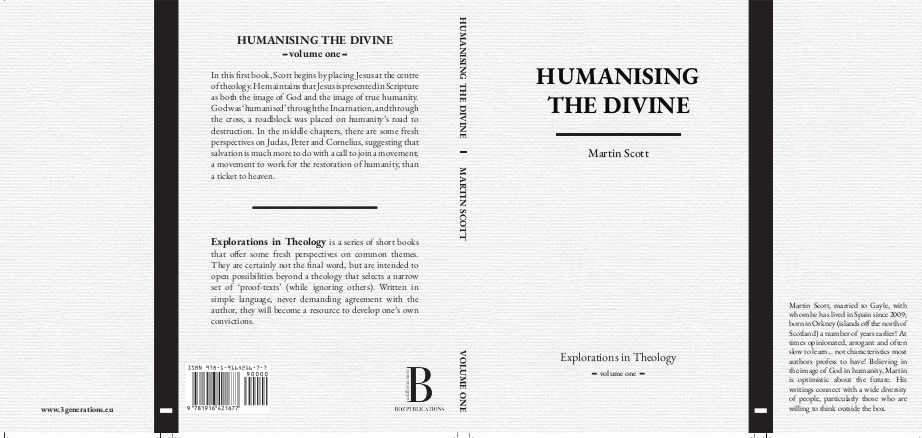
Many of you know that I have been working on a series of booklets – 3½ of an initial 6 are now written. The first one should roll out by early September, so a little advance note about what they are and what I hope to do with them.
Here is the blurb about the series:
Explorations in Theology, a series of short books that offer some fresh perspectives on common themes. They are certainly not the final word, but are intended to open possibilities beyond a theology that selects a narrow set of ‘proof-texts’ (while ignoring others). Written in simple language, never demanding agreement with the author, they will become a resource to develop one’s own convictions.
The first one is entitled ‘Humanising the Divine‘, here is the blurb:
In this first book in the series Scott begins by placing Jesus at the centre of theology. He maintains that Jesus is presented in Scripture as both the image of God and the image of true humanity. God was ‘humanised’ through the Incarnation, and through the cross a road block was placed on humanity’s road to destruction. In the middle chapters there are some fresh perspectives on Judas, Peter and Cornelius, suggesting that salvation is much more to do with a call to join the movement to work for the restoration of humanity, than a ticket to heaven.
They will be available in two formats: hardback print version and as an ebook that will be readable on most (if not all) ebook readers / tablets / phones.
I have run two zoom groups in the past months to try out the concept of what I plan to do, so I see three options:
The book in either format can be bought and read / or simply placed on the bookshelf (!).
The book can be bought and there will be a podcast on each of the chapters that will give a little bit of background behind some of the concepts, and suggest a few questions for reflection.
The book can be bought and one can opt to join a weekly zoom group (the first is not likely to start before October 1) where a chapter will be dialogued through each week. (This is what I have done with the two groups I mentioned above.)
[Once the first book is finally out I will give details of the above options – where to order etc.]
Also for those who have been on a zoom group they will be able to contribute to a forum for open discussion. Anyone will be able to read the discussion but only those who have zoomed will be able to contribute.
Who am I writing for?
Anyone… But I am looking to interact (zoom / forum) with people on a similar page. I am not for one minute suggesting I have the truth (as if!) and am not looking for those who will simply agree with me, but those who are willing to consider what I write, respond and then be able to disagree and come to their own conclusions. I am not looking for those who will quickly tweet ‘Goodbye Martin Scott’!!! (That last tweet was to a famous tweet from a famous person to a certain Rob Bell!) If someone of the Calvinist tradition wishes to read the book(s) and then review them they can feel free to do so on their own site – I have no objection to that, particularly as there will be enough in the pages to critique. There is no redemptive value in us trading blows – I am too fixed in my beliefs and ways for that to work and I think those of a deep Gospel Coalition perspective are too! So I am not looking for those who agree with me nor those who vehemently disagree!!!
Finally here is the bio attached to the books that will help position me and my (hoped for) interactors:
Martin Scott, married to Gayle, with whom he has lived in Spain since 2009; born in Orkney (islands off the north of Scotland) a number of years earlier! At times opinionated, arrogant and often slow to learn… not characteristics most authors profess to have! Believing in the image of God in humanity he is optimistic about the future. And his writings connect with a wide diversity of people, particularly those who are willing to think outside the box.
I see these books and the interactions as being a major focus for the next years / decade… so look forward to connecting with many of you.
Privilege. Most of us who read this blog are indeed among the privileged, certainly when we take in a global perspective. I appreciate though that we do not consciously live in a global environment but a local one – whether that be a geographic or social context, and so we often have a mixed experience where we are also disadvantaged in some ways. There were many privileged groups in the New Testament times, being a Roman citizen certainly set some apart as elite. It is though the shift of ‘status’ that took place through the Gospel that I am focusing on in this post.
This has come into fresh focus with some of the wider writing I am involved in and also as we have ‘zoomed’ into a situation where the predominant cultural view is that of male dominance, with Paul (and Jesus!) seen as favouring the male.
The great egalitarian text of Paul in one of his earliest pieces of writing is Gal. 3: 28:
There is neither Jew nor Greek, there is neither slave nor free, there is no male and female, for you are all one in Christ Jesus.
Written into the contentious situation where these non-Jewish converts were being subjected to the teaching that any follower of Jesus that was not in compliance to Jewish law was not a ‘full’ member of the community of God’s people.
This bit is strong!!
We even read of Paul confronting Peter face to face, and the strength of the conflict was very strong. There was a good (missiological) argument that had won Peter over. Those who came from James had a compelling argument: ‘how would they ever reach Jews back in the homeland if the Jewish followers of Jesus were fraternising and eating with Gentiles. For the sake of the Gospel you have to pull back, Peter.’ It does not get stronger than that, and if is or this reason I don’t think it was as simple as Peter was making a backward step but he felt compelled to take a compromising step for the sake of non-offence to the Jews, a step for the Gospel. That makes the conflict even stronger. The missiological argument could not overpower the fundamental Gospel one! (Think we have it hard trying to work out what is a godly redemptive compromise!) Back in the day, to be involved in a slave owning group who professed faith could have been argued for: a compromise for the sake of the Gospel… but eventually that compromise was not a compromise for the Gospel but a compromise of the Gospel. Deciding when that shift takes place takes wisdom and insight, and knowing what has changed in our society with respect to the Gospel likewise is very challenging.
Privilege… Either it feeds the demonic idea of elitism / above someone else; or it pushes us toward the ‘responsibility’ element. I consider that over centuries there was a downward trajectory in the life of Israel from the commissioned responsibility for sake of the nations to the elitism of chosenness. I have also been considering (of late) that maybe if we are of the ‘zionist’ bias (not one I can see in the NT at all) maybe there is also a knock on with regard to how we see the gender issue of male and female. Both seem to come from a way of reading Scripture that I find strange, but one I have to respect as I have no reason to suggest that those who read that way are not acting with integrity. I simply hope the reading is not being fuelled by any form of elitism.
With the household codes (the instructions on ‘husbands’, ‘wives’, ‘masters’, ‘slaves’, etc.) Paul follows the conventions of the day where philosophers and religious writers would lay out how their philosophy / religion would not at any level disturb the status quo of the Roman society. In our culture they are not too radical (understatement!!) but in that culture he carefully redefined them. He moved the dominant one from a position of ruling the roost to a place where they were to be an animated source of life.
There was an anonymous letter written to a person names ‘Diognetus’, mid 2nd Century, that suggested that Christians were to the world what the soul was to the body. They were to be present and animating. (The quote below is fairly long, the specific part I am referring to is in bold… so feel free to skip to that point… and apologies for the male language.)
Christians love all men, but all men persecute them. Condemned because they are not understood, they are put to death, but raised to life again. They live in poverty, but enrich many; they are totally destitute, but possess an abundance of everything. They suffer dishonour, but that is their glory. They are defamed, but vindicated. A blessing is their answer to abuse, deference their response to insult. For the good they do they receive the punishment of malefactors, but even then they rejoice, as though receiving the gift of life. They are attacked by the Jews as aliens, they are persecuted by the Greeks, yet no one can explain the reason for this hatred. Christians are indistinguishable from other men either by nationality, language or customs. They do not inhabit separate cities of their own, or speak a strange dialect, or follow some outlandish way of life. Their teaching is not based upon reveries inspired by the curiosity of men. Unlike some other people, they champion no purely human doctrine. With regard to dress, food and manner of life in general, they follow the customs of whatever city they happen to be living in, whether it is Greek or foreign. And yet there is something extraordinary about their lives. They live in their own countries as though they were only passing through. They play their full role as citizens, but labour under all the disabilities of aliens. Any country can be their homeland, but for them their homeland, wherever it may be, is a foreign country. Like others, they marry and have children, but they do not expose them. They share their meals, but not their wives. They live in the flesh, but they are not governed by the desires of the flesh. They pass their days upon earth, but they are citizens of heaven. Obedient to the laws, they yet live on a level that transcends the law. To speak in general terms, we may say that the Christian is to the world what the soul is to the body. As the soul is present in every part of the body, while remaining distinct from it, so Christians are found in all the cities of the world, but cannot be identified with the world. As the visible body contains the invisible soul, so Christians are seen living in the world, but their religious life remains unseen. The body hates the soul and wars against it, not because of any injury the soul has done it, but because of the restriction the soul places on its pleasures. Similarly, the world hates the Christians, not because they have done it any wrong, but because they are opposed to its enjoyments.
The explanation is somewhat hellenised, indicating how quickly there was a shift from a Jewish psychology to a Greek-oriented one, but nevertheless the description as an animating life-giving source is very clearly put.
In the Gospel the privilege of Jew over Greek was nullified (I count it all ‘dung’ said one very privileged Jew; the NT era Jews were basically given a generation to respond to Jesus etc.); the rich were always being slapped about – we do not read ‘woe to you poor!’ but we often read ‘woe to you rich’; and in the Gospel any male privilege that might be inferred from creation is totally cancelled. The Greek of Gal. 3:28 seems to deliberately use the same construction as we find in Genesis, but reversing it – no ‘male and female’.
No privilege, indeed we might suggest that there is a bias the other way because of the Gospel! And any privilege that society might give, or we find ourselves in is to promote life (the shift in Paul’s household codes), to work toward an egalitarianism with everyone finding true life, and a corresponding emptying out of the privilege. Privilege is to be temporal and can only be in order to move things in the direction of the new creation.
I am currently writing, my fingers getting a little worn out, but enjoying it a lot. I am on to ‘volume 3’ (though they are really ‘volumetes’ so don’t be overly impressed). My writing today coincided with my readings which took me to the Transfiguration stories. There Moses and Elijah (the law and the prophets?) came to meet Jesus and glory was revealed as they talked.
The part that stood out to me was in Luke 9: 31 where they talked of Jesus’ forthcoming Exodus in Jerusalem. The normal word for ‘The Exodus’ is used and I consider very deliberately. Then I thought – cos it lined up with what I am writing about, the ekklesia released / commissioned with the p-small ‘p’ political gospel that means the public sphere is where the good news that Jesus is Lord is to be outworked… an exodus where?
Back up. Original exodus was so that a people called by heaven (and in those designations the people were called an ekklesia, hence Moses was with the ekklesia in the wilderness (Acts 7)) could go to their destiny, to a land flowing with milk and honey. They could escape the place that supplied all their needs… but at a price. The imperial rule of Egypt. Fast forward some 1500 years (from one possible date for the exodus…) and the Exodus is now not in a ‘foreign’ land but in a land that has become foreign to the ways of God, overrun by all kinds of foreigners, or maybe better by one kind of foreigner, the ones who represent the power of Babylon!
An Exodus in Egypt so that there can be a departure.
Now an Exodus in Jerusalem, so that…
Yes I think so! So that there can be a departure to the always-desired destination. As Paul says in Romans 4:13, the descendents of Abraham are not defined by race but by faith (always was the case just radically more so post-cross), and that Abraham was promised not a land but the world (hokosmos).
The Exodus in Jerusalem was to free a people from all bondage. Nowhere was more in bondage than Jerusalem at the time of Jesus, hence he comes at the fullness of time. There is an Exodus and there is a departure. No lockdown in that city at that time!
In this little old lockdown era, that signals something much longer term for us all, along with countless thousands of others I have been discovering the world of zoom. Yesterday Brazil, today Germany and so it goes on daily. At the same time I have been writing, working on writing a book, or a series of booklets, not sure what to do with them yet, but one thought I have is of some form of publishing and then with a small group of doing a zoom chat on a chapter per week. So for all the millions who follow this blog put that at the back of your mind as ‘I would love to do that.’
I am trying to write material that would tackle some of the theological issues in a down to earth simple way, not so that I can gain converts to my incredible movement but to be a resource. I am sure that our goal in life is not to convert others to our viewpoint but to help stimulate people to develop their own convictions. Sadly so much of what we can access is predictable and simply re-enforcing the status quo. I think some simple theological principles might help equip us for wider engagement. Or so go my thoughts.
And before the Scripture quote (one I have been looking at in the context of the writing) how about this for a stupendous quote, regarding being inspired by the natural world:
The deep swirling grandeur of our gorgeous planet drifting through space on a mission to increase compassion and wisdom (Stephen Harding).
Moving on to the Scripture I was meditating on yesterday. In John 10: 47-53 we read of a behind the scenes meeting:
Then the chief priests and the Pharisees called a meeting of the Sanhedrin. “What are we accomplishing?” they asked. “Here is this man performing many signs. If we let him go on like this, everyone will believe in him, and then the Romans will come and take away both our temple and our nation.” Then one of them, named Caiaphas, who was high priest that year, spoke up, “You know nothing at all! You do not realise that it is better for you that one man die for the people than that the whole nation perish.” He did not say this on his own, but as high priest that year he prophesied that Jesus would die for the Jewish nation, and not only for that nation but also for the scattered children of God, to bring them together and make them one. So from that day on they plotted to take his life.
So much detail from the insider meeting. The corruption of the Jewish hierarchy, their collusion with Rome so that in the symbiotic relationship (you scratch my back and I will scratch yours) there was a recognition how everything could be sustained if they did not rock the boat. Jesus was rocking the boat and everything was being challenged, with a focus on the loss of the Temple. They decide Jesus has to be put to death to save the Temple. Ironically Jesus said ‘destroy this Temple and I will raise it in three days’, and he also said that within 40 years of his death the Temple the hierarchy cared about would be destroyed… wait for it… by the Romans. Irony, or irony?
The area that interested me in the text was that ‘Jesus would die for the Jewish nation (and not only…)’. We have focused our theology on ‘and not only…’ and in a very personal way – for the sins of the world = for my sins. However there is a huge theme in Scripture (or at least in the Pauline writings) of ‘the Jew first, then the Gentile’.
I think so much of our theology has been removed from the historical narrative of Scripture so much so that we have approached the Bible as if it was there as a book to develop systematic theology. Here is my illustration. We have a jigsaw puzzle, the biblical texts being the pieces. We know the finished product, the picture on the box (=my theology). I work my way through the pieces finding the ones that fit the picture, ignoring all along that are pieces in there that don’t fit the picture, they seem to belong to another puzzle. But we are convinced we have the right picture! So we proof-text (choose the bits that fit the picture) and ignore the non-proof texts. But the Bible is not a book of systematic theology it is a narrative. (Before moving on I simply need to state very humbly that I do have the correct picture and all texts irregardless of colour, shape or size fit my picture, but I state this humbly.)
In making a systematic theology we run in to the cross of Jesus and sadly often come down to some crude system that splits the Trinity. Jesus is definitely good, the one we call the Father… maybe some anger issues there? That is often the result of seeing the cross in a vertical way… God and humanity. (BTW I have written yesterday a chapter on the ‘wrath’ of God… appetite whetter there.)
If however we follow the biblical trajectory the cross is not primarily presented vertically but horizontally, it is set in a very exact time frame. If so then it needs to be explored what history is it bringing to an end, and what future is it opening up. No need to start with ‘God is angry’ and wrath can then fit in where I think it does elsewhere in Scripture, so we end up making a shift as the writer in Isaiah 53 did, from ‘we considered him smitten of God, BUT…’
Caiaphas prophesying said his death was for the nation. That is historical, that is horizontal, that is narratival, that is Jew first, then the Gentile. So the cross of Jesus answers an historical issue first. If we don’t start there I think our systematic theology will be squeezing the texts to fit with the courthouse dramas that came from the Reformation era not the narratival story of Jesus coming ‘to save his people from their sins’ (Matt. 1:21).
Well not really about to write about moodiness and certainly never going to get me to confess to any level of moodiness, but going much higher than that! It is so easy to read of ‘the wrath of God’ and picture a moody out of sorts older person who has just had enough. Grumpy and ready to lash out. Then add to that the picture of the cross and Jesus taking the anger that was coming our way.
We continue to have language such as ‘act of God’ for events that take place that we can’t really find someone to blame. Strong language, but also found to some extent within the pages of Scripture (Old Testament). At least on that there is something of a shift from Old to New. In the Old there is a more primitive view of God (did I write that? Yes and would defend that perspective!) with everything coming from God. We can see a shift within the pages of the Old Testament itself. In Kings God entices David to count the people and then well and truly slaps him down for doing it, whereas in Chronicles ‘Satan’ does the enticing. Amazing how theology can change over a few hundred years! (It could be argued that Satan is invented in the sense of discovered as the revelation of spiritual reality developed. The serpent in the garden = Satan is fundamentally a biblical reading back in to the situation.)
Jesus made comments about the theology of an ‘act of God’ when he referenced the tower that fell causing death.
Now there were some present at that time who told Jesus about the Galileans whose blood Pilate had mixed with their sacrifices. Jesus answered, “Do you think that these Galileans were worse sinners than all the other Galileans because they suffered this way? I tell you, no! But unless you repent, you too will all perish. Or those eighteen who died when the tower in Siloam fell on them – do you think they were more guilty than all the others living in Jerusalem? I tell you, no! But unless you repent, you too will all perish.” (Luke 13: 1-5).
Basically it was one of those things (an accident, or through human error in construction) but it was not judgement. And beyond that he calls for a repentance – probably in this setting calling Jews to follow a way of peace and the ways of God otherwise the future will be one of perishing at the hands of the Romans. (Probably to be read that way rather than ‘eternal perishing’ in this context.)
The current coronavirus is one of those things. Dis-ease is in the world and Scripture clearly puts that at our feet. The falls of creation flow from the fall of humanity.
I am just reading a book that has numerous wonderful insights in it. Two days ago I read a comment on John the Baptist, quoting John’s Gospel that the Baptist ‘was not the Light’. The greatest born of woman, one coming in the spirit and power of Elijah was not the Light. He stood within the Old Covenant era, having opened the door to the new. But where he stood meant he could point toward the Light, but not be the Light. Only Jesus is the Light, that enlightens everyone. Gladly we cannot read the Old Testament unless we read it through the New. God’s revelation is not essentially propositional truth (such ‘truth’ will approximate or point toward the Truth). God’s revelation is incarnational, and John nor any writer was the Light.
So back to the bad mood situation.
The wrath of God is being revealed from heaven against all the godlessness and wickedness of people, who suppress the truth by their wickedness (Rom. 1: 18).
Wrath is clearly referenced – but not wrath against people. Wrath against sin, wickedness. My reading today took me to Isaiah 53, I read again these familiar words:
We considered him punished by God, stricken by him, and afflicted. But he was pierced for our transgressions, he was crushed for our iniquities (Is. 53:4,5).
We had one viewpoint… probably because ‘we’ saw God primarily as a punisher, but – and there is a wonderful ‘but’ something was taking place that is hard to theologise without distorting who God is, it was ‘for’ us.
‘Sin in the hands of an angry God’ would make a good title for a sermon. God is heaven-bent on destroying all that is destructive, and we need to understand this. Otherwise we can live in fear, from legalism, or conversely be over-familiar with someone we don’t even know.
Yes there are some real hard Scriptures and themes. Maybe we don’t get it right, but we certainly cannot transfer our understanding of (fallen) human emotions on to God.