Leviticus… just read!

OK… so I don’t really enjoy reading Leviticus. Plain hard work and tedious, but that’s where I am at the mo. Laws, laws and more laws. Obscure laws – don’t plant two types of seed in the field; don’t wear clothing made of two types of material. Really?

OT law was essentially unitary. Previous attempts to divide them down into ‘moral’, ‘ceremonial’ and ‘judicial / civil’ might be semi-helpful, but in reality the law was one. Debate might be over, as Jesus was asked, what is the greatest commandment, but they were all commandments, and as such marked out the people from other peoples. They were the boundary lines that marked the people, and the contrast is not between law and grace, but between law and Spirit for the followers of Christ. ‘These are the children of God – the ones led by the Spirit’, was a Pauline perspective, in contrast to how one knew that the person was a practising Jew – they were the ones led by the law. (Anyway my simplistic take.)

In Leviticus there are some tough old laws that either seem to have no significance for us, or back up patriarchy (a woman is unclean for 7 days after the birth of a male, but 14 days after giving birth to a female child), or ownership of another (a man sleeping with a betrothed female slave has to make some reparations but basically gets away with the abuse).

There are however some crackers in there. How we move from OT to New on issues of law is pretty difficult. Neither the ‘all apply except for those rescinded’ or ‘none apply except for those re-worked’ both fall down the large gap inherent within either approach. Something like – ‘all have to be taken seriously, but none applied directly without coming through the cross’ seems the only way. So back to the crackers (if reading in a second language, ‘really good ones’!)

Do not maximise profits

I am certainly not a communist – the state is god!!! OH no. Neither am I a neo-liberal with the ‘invisible hand of the market’ being the controlling principality. There has to be scope for entrepreneurship and gifting but the controlling element cannot be that of maximising profits. Indeed this is expressly forbidden:

When you reap the harvest of your land, do not reap to the very edges of your field or gather the gleanings of your harvest. Do not go over your vineyard a second times or pick up the grapes that have fallen. Leave them for the poor and the foreigner. I am the Lord your God (Lev. 19: 9, 10).

So we have a field, but the context is of stewardship, not ownership. We love Paul’s words ‘owning nothing but possessing everything’. We, though have to think in reverse. Here Gayle and I own almost everything, so how do we live so that we own everything but possess nothing, or at least make it easy for others to possess what we own. (We do try and outwork this…)

A very generous immigration policy / commandment

A second cracking law I read this morning comes a few verses later:

When a foreigner resides among you in your land, do not mistreat them. The foreigner residing among you must be treated as your native-born. Love them as yourself, for you were foreigners in Egypt. I am the Lord your God (Lev. 19:33).

Maybe not easy to apply as a straight line into all immigration policies, but certainly does not allow us to suggest the godly thing to do is to go out of our way to have legislation that marginalises them. (I write of course with vested interest, being a first generation immigrant.)

Love them as yourself – ring any bells? A foreigner as our neighbour. Now that would make for an interesting immigration policy.

We were, probably pretty much all of us, foreigners at one time or another, and that is one of the points the law makes. Maybe our ancestors moved when it was easier to find space in the land they emigrated to, how much more then should there be a leaning toward generosity to those who are emigrating in a harsher climate today.

The ‘foreigner’ is expected to live in such a way that they make a contribution to the land – that comes through in other verses, but how easy is that in today’s climate? Opportunities for education, training, access of health care…

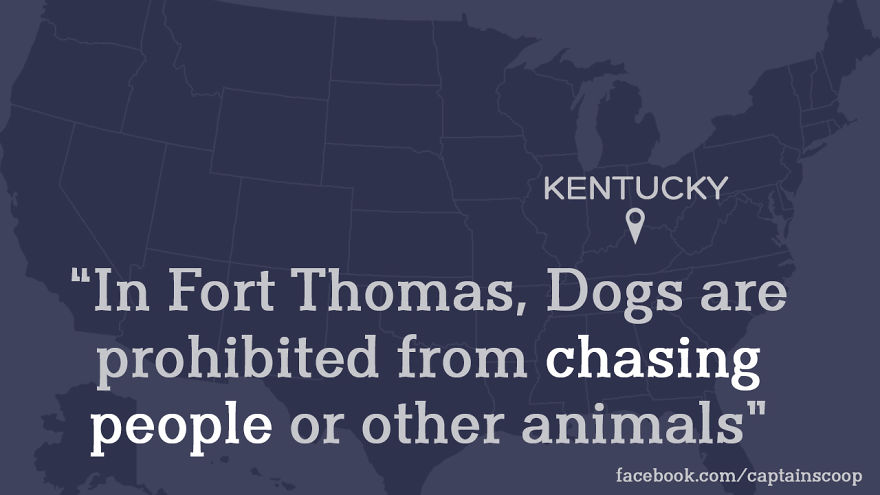
Maybe Leviticus is just a bit more of a resource than I thought. (Or if you would rather just have a little light entertainment check out these laws:

https://www.boredpanda.com/stupid-funny-laws-united-states-captain-scoop/?utm_source=google&utm_medium=organic&utm_campaign=organic

Be engaged

In considering that the apostolic gospel is political I consider that such a long-term vision challenges:

  • Party allegiance. We might be aligned to a particular party, but we cannot be bought. There is no party that is perfect, no party that is Christian. The critique of the Gospel is that we have all fallen short of the glory of God. All parties and all systems certainly have! In a given situation we might always put our vote somewhere specific, the guiding choice has to be how redemptive we consider the vote is, how beneficial to a healthy, relational and equitable society the direction that party would move us in.
  • The apostolic vision is one that looks long term, and resists simple short term action that is justified by the outcome. Although in a time of crisis short term responses are always necessary. If a house is on fire we need to get the people out rather than leave them there while debating the best building materials to employ.
  • It challenges strongly the belief that change can only take place from the top, indeed I suggest that the apostolic Gospel suggests it rarely takes place from the top.
  • Challenging the idea that we have to be in power to be effective, it raises an interesting issue. Maybe (if there was such a thing!!) a Christian party would be best placed not in power. That is a challenge to the voter – vote for us, we do not aim to be in power! However bizarre that might sound the apostolic vision is a challenge to the power dynamic, and to the hope that someone elected will do it for us. Servanthood and a denial of vested interest has to be promoted and the empowerment of the grass roots, rather than power and an unconnected representative body.

An apostolic vision also recognises that:

  • Almost certainly with any party that we vote for, there will be policies that they endorse that we do not agree with. There is necessary compromise along the way. If God ‘allows’ we most certainly cannot legislate. The compromises that God is pleased with are the redemptive ones, the ones that might not be perfect but move it to a better place.
  • We also have to consider what are personal values and what are public ones. I might have a personal value that comes from following Jesus, but do not believe such a value should be imposed on society.
  • That our hands are not clean. We are all implicated in the system of destruction. The issue is that we are not clean, but in not being clean we do not have to be dirty. Our choices, our life-style has to be set through redemptive, though compromised, decisions.
  • That God works not to give people a guilt complex so that they might find him, but gives them a shape, a set of boundaries, within which they can find him. We likewise should not look to off-load righteous legislation but create a shape where people can prosper. All legislation should be redemptively creating shapes where people can best develop who they are. Sin is to not be the person I can be: a person in my skin representing the character, persistence and love of God. Sin is not avoiding through legislation a set of predetermined evils.

There are troubled areas for believers that often swing their vote. But as we cannot legislate in an absolute fashion we come back to the dirty world and the compromises that are required.

Abortion is often the single issue politics that determines the ‘Christian’ vote. Yet the issue is multi-faceted and the factors that surround it are complex, certainly including education and economics. It also sits on a spectrum of pro-life issues. What our response is to the current and pressing crisis related to climate change and global warming. Every response to this issue is a pro-life choice, ultimately determining who will live or not. Abortion and abuse of the climate are connected to the future of the unborn, and to those already born.

We could add xenophobia (and nationalism) likewise as they sit on that same spectrum. They are all positions that reflect on who we wish to prosper / live. The death of Jesus as a privileged male and a compromised Jew was for all, regardless of faith, gender and national identity.

The vote for a believer is indeed a challenge. We cannot simply vote along party lines. Also we do not carry a vision of getting our person to the top (the word of God came to John in the wilderness). We can though be governmental and help create a shape that pushes back the powers that control so that those who are equipped can come through to occupy in a humble spirit positions that are there. I consider that we are here to create and hold a shape.

In creating a shape – lifestyle, relationships, prayer, action… there are also those who we will partner with. Theologically we cannot simply partner with those who profess faith. Paul had friends who had a lot to lose, as far as wealth and status was concerned, on the basis of his vision, but were committed to be with him and support him. They had not recognised Jesus in the sense of at the level of personal allegiance to him, but they were simply convinced that Paul carried a vision for the future of this world. That vision was not one that was compatible with the structures as they were currently defended in his imperial world.

Who do we partner with? On a spectrum we are at times tempted to place, for example, atheists at the opposite end to that of Christians. I suggest we need to think again. There are atheists who are anti-God and there are atheists who do not believe in god. I too do not believe in god. I share my non-belief with a number of ‘good’ atheists. We have that in common, even if they do not share my belief in God.

More often than not there are those who are believing in a false god who are at the other end of the spectrum of those we can work with. Some of those might use our language, but fill it with other meaning. ‘God’, ‘Jesus’, ‘the cross’ are words – the meaning we fill them with is what is important. There might be those who are ‘Christians’ that we cannot partner with, how they understand the cross (by this sign we conquer) might be in such a strong contrast to how we understand it (the instrument that we carry daily for our own death) that we cannot partner with them. Our connections might be those who do not believe in god.

Theologically we have hope and vision for this life… and beyond. And as eschatologically the age to come is shaped from this one we cannot not work in this age. Our political involvement at whatever level, whether fruit is seen now or not, is vital. It can produce fruit now, and even if it fail will become seed for the age to come. (Again I applaud where an atheist who has no belief in an age to come in which they will participate is committed to work for a better future. If they can how much more should I be willing to do so.)

Disruptiveness has to be part of the political involvement. Particularly given how privileged we are. Most of us do not have the context of the threat against our lives, and in that context Paul even gave a voice of caution. That is not our context so we have responsibility for those who are threatened. The current Extinction Rebellion is making a very real impact. People are willing to be arrested for their beliefs. Yet the resistance is overwhelmingly white. In our cultures a non-white person is rightly cautious about being arrested. This does not negate the movement, but we must be slow to pat ourselves on the back when our protest is a privileged one.

Practically drawing on the work of Roger Mitchell he suggests that from the life, teachings and example of Jesus there are 9 areas that should prioritise our energies and commitments. The notes below are mine, so I hope I do not misrepresent.

The making space for the feminine. Given that cultures, structures and societies have been formed by men and the masculine, holding space for a feminine voice and creative response is vital. The lock up in Cataluña is an example of this. The age old conflict is in lock up because of power. No one can back down. A person such as Ada Colau, the mayoress, is not weak, indeed has to have more strength than those who resort to power and endorse violence. She is also a good example of who we have to take care of by taking responsibility to hold back the powers that seek to ‘steal, kill and destroy’. There are those who can speak to this much more than I can. There are some males who probably can, but the best we (males) can normally do is to be silent but hold space so that the voice of the feminine woman is heard.

The prioritizing of children, to whom the kingdom belongs. To reduce the future for the unborn to the issue of abortion is simplistic and wrong. Jesus prioritised children. Health care and education are two aspects, for sure that come to the top of the list when making space for the future, as are the issues mentioned above when touching on abortion.

Advocating for the poor. This moves beyond the patronising of doing things for those less privileged, to doing it with them. We cannot be those who do things to the poor, sometimes we might only be able to do things for them as it can be hypocritical to assume we are ‘with’ those who find themselves economically marginalised. These issues hit home. We can demonise the top 1% and immediately baptise the next 4% as being OK simply because that is where we find ourselves.

Care for the creation. This is God’s world and it is our habitat, and the habitat of those who are yet to live. The original habitat was in order to create an environment where God could be at home. Planting trees could be our greatest contribution to the future. The tree biblically is what bridges the arts and practical sustenance – maybe this could be a factor in why humans are described as trees?

Freeing prisoners. Of course we spiritualise the words of Jesus who came to set the prisoner free. Yet there are prisoners at all levels in society, as all systems will imprison. There are no simple answers, but the level of imprisonment in certain Western world countries indicates something is desperately wrong. Restorative justice aligns to Scripture in a way that punitive justice does not.

Promoting health. Jesus healed and did good. Healing is multi-faceted, and each political response is a sign of who God is. I find it hard to see how health is a privilege that can only be offered to the wealthy, and not at some very real level a responsibility to provide for as many as possible. We live as aliens in Spain but have stood against private health insurance. Maybe in some situations that might be necessary, but our approach to health care is shaped by our beliefs in the Gospel.

Confronting the powers. This is one I like a lot! Confrontation is not simply to put something in its place but to give an opportunity for the person representing that power to act humanly.

Making peace. Blessed are… We live in a fractured society that has its divisions. Divides so often because a voice that comes from a different experience and perspective is so often not heard, other than in that particular circle. We can allow voices to be heard, that is the only way that we will hep people move forward without the felt need to shout, or the reaction through intimidation or inferiority to be silent. At a very small level Gayle and I had a good experience in having someone stay with us who took a different stance on the Brexit issue and a different take on money. We were enriched.

Publicizing the good news of peace. Politics and faith do mix! We can at al times be ready to give a reason for the hope that is within us. How and what we share has to be shaped by the love of Jesus. This too cannot be ‘top-down’.

Until he come (parousia) we work, relate, disrupt and proclaim (ekklesia). What we do now will, if done in line with the patient apostolic vision of lives laid down in love for the world, will come through the fire. Are we politically involved. For sure, with a small ‘p’ or a large one. Everything we do is about shaping the future, the future here and now and the future then. The small responses we make are so vital. They too are political.

Terminology speaks

The Imperial world of the NT gave the Gospel an inevitable conflict politically. There was a vision of transformation within it. The terminologies were so in your face:

  • Son of god
    The common and official title of Augustus Caesar in Greek documents was ‘Emperor Caesar Augustus, son of god’. An inscription from Pergamum refers to Augustus as ‘The Emperor Caesar, son of god, Augustus, ruler of all land and sea’.
    Caesar’s did not claim to be god but were seen as invested with the divine and to such an extent that each subsequent ruler was termed ‘the son of the divine (previous) Caesar’.
  • Peace through his blood who did not resist, or through the blood of those who resisted.
  • Who is ‘lord and saviour’ and ‘king of kings? And this came with the further question of how is that lordship and kingship defined, and outworked. Jesus is not simply the alternative Caesar, one who also acts in the same way! Power, top down; or love with empowerment beyond.
  • The word euangelion (Good news) was used in ancient Greece of the public announcement of good news. It was used of a public declaration of a military victory or public policy. In the Roman world it was used whenever there was a royal ascension to the throne. The good news of Caesar Augustus the son of the divine Caesar. (Augustus, being the successor to Julius Caesar.)
    When the apostolic band came to a Roman city and came with a gospel message the expectation was of a proclamation concerning the activity of an emperor. The person in the street was not pinning their ears back with an expectation of a three point sermon but of representatives of the government to proclaim good news. Government representatives they most certainly were!
  • Paul taught about the ‘kingdom (basileia) of God’, the very term used by Rome of their basileia (empire) of Rome, basileia being the Greek term and the vast majority of the world where Paul travelled was Greek speaking.
  • Then the term ekklesia (church) was loaded with political implications. We have a very challenging question to answer when we ask what was in Paul’s mind when he was planting and encouraging ekklesias in city after city? Each Roman city already had an ekklesia – the political assembly that was the means to shape the future of the city. Each significant city had a Roman assembly… and here comes Paul planting a heavenly assembly, an assembly of Jesus Christ. I have no doubt that the very name ‘ekklesia‘ suggested that this assembly was the representative of Jesus called to shape the future of the city.
    We have to ask what was Paul, for example, teaching on a daily basis in the hall of Tyranus in Ephesus. I consider it had a strong political message, so strong that the rulers of Asia (Asiarchs) became friends with Paul without ever responding to the ‘pray the sinners prayer now’ part that we assume was his message. They could not, or would not, get that part but so got the other part that they wanted to preserve his life. So different to the Jewish leaders who wanted to extinguish the life of Jesus to preserve the nation and Temple!
  • We pray till he come, we anticipate his parousia. Cities longed for the parousia of the emperor, the royal visit. Great blessing would come to the city, areas where they were struggling to see Roman culture expressed would receive such a boost. With the simplicity of the common meal those early disciples proclaimed his death until his parousia.

The political apostolic Gospel

The marks of an apostle were with Paul. He mentions signs and wonders and miracles, yet Jesus had said that there would be those with signs, wonders and miracles that he would distance himself from. Paul says that the miracles were accompanied with ‘great patience‘. An apostolic vision works today for the long term. At the heart of it is a conviction that a death by one is a death for all; a death in one place is for all geographies; a death at one time for all time. The apostolic carries a long-term vision of transformation of God’s world. A political vision that is not looking simply for short term fixes but long term healing. In that there will be great gains, and if the ground is not held great losses.

Jerusalem to Rome

Jesus and Jerusalem

The Jewish Court had decided that Jesus would have to be dispensed with in order to preserve the nation and Temple. However, by the time of Jesus both Temple and nation (as a whole) were not fulfilling the purposes of heaven. Even the Temple was no longer a house of prayer for the nations, hence its future could only be where ‘not one stone would remain upon another’. If the Temple no longer served a redemptive purpose there was no hope for the city nor for the nation. Nation and Temple could not be saved, yet a living ‘temple’ and a ‘holy nation’ for the nations could find salvation. Salvation from the coming destruction and salvation for the nations. Jesus came at the fullness of times, born human and specifically as a Jew. His focus took the message of John the Baptist to a new level. Religion, and in particular compromised religion would never fulfil the political task of being a light to the nations.

The task in Jerusalem indeed brought to a finish the work that the Father gave Jesus to do; yet it also marked an important pause in what he came to do. It was both the finish and also simply the beginning of what he did and taught. Given that framework to the book of Acts that Luke says right at the outset, the work of Jesus is not finished, but continues through the book of Acts with the apostolic work and context. No longer a focus on Jerusalem but on the Imperial world of Rome. If we thought that Jesus’ message was religious with no political implication we soon have to reframe his message. It was deeply spiritual, deeply concerned about our response to who God is as that core shapes and directs the whole political approach to the nations.

The end of Luke and beginning of Acts gives us the biblical focus that Jesus gave to the Jewish disciples. That focus was through Scriptural understanding concerning himself, the suffering he was to endure and the nature of the kingdom of God.

And beginning with Moses and all the Prophets, he explained to them what was said in all the Scriptures concerning himself (Lk. 24: 27).
This is what I told you while I was still with you: Everything must be fulfilled that is written about me in the Law of Moses, the Prophets and the Psalms (Lk. 24: 47).
After his suffering, he presented himself to them and gave many convincing proofs that he was alive. He appeared to them over a period of forty days and spoke about the kingdom of God (Acts 1: 3).

All of that had a focus on Jerusalem. From the wilderness with John came a movement that arrowed in on Jerusalem. But by the end of Acts the focus is not Jerusalem but Rome. Paul has completed his task but the apostolic task remains unfinished. We have no idea if he left the prison situation in Rome and continued on his way. We don’t even know (from Acts) if he died in Rome. Seems to me significant. It is unimportant if he got beyond Rome, and his death is not vital for us. It is important that in understanding the message deposited in Rome that we get to all places beyond ‘Rome’ and that we find where we are to live out the Gospel.

By the end of Acts Rome is the focus

Luke states that Acts is a record of what Jesus is continuing to do and to teach. His work from birth to ascension was the beginning of his work. That took him to Jerusalem. Paul takes it to Rome. If Jesus’ work was unfinished, so then is Paul’s and what he represented – the work of the apostolic Gospel to the nations.

There is such a significant turning point in Paul’s journey and such a focus on where the message of the Gospel is to travel to in Acts 25:

Paul answered: “I am now standing before Caesar’s court, where I ought to be tried. I have not done any wrong to the Jews, as you yourself know very well. If, however, I am guilty of doing anything deserving death, I do not refuse to die. But if the charges brought against me by these Jews are not true, no one has the right to hand me over to them. I appeal to Caesar!”
After Festus had conferred with his council, he declared: “You have appealed to Caesar. To Caesar you will go!” (Acts 25:10-12).

It was the Jewish court for Jesus, but not for Paul. Jesus was focused to get to Jerusalem but Paul wanted to get to Rome, the political centre, so that he could get to Spain – the ends of the earth (Rom. 15: 28). His journey to the ends of the earth would take place through the centre of earthly power. His desire to come to Rome was to proclaim to them (the believers) the Gospel. He is not looking to hold an evangelistic crusade, but to align the believers there with the Gospel. At the end of Acts we read:

They arranged to meet Paul on a certain day, and came in even larger numbers to the place where he was staying. He witnessed to them from morning till evening, explaining about the kingdom of God, and from the Law of Moses and from the Prophets he tried to persuade them about Jesus (Acts 28: 23).

The same work as Jesus did in Jerusalem so Paul did in Rome. Scriptures, and kingdom of God. The Gospel that had implications for Jerusalem now had implications for Rome.

The world of the New Testament

The one time we have had an-all but one world government was the world of the New Testament. Rome’s rule extended beyond anything that had gone before. It is for this reason that I see no reason to posit a future one-world government, nor a global antiChrist. We have had that, and in true Babylonian fashion it was never absolute for Babel will be forever unfinished. I do not look for that future reality, but through the book of Revelation consider we can have our eyes open to the reality of it around us now. There is a one-world government, there are antiChrists, the call of Jesus has implications economically for there will always be restrictions on the extent to which we can buy and sell.

The Roman world was the empire of its day. For the Jews the big ‘monster’ was Babylon and Babylon continued to represent the enemy of Israel symbolically. Likewise Rome. The empire of the day and the ongoing symbol for that one-world opposition to the kingdom of God.

The Pax Romana

In true Imperial fashion Rome conquered and offered a way of life beyond anything that had gone before. The Pax Romana was across the world – a peace that came through the power of the sword. Comply and be blessed; resist and be eliminated! (And Paul’s words about the powers being appointed by God and can wield the sword is so tongue in cheek given Nero’s claim that he did not need to raise the sword. What a man of peace Nero was… NOT!)

Peace in the imperial world was considered such an achievement that the one who brought that was seen to be operating with divine power. It further pointed toward the divine nature of the emperor.

Peace was not the absence of war but was the result of war. Peace meant being in submission to Rome. Peace was imposed on the subjugated by means of force. Peace was brought about by taking lives and creating inequality. The Pax Romana!

As is often the case the reality is there to be seen if we are willing to look. The altar of peace stood on Mars Hill, the hill dedicated to the the god of war! Peace was brought about by war to the Romans.

The contrast to the message of Jesus where he established peace through sacrifice, not through killing his enemies. It was love for the enemy that was exhibited at the cross, thus all powers were stripped bear and exposed. The lie exposed.

Caesar was indeed ‘lord and saviour’ and ‘king of kings’

In secular Greek, the word ‘saviour’ was attributed to someone who had done something significant that safeguarded the people or preserved what was precious. That person ‘saved’ the city and as a result could earn a person the title of saviour. Not surprisingly the title of saviour was in common use for the Roman emperor, especially denoting his ability to maintain or restore peace in the empire.

Of Julius Caesar it was written:

In addition to these remarkable privileges they named him father of his country, stamped this title on the coinage, voted to celebrate his birthday by public sacrifice, ordered that he should have a statue in the cities and in all the temples of Rome, and they set up two also on the rostra, one representing him as the saviour of the citizens and the other as the deliverer of the city from siege, and wearing the crowns customary for such achievements (Dio 44.4.5).

Likewise in connection to Augustus:

Whereas the Providence which has guided our whole existence and which has shown such care and liberality, has brought our life to the peak of perfection in giving to us Augustus Caesar, whom it filled with virtue for the welfare of mankind, and who, being sent to us and to our descendants as a saviour, has put an end to war and has set all things in order. (Priene calendar inscription; 9 B.C.).

The emperor was often called ‘the saviour of the world’ or ‘the saviour of the inhabited earth’.

It is not surprising that on hearing the apostolic message it was heard politically and understood to be a rebellious one at that. These apostles were proclaiming a rival to Caesar.

The message was political. It might have been possible to miss the deeply spiritual element within it! Yet there is a deep spirituality, a radical relationship to heaven that was contained within it. From that commitment to the God of heaven (the ‘foreign’ God of the Jews) this message called for a political way of life and carried a political message for the nations.

If Caesar is not lord, but Jesus; if he is not the saviour of the world, but Jesus; if he is not king of kings, but Jesus. We have a clash. The Christian message could be ignored, sidelined, or controlled. But what Jesus began till the days of his Ascension, and Paul’s ministry symbolised by centring in on the centre, has and will continue ‘until he comes’. That being another imperial term…

Begins with the wilderness

From the wilderness there is a journey to Jerusalem

The word of God that came to John in the wilderness does not remain there. It does not begin as a ‘top down’ movement and does not proceed in that way, but for sure there is a challenge to the top. Jesus spent most of his time away from the centre. Although it was hard to stay hidden he did not pursue a journey that promoted his own visibility, but when the time comes he sets out with purpose to Jerusalem:

As the time approached for him to be taken up to heaven, Jesus resolutely set out for Jerusalem (Lk. 9:51).

In any case, I must press on today and tomorrow and the next day—for surely no prophet can die outside Jerusalem! (Lk. 13: 33).

Jerusalem is the centre for faith, but it is compromised. Compromised with political power. The High priestly family is one of the richest in Jerusalem. Religion and politics not mixing? So often they mix when there is a symbiotic relationship. Religion getting privileges from the political arena and politics getting the support of religion so as the status quo is maintained. In the midst of this compromised relationship the Jewish hierarchy are not only willing, but keen, to sacrifice Jesus so that the nation has a future and the Romans do not take away their Temple. The Jewish court was the place where it was declared:

If we let him go on like this, everyone will believe in him, and then the Romans will come and take away both our temple and our nation.
Then one of them, named Caiaphas, who was high priest that year, spoke up, “You know nothing at all!  You do not realize that it is better for you that one man die for the people than that the whole nation perish.” (John 13: 48-50).

Jesus was ultimately judged by the Jewish court and handed over to the Romans, so that the Jewish system could continue! Together, religious and political power bonded together in economic transaction, crucified Jesus. Ironically it was the Romans a generation later that took away the Temple and nation. His death did indeed save them and the Temple, but not as they thought. He gave them a path of salvation so that they might not be as one of the nations, and the ‘true temple’, one not built by hands might emerge. In this context we can read

Salvation is found in no one else, for there is no other name under heaven given to humanity by which we must be saved (Acts 4:12).

Peter and John are addressing the Jewish ‘rulers and elders’, quoting Scripture about the rejected stone becoming the cornerstone (of the Temple), this is not a universal Scripture concerning salvation, but in its context a Scripture about the path of ‘salvation’ that comes through Jesus for the nation of Israel – and salvation from the coming troubles that Jesus prophesied would come within a generation. Salvation, amidst the destruction of Temple and dispersion of the nation, was promised through their Messiah, and the focus is not on salvation in the ‘beyond this life’ setting but salvation to be who they were meant to be in a ‘this life’ setting, the setting of the imperial and political world. All who are in Jesus will be saved. Saved from the Roman onslaught, saved from being focused on a building in Jerusalem, and saved from being a member of a nation that had so become one of the nations. Saved to be a living stone in temple not built with hands and saved to be part of a holy nation, a royal priesthood, aliens throughout the nations.

In hoping to find continued safety the religious powers to preserve their status were willing to sacrifice Jesus; conversely Jesus was willing to sacrifice himself to save the nation, but not as a compromised through wrong-political-alliance-nation. The Jewish elders were able to justify the ultimate exercise of power and control (taking life) to preserve themselves and who they were – the chosen people. Change if need be, for them, will come via that level of ultimate control. Jesus though takes the path of laying down his life to effect change. Change will come through death, not change through killing.

His travel to Jerusalem was to break the hold of compromised religion, for then there is real hope for transformation beyond. There is a process. The faith community must be set free from wrong political alliance and dependency. Religion is a parody of real faith so that has to be broken, and as Jerusalem was the centre for that, to Jerusalem Jesus travels. The first step is that the Prophet has to die in Jerusalem. In the same way as religion is a parody of true faith so the wider world of the Roman empire (as per all empires) was a parody of the rule of God among people. Not surprisingly the focus shifts from Jerusalem to Rome. The era of the prophets dying in Jerusalem is over. Rome is where they will live… and die.

Loss of privileges

Most of us at a personal level have been frustrated that we have not had a voice. Sometimes we have a voice but the negative feeling is as simple as others have not agreed with us! On the wider front this has been the feeling about the lack of voice (being listened to / agreed with) from within the church as far as the political world is concerned. My strong guess is that the church is not alone in this feeling and there are many marginalised groups that must feel similar. I think though it is compounded by a sense of privilege, for after all ‘we are a Christian country’.

The cry of ‘we are losing our influence’ was (my perspective) one of the main reasons in the USA for the rise of the ‘moral majority’ and to provoke a heavy investment into the sphere of politics, with the majority of the moral majority coming to endorse the Republican party, the party of (supposed) small government and pro-life (or supposed pro-life). It probably awakened a realisation that following Christ and politics are not in two separated realms. Following Christ has a personal element to it, but faith does not mean that the public arena is irrelevant, indeed personal faith becomes another factor that provokes an even greater focus on the public arena at a different level.

In many circles where there has been an emphasis on transformation a theology has developed such as the seven mountains of influence, where society is seen as consisting of mountains such as politics, media, the arts, etc., and to influence those areas for Christ there is the realisation that the top 3% within those realms are the shapers, therefore it is essential to either become those top 3% or to influence them for Christ. This is both a theological and pragmatic approach, and owes much to the thinking of Abraham Kuyper, prime minister of Holland from 1901-05. There is a theology behind it that the Lordship of Christ and claims of Christ extend to every area of society, and there is a pragmatism that looks at how to bring about change in line with the claims of Jesus. The final outcome might not look too different to that of Sharia law! In this approach something that needs to be critiqued is that of power, of how the influence of Jesus is expressed and how much a shaping from the top-down is in line with the cross of Jesus.

Christendom where the privileges offered to the church (bishops in the house of lords, royalty crowned and anointed by the church), and the idea of living in a Christian country is coming to an end. The demise of the so-called Christian west is not necessarily the demise of Christian faith, indeed it should prove to be the fertile ground for faith that resembles more closely the faith witnessed to by the New Testament, a faith that was political.

A note on the word ‘political’. It comes from the Greek polis (city) so carried the sense of being involved to shape the future of the city. It developed semi-democratically where the ekklesia (church) was formed of the mature and free males who could vote on issues.

The Bible, Israel and politics

Israel was called to be a light to the nations. Called for the nations, not to convert them, but so they might find their way. Israel, shaped by law, and that law was predominantly social hence it shaped their community life. (Convenient as it might be to distinguish the ceremonial and judicial aspects from the moral law, this was not in line with how it was given nor received. The law was law as a whole. To be disobedient in one aspect was to be disobedient.) The law placed limits on behaviour and curbed excesses, particularly in the economic realm. The 8th Century prophetic movements were huge critiquing voices against economic exploitation. The maximisation of profits was illegal, care for the ‘widow, orphan and alien’ was a regular reminder brought to Israel. The law was unique to Israel, they alone were to be not as the other nations, with Jewishness less defined by race than by faith. Unique in the world, but in existence for the world. They were elect not in the sense of ‘saved’ but in the sense of uniquely set apart for the sake of others. Their politics was clear, Torah defining that, and as a guide they were to provoke and facilitate the nations finding their own way, their own politics. (By this I am not suggesting that they were not going to be evangelising, proclaiming the news that there is one true God who sets the prisoners free; simply I am focusing here on Israel was a unique theocracy.)

It should be no great surprise that the NT flows from that understanding of what it meant to be unique and therefore it is no surprise that the early impact of their faith in the liberating God was visibly seen relationally in the economics of the community. The early response in Acts, post-Pentecost can be understood as a Holy Spirit response to the requirement of jubilee, something that it seems Israel were never able to fulfil. Living as aliens in an imperial world the the self-identity as royal priests within their geographical setting was deeply appropriate. Living, as Israel had done before them, as a light to the nations, it is not surprising that there is a huge political element to the NT, and that the final book is still, after 2000 years, the highest critique of power, institutionalism, economic policy and international trade relationships.

Church (ekklesia) as community and as movement

I have written before about there being two sociological ends of a spectrum when looking at healthy groups. At one end of that spectrum the existence of the group is focused in on being there for one another, so that in the interaction each person is encouraged and healing brought to them to be a continually improving version of themselves. That ‘community-focused’ perspective is present in the NT – encourage one another, admonish one another, love one another etc. The other end of the spectrum is around what is understood as a movement. A movement is part of a wider community but the movement is formed around a world view that the wider world does not share. A good example would be that of the civil rights movement, Martin Luther King’s ‘I have a dream’ speech epitomising the world view that was their vision – a world of equality. That was why they were together, not primarily to see healing come to one another, but to see a transformation of the world around them. They are ‘mission-focused’. My bias is mission-focused – and I believe the raison d’etre for the church in the NT is that of mission-focused, for the nations.

Post Christendom – a challenge to transformation by power

One of the biblical issues we face is that God works in and through all forms of less-than-good structures. A pertinent example is that of the king in Israel. The request for a king was a rejection of God, yet God anointed the one who symbolised the rejection of God.

We cannot justify something because God has used it. In the days of the British Empire there was the twinning of expansion, colonialism and missionary enterprise.

The church has been complicit in believing change comes through enforcing it, indeed the church has strengthened that way of acting, thus empowering the government to act in such a way, particularly when it enabled Christian privileges to be maintained. In a post-Christendom space there is opportunity to see powers disempowered, but this will only come about by an embracing of true servanthood.

In the fifteenth year of the reign of Tiberius Caesar – when Pontius Pilate was governor of Judea, Herod tetrarch of Galilee, his brother Philip tetrarch of Iturea and Traconitis, and Lysanias tetrarch of Abilene – during the high-priesthood of Annas and Caiaphas, the word of God came to John son of Zechariah in the wilderness (Lk. 3: 1,2). 

Change did not take place by replacing the rulers with Christian rulers, nor by converting those rulers. Rather the word of the Lord was embraced in the wilderness, those who came were submitting themselves to be part of a movement. There is a repeat of Israel’s history, formed in the wilderness, receiving the law in the wilderness, crossing the waters of the Jordan. A movement for the world. This is a new beginning, children of Abraham who God could raise up from stones… race will prove not to be the issue, but faith.

And the process of change did not begin from a ‘top-down’ position. And from that beginning the process did not become a top-down movement.

Loss of privileges, for sure. But what possibilities!

Male and female

There is a patriarchal bias in Scripture and there is always a challenge as we read any portion of Scripture to grasp how we should respond. We can capture the Bible to our bias and use it to confirm our position, status and bias, or we can also seek to read it ‘against’ us as well as for us. That of course is very difficult to do with real integrity. The ultimate lens through which we have too view the various texts if Jesus, who is both the word of God and the revelation of the invisible God.

However much of a patriarchal bias appears at times in the Scriptures the first creation narrative does not seem to carry that bias.

So God created humanity in his own image, in the image of God he created them; male and female he created them. God blessed them and said to them, ‘Be fruitful and increase in number; fill the earth and subdue it. Rule over the fish in the sea and the birds in the sky and over every living creature that moves on the ground.’ (Gen. 1: 27, 28).

There is a temple theology undergirding the creation story. The whole of creation is a temple with the fitting final element placed at the heart of this ‘good’ temple – the image of the deity. Now we have a ‘very good’ situation. There is no carved image for this cosmic temple, but an image ‘made’ by God. That image cannot be expressed by a gender, but by humanity as a whole, or perhaps we could say humanity as intended.

We might wish to say that the image of God is equally revealed in the female as in the male but I suspect that is travelling in a too-Western and individualistic direction. I don’t think the gender distinction is really what is in mind here. Humanity is created and the language is probably a type of speech known as a ‘merism’. We use such phrases when we say ‘I searched high and low for…’ We do not mean we only looked in high places and only looked under other objects. We searched high, low and everything in between. Genesis begins with a merism by stating that God created the heavens and the earth – the whole of creation. Here then I also consider we have this type of speech: the focus is not on male or female as distinct but on humanity as a collective whole.

Humanity relating together is where the image of God is to be seen, and where those relationships are dysfunctional that image is tarnished and at the extreme simply is obliterated. Hence how we see others is so key.

Paul in his ‘freedom in Christ mantra’ refers to this Genesis text. He says

There is neither Jew nor Gentile, neither slave nor free, nor is there male and female, for you are all one in Christ Jesus (Gal. 3: 28, emphasis added).

The language is both a direct quote from Genesis and also incredibly strong. He writes twice ‘neither… nor’ but when he comes to this gender element he changes the language to ‘nor… and’. The gender difference has no weight at all in Christ, being human is the point. With Jew and Gentile there is a difference regarding election – not to salvation but to purpose. Slave and free is as a result of economic and social inequalities. Humanity, regardless of gender is something we all have in common – hence all war is ultimately civil war. This shared humanity is something so close to all of us where we can respond.

In the three distinctions I suggest we could think creatively about the election being with a purpose of holding space for a just society. Israel was to be an elect people for the world, both as a sign to the world, not being as one of the nations, and as a gift for the world. Slave and free, where position and status determine identity cannot be present in a true expression of the kingdom of God. All of this is founded on the creation reality that there is NOT male and female in the sense of identity, role and status. One humanity in Christ as image of God.

Definitions are difficult, and stereotypical generalisations are often not helpful but restrictive. Maybe there are feminine characteristics that are more intrinsic to females, and masculine ones that are more intrinsic to males. Maybe. However, it is whenever truly human characteristics are manifested that the image of God becomes visible, and the outworking into creation can take place.

For sure that can never take place in the context of a patriarchy that limits ‘male and female’; it cannot take place where ‘male and female’ are demarcated so that the image of the divine cannot be seen. There is something so fundamental at stake.

Maybe we need to draw up what are feminine and what are masculine characteristics. Probably very helpful so that we can gain clear sight. However, theologically it is essential to discover what is truly human and what is not.

We know that when God is present something happens to our relationships, and if it does not we have to question what ‘god’ was present. The radical nature of the Genesis verses are that when humanity relates rightly God is present! The image of God is there, God is seen, his goodness is distributed. Moses looked to the desert and saw the glory of God. He looked to the dry dust. Dust animated by the breath of God is where glory is seen.

Leonardo da Vinci has a quote attributed to him:

An arch consists of two weaknesses which, leaning one against the other, make a strength.

Now that is a challenge. Lean in not with our strength but with our weakness. In Spain vs. Cataluña there is no leaning in but coming in opposition to each other, even to the extent that the phone is not being picked up until the other party backs down. The result is a lock up. The result is division, fighting and violence. What is clearly visible there on a macro scale so often though comes through at a micro-, at a personal interrelationship level.

Leaning in… leaning in in weakness. Leaning in in such a way that there is no male and female. That is a different version of ‘ruling’!

A great egalitarian Scripture

I will from time to time look at a few of the wonderful Scriptures that overwhelmingly convince me that status by gender is not something the Gospel entertains. Of course as always how we read Scripture is an issue for we can read it to almost defend whatever view we wish. Maybe if I get round to it I will also look at that. But for an opener there are two verses that record for us an interchange between Jesus and a woman that are simply mind-blowing (Luke 11: 27, 28). They follow on from some pretty hot teaching and activity by Jesus, demonstrating wisdom, understanding and the delivering power of God in a way that had not been seen before. In that context the woman says:

As Jesus was saying these things, a woman in the crowd called out, “Blessed is the mother who gave you birth and nursed you.”

Jesus responds immediately. He does not need to wait to consider what she said. We read

He replied, “Blessed rather are those who hear the word of God and obey it.”

In this very short exchange comes an amazing contrast of world views. A world view that was common to the day and the starkly contrasting world view of Jesus as far as the status of women was concerned. The woman holds to the dominant world view of her day concerning the gender difference, and she articulates, without realising it, what the culture has taught her about as far as significance was concerned. She is so impacted by what she sees, hears and experiences when encountering Jesus directly that from deep inside something spills out.

It spills out, almost involuntarily, because the very act of speaking (shouting?) out as she did in public was not something that her world view supported. The impact of Jesus provoked her in that moment to act beyond what she believed was even appropriate. Her speech even confronted her own views!

Her world told her that her gender had a status that could increase with every break she might get in life:

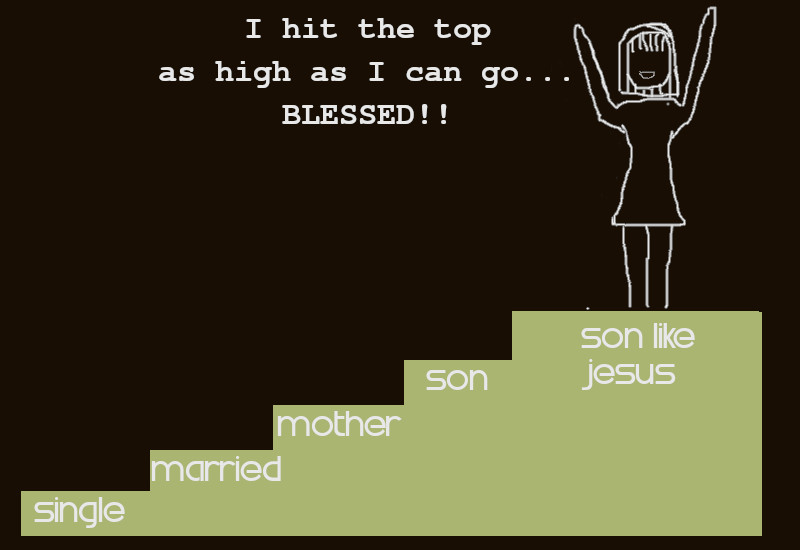
She would start as the daughter of, growing up her status might increase if she was not single. So singleness was the base level. If however she could be married – be the wife of someone – she would go to the next level. Married but childless? That was not something she could live with easily. So to bear a child was the next level… and if the child was a male an even higher status was hers. That was as high as anyone could ever hope for, but on this day when she encountered Jesus she realised there was one higher step: imagine giving birth to a rabbi who lived, taught and behaved as Jesus did.

Blessed is the mother who gave you birth and nursed you.

The contrasting view is the one Jesus came back at her with and in a few words turned her world upside down. Status is not based on gender, it is the same for women and for men. It is simply becoming who we were meant to be. There is no higher blessing, perhaps I might even suggest no higher glory.

Pause for a moment. Being the mother of Jesus is not the highest calling for a woman. Mary is blessed, but…

The Gospel is crazy. It does not put us down but pulls us all up. Unless of course we take a superior attitude then it seriously does pull us down. There are not many attitudes that God actively opposes but pride, arrogance, superiority? The Gospel has always been good news for the marginalised. And it will not appear as good news to those who do not make way for others to discover who they are and express who they are. Freedom to discover and to express rather than restrictions and blockages will always be the bias of the good news that Jesus brought.

Equipped to serve…

With all my great abilities (!!!), or with a mediocre level of ability, I have over many years been involved in helping teach on courses that seek to equip people. Most of that was aimed toward helping people be more effective in evangelism or in taking responsibility within the (local) church. I have always enjoyed that and think a few people have also benefited. Thankfully this has not just involved helping develop skills but also in highlighting life issues and attitudes as being vital.

In this current stream of posts, writing about ekklesia it seems to me that there has to be a shift to helping equip people to serve the ekklesia, the body of people called to enable the world to find her right alignment. This is not to negate the need for all of us to be better equipped to share our faith or to hone pastoral and other skills, but once we consider that the setting for our faith to be outworked is the world, any element of training will be differently focused. Probably one aspect that will develop in these coming years will be networks of training that are not simply focused as previously, but on the implications of the ekklesia in the world. This is certainly one aspect we see for Spain.

Training people for ekklesia! That opens a wide scope and is so challenging. Many of the practical skills will be honed in the traditional settings, and in – sorry for the language as it is desperately shorthand – secular settings. But surely a commitment to Jesus should mean there are specifically Christian aspects to be developed.

We sat yesterday in an hour’s political gathering that had a focus on the environment. Two contributions stood out. One speaker named those who are (or were) prominently involved in politics within Spain and who are directors of, or financed by, the energy sector (gas, oil, electricity etc). The extent of the list was mind-blowing. Into a debate on climate change one realised just how ‘bought’ are the policy makers. Even where such politicians are not involved so much of their financial support comes from those sectors. (An aside – the reason we perceive that no coalition could be formed here in Spain and we are headed back to the electorate is that the banks stated directly who they would accept. This was both undeliverable and blocked all obvious other coalitions.) The speaker went on to say that democracy’s voice has to temper the economic world, or if not then that (economic) world will temper the voice of democracy, indeed it will all-but silence that voice. The other speaker that made an impact on me said in all the push for change in this crisis area of climate that if we ever resort to violence and move away from love that the means will never achieve the desired end, indeed it will block the path to the desired outcome.

I was deeply moved with the insights. (Interestingly as we sat there, listening and praying, we both saw behind one of the speakers an angel with him. This person is soft in heart, has been grossly maligned and professes to be an atheist… challenging paradigms, but we have to discover afresh who God is standing behind.) Those insights were so right on… and the challenge is that anyone following Jesus should be able to give those perspectives. Challenging as it leaves one thinking maybe there is no need for the ekklesia, with the voice of Jesus being so clearly heard… Or the bigger challenge of how different would a follower of Jesus be in those settings? We might have to learn some new language but as carriers of heaven there has to be something unique. The need is there to help followers of Jesus understand that they do carry something different, something beyond street-level enhanced wisdom. Equipping carriers of heaven to be an effective part of ekklesia.

We have to move beyond some old discussions. There are crises on almost all sides, with thankfully the climate crisis getting some front page space. We might as believers have been known for being pro-life, sometimes known for campaigning outside clinics, but the climate issue? To be pro-life is to look to the future so we cannot ignore it. To ignore it and claim to be pro-life seems every so empty. We drove to Madrid a few days ago and to see in spite of the levels of rain a few weeks ago that in October the land is parched (hence photo of Spain’s crisis attached to this post). Water, water everywhere (climate change flooding)… but increasingly for more people, but not a drop to drink.

Gayle and I are full of (self-examining) questions at this time. We are no experts. Here are a few of our musings (OK our confusions):

Where does change come from?

We are opposed to the idea that as the top 3% influence society so we need Christian people to get to the top of the mountain. Yet we carry some written words for those in the public eye who we believe God has placed there. Are we also believing the top 3% are the ones to be addressed?

We try to approach this with, the person who gives a cup of cold water is key to change the world. Change takes place through the smallest of acts. Yet there are those with influence for change, but if they seek to impose change top-down and do not flow from love they will not have contributed redemptively to the future. It is not simply structural change that is needed but a heart shift.

The early ekklesia is a challenge. Not many important, wealthy, wise etc. And chosen not to become the wealthy and wise but to bring to nothing that which is. (Now where did I put that Bible that told me my faith was a private thing that I can keep locked up in the world of my own spirituality. Better find it quick as the one I have now is causing me a lot of trouble.)

Are we too embedded in the system?

How does one look to see a shift in the economics of this world? Can it be done by buying in to the safety net of what do we do when we retire? Does wisdom (dependence on pension schemes) mean we are simply filled with hot air? In the scheme of white middle class we are not well set up, and having made the choices we have made our joint incomes are now 1/4 of what they were before our move to continental Europe… But in the big world of 7+billion we are maybe totally guilty as charged. Following Jesus is not a hobby, nor are prayers for global shifts ever without personal implication, yet I suspect that many current disciples are contributing to a future of greater inequalities as they put away their monthly contribution and are going to leave their offspring some serious resources. I don’t know if that is wisdom or building on sand. What we do know is we cannot answer for others, that we live in a world that is not clean… but we have to make sure that our actions, plans, hopes and securities line up with our prayers.

Are we contributing members of the ekklesia?

Are we effective, the measurement of which is not to be made by who we are but what happens around us. Life for the NT believer was measured by the presence of the life of the Risen Lord who became a ‘life-giving Spirit’. Life by NT definitions is measured by what happens through us. Is Spain different because we live here? One can have a house but a home in a place is very different. A home is a place where God is present and when s/he is present there are some very clear evidences.

Have we been able to make space for others to rise? We have certainly seen too many aspects go in the wrong direction to pat ourselves on the back too much!

Being an effective part of the body of Christ will make a difference to the world we live in. We seek to do that as we did yesterday, sit and pray. It is unlikely that an atheist is going to shift the spiritual powers that need curtailing, so at least we can do that for someone like him, who is better trained than we are and talks hope for the future. Then there is that family who we gave keys to our apartment so they can use it when they wish. If we want keys to Spain surely the least we can do is give them keys to here? Or is this to be our private property… in a land with many crises in housing.

Are we effective in helping those who do follow Jesus align themselves to the call to be witnesses to the Easter event and heralds of the coming parousia? I spent many good years with a focus on helping people align to be effective members of the local expression, and to evangelise so that expression might grow. But the future has to be increasingly provoking people to be witnesses so that the presence of Jesus might increase within the world. For all of us we will need to respond to the challenge of enabling people align to ekklesia, that body of people who self-consciously have taken on responsibility for the future of the world.

I just hope our musings / confusions, along with a few faltering steps, as we have tried to self-consciously align to ekklesia is taking some responsibility for the future of the world.

A final (or further) piece

It is great being the author of a blog as one always has the final word to say, although I cannot quite claim to have ‘great and unmatched wisdom’, though I am obviously working on that. Yes the gentleman who suggested that was one of his many attributes has set the bar high. So pulling back, momentarily, from self-inflated opinion I will modify the title to be a ‘further’ (and certainly not a ‘final’) piece on the ekklesia.

I appreciated the comments on the two articles and of course I am coming strongly from a perspective, hopefully not denying the validity of other perspectives. There are two ways in which sociology approaches healthy groups. They are either at the ‘community’ end of the spectrum or at the ‘movement’ end. Community is centred in on being there for each other, to enable one another, movement is focused on purpose beyond the community. Both are visible in Scripture. There are enough ‘one another’ Scriptures related to followers of Christ to see that perspective is a strong one. (‘Love one another’; ‘admonish one another’; encourage one another’; etc.) Most Christian communities that I know that carry this emphasis also strongly desire to change their environment. Movements have something in common among themselves – they hold to a common world-view that is not shared by the wider world and are seeking to change the wider world based on their world-view. The Civil Rights movement can act as an example. Martin Luther King’s speech ‘I have a dream’ is one example of what they shared in common that was not realised in the wider world that they were a part of. Their aim was to change the world-view and practise of the wider society.

Writing about ekklesia with its background both as the Hebrew of being called to listen to God then act in the light of that instruction, and the Graeco-Roman background of the legislative assembly I was pushing the ‘movement’ understanding of being together. That is my bias. I was also pushing that as a push back against a common approach that only accepts one expression (‘local’) as church. I am not advocating independence nor that another form is how it should be done. We need one another, one size does not fit all, and most of us recognise that many others who are followers of Christ are responding to the claims of the Gospel better and more faithfully than we are.

The challenge that we all face is being faithful in our context. Maybe we all find ourselves in settings that are ‘sub-church’! Now there is an adjective that might be very applicable. I find the thought of what on earth was Paul up to in planting and nurturing ekklesias within the one-world government system of Rome fascinating.

I suggest Jesus, and no one else could have done this, opened the door for Peter (as representative not in his unique right) to give shape to what an ekklesia would be within the Jewish world. That is one window on ekklesia but it is the world of pre-70AD and also of pre-Gentile mission. It is really the expression of ekklesia beyond that that should provoke our thinking deeper. Peter opened the door to Paul, in that he was the first, and reluctantly at that, to go beyond the Jewish world to the Gentiles. The Gentiles (us lot) was Paul’s first century mission field. The context was not of a covenant-people but of the world, and as already mentioned an all-but one-world government world.

It is interesting that the term ‘synagogue’ is rarely used for the Christian communities of the New Testament. That expression was developed in Babylon, and I wonder if it was something of a compromise in order to survive that then became the accepted norm. Paul uses the term ekklesia which would have been strongly understood to be political, and confrontational to the system.

There is good research that shows that many forms of church enable people to grow to a level of faith, but then by default place a ceiling over people going further. We also know of many lone-rangers who seem to get detached from the core of the faith.

As I look at the wider world we are in crisis. We could see the collapse of so much, or the coming together in alliances that provide the platform for dictators. Into that context I cannot help but believe Paul’s Gospel is so relevant. And yes, I do think he is pushing the movement end of the spectrum, while strongly recognising how much we need one another.

So thanks for the comments – provocative and clarifying. But not quite ready to suggest the photo I have attached is the image of the church. It is a photo of a very impressive building in Rome and worth a visit!

Perspectives