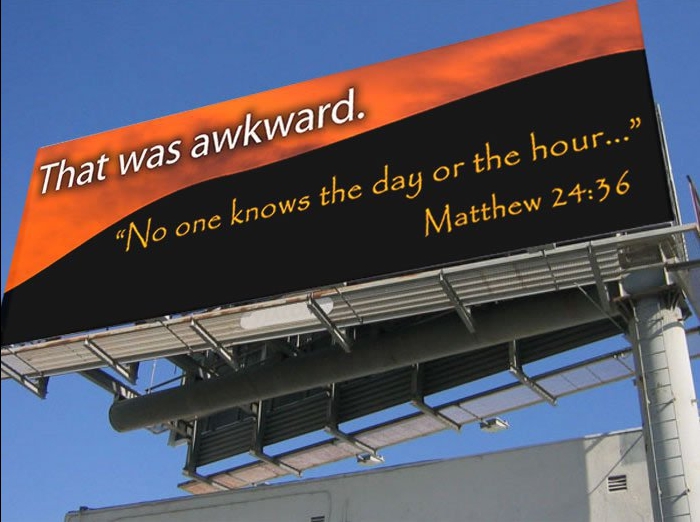
This time – it is the end

COVID-19; no-deal Brexit a real possibility; recount the election AGAIN; Jewish group not happy with arms deal to UAE; Santa on strike and no Christmas pudding in the shops. Any combination of the above of course can be read as signs of the times that the end is here within view.

There could be an end in view of course with democracy being repeatedly challenged, or the possible economic outcome of a non-deal for the UK, or if the virus is only the first of a number to whack us this century. End of the world? No, but the end of certain states of play as we have them. That has always been the case and societal endings are often amidst crisis, something giving way for something else to rise in its place, either something better or worse.

I have completed four books – two waiting publication – and am just hanging around a little before finding the right direction for the final three. I intend them to be on our future hope, but with a flashy title of course. Not sure what to write as on many of the classic themes (Middle Eastern conflict; Armageddon; great persecution; rapture; millennium; antiChrist) I think the Bible is either silent or quite eloquent as to why we really should not go there. If I go down the silence of Scripture route not a lot of material for a series of three books – simply a page in large print with the words from the parenthesis above and then a dash and the word NOT following it.

So while hanging around, a short little explanation here. There are ‘horizons’ in view in Scripture. (Back in the day writers such as George Ladd gave a helpful way of describing the Jews with one horizon, a future that marked the two epochs of ‘this age’ and the ‘age to come’, which the NT separated the division yet further with the kingdom being ‘already but not yet’. Helpful but over-simplified. Reading the Scriptures even more consistently as historic-narrative N.T. Wright, and even more radically Andrew Perrimann, opens up a slightly more complex view – one horizon becomes further divided.)

Although it is not totally accurate to say ‘the Jews believed…’ as there were diverse beliefs among Jews, but ignoring that caveat the Jews believed in a future horizon, when Messiah would appear and there would be a total re-ordering of the world (NB: not much ‘going off to heaven’ going on here; we have the Greeks to thank for that angle.) Simplistically we could suggest they had a horizon in view; a one-horizon view.

Along comes the Incarnation and for those who believed he was the Messiah, certainly post-the-cross the one-future-horizon was inadequate. Looking back from the resurrection they understood that what took place over that period of time from the first Christmas to the first Easter was a horizon. It was a dramatic intervention of God in the world, into the Jewish context, and at a very specific time, when there was an all but one-world government that was opposed to the values of God, that oppressed all. Peace established through war, so much so that the temple to ‘Peace’ (goddess) was on Mars Hill (Mars being the god of war!). [Netflix have a great series on the Roman Empire that gives some good insights into it.]

That intervention marked something incredible for there was the revelation of who the God who created all things really was. The cross being one of the places where that glory was revealed, hence the self-emptying of Jesus (Phil. 2) can only be understood as a revelation of the eternal nature of God, not something taken on for a short season. (If not yet read I think that Thomas J. Oord, Uncontrolling Love, is so worth a read.)

That first horizon had enormous implications for the world. But first, huge implications for the Jewish world. Into that world came the proclamation of no other name under heaven by which people can be saved (Acts 4:12); not the name of Abraham, the patriarchs, David the idealised king. None of them can do it… this is picked up in Revelation 5 in what I reverently term cartoon form. When we read the New Testament in its historic context, with the majority certainly written before the calamitous era of 66-70AD, we necessarily read the pages somewhat differently. It is not about our day, nor about our future… but is deeply significant for our day and our future.

Leads us to that second horizon that now comes in view. Jesus spoke of a future that would happen within a generation, that the events would be climactic and therefore when it came to fleeing to pray the flight might not be in winter or on the Sabbath – all of which are speaking into a specific geography and a specific time of history. No reason to push it to our future, but to understand it as the foreseeable future of those hearers, and that was the horizon that the early followers of Jesus had understood him to be speaking of. The horizon that culminates a generation after that first Easter. In the final days of that time when, as predicted, ‘the armies shall surround Jerusalem’ the Romans were crucifying up to 500 Jews on a daily basis by the city walls so as those inside knew that their days were numbered. The upside was that this was the sign of the Son of Man coming (Daniel 7), but that upside was an upside in marking the end of an era in terms of the intervention of history, the actual era of history was indeed very painful for the ‘elect’ those who were part of the chosen nation, but had not aligned with the truly elect one.

Given that our writings are pre-70AD whenever we come to future references such as Paul in 2 Thessalonians (maybe 52AD) concerning the ‘man of sin’ there is again no reason to push something beyond the lifetime of the readers, to something that had no reference to their time and setting. I still see such events as past for us, future for them and sitting in that same period of time before the second horizon came fully into view.

A third horizon though does seem to persist through all the writings, and I think it is the horizon that inspires the hope that comes through in Revelation. The book might well have had an initial write in the mid-60s but I stick with a late date (maybe 96AD) for the book as we have it. After the Jewish wars. The focus has switched, the Temple has gone, not one stone upon another left… but the beast has continued, indeed survived against all odds on numerous occasions but particularly in that ‘year of the four emperors’ that took place in the midst of the tumultuous era of the Jewish Wars. Mortal wounds to the head, but continues – that was the story and continues to be the story.

So time to bring this post to its appointed end. ‘Do I believe in a future antiChrist?’ Perhaps and probably as history witnesses to many antiChrists (past) in both limited and all-but universal situations. There is always a tendency to ‘make a name for ourselves’ towers to be raised, along with the witness of Scripture that they will never reach heaven and be permanent. ‘Do I think the Bible predicts a future antiChrist?’ No. No more than it predicted Judas Iscariot, but when the time came it easily said that he fulfilled the Scripture.

Well that would be some of the content to appear somewhere in books 5-7, along with references to the books of Scripture that show how there were clear predictions and also a recording of the history related to the predictions, yet the predictions were not fulfilled. A shocker? Or a nice indicator that prediction like that is not the area that Scripture deals with – rather the category of ‘promise’. Now there’s a thought – fulfilments of Scripture that look nothing like they were predicted. Might just get on with writing those books.

A 72% perspective I have

This site is headed as ‘perspectives’. I just held back from calling it ‘the truth, the whole truth and nothing but the truth’ but then just mentioned to resist. I am now involved in these zoom groups and believe it or not there is not just a simple agreement that what I have written there is the finished article. I am shocked! So I thought I would scribble here a few thoughts that are maybe along the lines of a perspective that is firming up. Don’t take it as the truth (unlike everything else I write….)

I am still wrestling a little with how I write vol. 5 which I plan to be an introduction to our hope. First what I don’t go for – no millennium (just too many symbolic numbers in the book to try to make this one literal); no Armageddon (the place does not exist, indicating that surely it cannot be literal); no rapture (an invention from 1831); no signs of the times (a little more controversial and take a little longer to explain why); etc. So not along the lines of what many think of as conventional eschatology. My question is whose conventions?

Basically for me very simple. We provide the building blocks (hence Paul’s warning to apostles not to mess around in 1 Cor. 3) and God builds it. We do not build it; God does not provide the material. Then Jesus has not yet returned as not enough material.

Can be a little depressing as it would be nice for God just to wind it all up and all the injustices sorted. So, if we are waiting, a lot seems to be down to us… But here is a thought.

What if there is already (and has been for some time) enough material to wind it all up and to bring in the age to come. But the age to come could be even better yet and for this reason God would like to hold back a little longer so that it can be even better still?

Crazy thought? Well it is only a perspective and one that I am only 72% endorsing. I do wonder though if the word ‘eschatos’ pushes us beyond the 72% conviction? ‘Telos’ is the other word for ‘end’ in NT Greek, used for example of Jesus being the end of the law, the terminus and termination. Maybe eschatos (‘eschatology’) indicates it is the end but not the final. What if the eschaton is to be the beginning of something incredible, and God is holding back to give us the best beginning that we can help bring about?

Get up

Maybe it will be a very short book

I found an interesting set of quotes the other day regarding Martin Luther. Although never dogmatic, and apparently not always easy to work out what he believed, he seemed to lean heavily toward ‘soul-sleep’ for those who have died.

Lutheran scholar Kantonen (The Christian Hope) quotes Luther as writing:

For just as one who falls asleep and reaches morning unexpectedly when he awakes, without knowing what has happened to him, so we shall suddenly rise on the last day without knowing how we have come into death and through death… We shall sleep, until He comes and knocks on the little grave and says, Doctor Martin, get up! Then I shall rise in a moment and be happy with Him forever.

Not sure Jesus will actually call him ‘Doctor’ Martin but aside from that very cute indeed!

I have always vacillated between the two positions of ‘soul-sleep’ (though don’t like the word ‘soul’ in that context) and an interim bodiless existence post death in ‘heaven’. Why vacillate? Because one view might just have the vote biblically, the other I think wins it theologically. That kind of dilemma illustrates why it is not always easy to be certain. On this issue it does not matter too much – we will all find out one day! It does not greatly affect the here and now. Gender issues (male / female relationships… not to mention the complications that arise when we consider the gender spectrum) would be something that cuts a lot deeper with respect to the here and now; our view of the planet, the economy etc., now those are critical issues.

As above on Luther’s view a theology that enables us to interpret texts will be essential; and that theology has to be nuanced through listening to the voices of science for such studies are not intrinsically anti-Scripture, far from it! And we cannot just adopt a theology that ignores the texts.

So I continue to vacillate on the post-death issue that I started with, and probably on more issues than I care to admit. On post-death there seems to be a big empty space in Scripture, for the texts are predominantly shaped by a focus on quality of life here and now, and on life in the age to come – life post-post-death, post the parousia of Jesus, what I describe as the ‘here and then’. For this reason it is probably best to be agnostic and focus on life here (being human, truly human) and on life then – when we will be truly embodied humanity.

I am partly interested in this as I am wrestling with how to write volume 5 of my short series. I wanted it to be an introduction to our hope, but was going too quickly down the line of bashing through a bunch of texts, instead (a heads up coming) I am thinking of just a broad sweep suggesting the reasons why I don’t believe in an antiChrist, a millennium, a great tribulation, a rapture, eternal punishing (note the last three letters, happy to replace with four others), a rebuilt temple, blah blah blah. I would certainly include prophetic writings where in the same book of the Bible that contains the prophecies the outcome is mentioned, and the outcome is vastly different to the prophetic word (that messes with one’s head for sure, and I think is a lack in the works that suggest the apostles are the equivalent of the prophets of the Old Testament… a view not sustainable by Scripture, but one I suspect is motivated to endorse a view of inspiration). I might write about ‘there could be a future antiChrist that matches the description in the Bible, but even if so I don’t consider the Bible taught us to believe that there will be one, it did not predict it.’

And I will probably write a chapter on the only concern we have, and the only delay in Jesus’ appearing is that we have not supplied enough building material yet for the new creation.

Or I might just say ‘deeply agnostic on all the above but consider that what we do here and now is shaped by what we believe will be here and then, and what we do now will shape here and then.’

If I choose the latter and no more that truly is a booklet. Maybe this post is the fifth book(let).

Luke 21 – the pestilence

Perhaps I should not have been surprised but I saw a number of articles on the web tying together Jesus’ words in Luke 21: 11 concerning pestilence and the coronavirus. But NO!!!

It would be such a stretch to get to the idea that Jesus was prophesying the virus and thus indicating that we are in the ‘end times’. I even saw one post that said these they had expected these events to be in the first 31/2 years of the 7 year period of tribulation, but were happening now. WOW… (Where do these people get the time from to think all of that… read a little, and only a little history to see where these ideas come from.)

Before having a quick look at Luke 21 here is what I consider is the framework we have to be looking at. The Jewish ‘one-horizon’ view shifts to multiple horizons in the New Testament. The Jewish one horizon view was simply that God will through the Messiah intervene, subduing all his (and therefore Israel’s enemies) causing the great reversal to take place. (Some views had two Messiahs, others saw the intervention without a Messiah – the ‘Jewish’ view is really the Jewish views.)

There were inevitable unforeseen events by those who shared that view. We see that reflected in the road to Emmaus discourse. ‘Did you not understand that first the Son of Man must suffer…?’ being Jesus rhetorical question to the married couple. Fresh horizons had appeared and others were yet to appear. The one horizon was proving inaccurate, multiple horizons needed to be seen.

We might separate out the immediate horizons of the Cross, Burial, Resurrection and Pentecost or we can put them together. Together they effectively make the first horizon. Jesus inaugurated a new day post-his forty days in the wilderness, opening up his earthly ministry, and post-cross another 40 day period of transition to the post-Pentecost ministry of the body of Christ. So the first unseen horizon was that of Easter / Pentecost. Not surprising as a common Jewish view was that when the great reversal took place it would be marked by the resurrection of the dead and an outpouring of the Spirit.

(A sidenote the 40 day periods and the 40 year period from Jesus predictions in Luke 21 to the fall of Jerusalem are tied to the Exodus period to the entry to the land. Jesus beginning his 40 days with his baptism, his death being an ‘exodus’ and all paving the way for the entry to the land / lands.)

The second horizon was that of the fall of Jerusalem within a generation, and Jesus clearly prophesied that. (I also consider that Paul in 2 Thessalonians 2 is referring to this event.) Such a dramatic and traumatic end of an era. The religious centre, the hope for the nations destroyed, and it marks a major cutting off between Jewish believers in Jesus and Jewish non-believers in Jesus. The followers of Christ abandoned Jerusalem understanding that was exactly what Jesus instructed them to do, leaving behind many residents to the brutal reprisals of Rome, which included many punished with crucifixion.

The third horizon I consider lies future. The parousia of Jesus, the time of the resurrection, final judgement and such events. For me only the book of Revelation is written post-the Fall of Jerusalem (AD70), and it is not obsessed with prophesying events to come but with unveiling the reality of our warfare, of what we are asking to change every time we pray ‘let your kingdom (basileia) come’. The book and that ongoing disciples’ prayer is set in the context of the Empire (basileia) of Rome.

So to Jesus and his words in Luke 21. The immediate context is of the Temple that Jesus said would be utterly destroyed resulting in the question of ‘when will these things take place?’ (21:7). The time frame was future for them, but past for us. Into that time frame – the next 40 years from the time of speaking – Jesus spoke of great traumas and of famines and pestilences. The decades that followed culminating in the brutal assault of Jerusalem (66-70AD) with mass crucifixions, cannibalism inside the city, the appearance of false Messiahs etc., were horrendous. Horrendous within Israel and with a sharp focus on Jerusalem but also deeply traumatic in the wider Imperial world. 68AD saw the year of the four emperors, as civil war broke out, and there seems to be some allusion to that in Revelation with the mortal wound to the head of the beast, but the wonder from the people that the beast survived. (Babylon’s cry, and the tell-tell sign that any institution is embracing Babylon’s values, are that ‘we will survive’ and at any cost, that ‘we will always have children’ but in the process eats the life of the children.)

In Luke 21 Jesus speaks to ‘you‘, speaks of being brought before synagogues, and decisively about Jerusalem being surrounded by armies, and that they will need to flee from the city and from Judea, and that the wrath will come on ‘these people’. Everything is geo-, ethnic- and temporal related. Josephus and other contemporary writers bear out the horrendous nature of those years.

In that context the sign will be visible that the Son of Man will come in the clouds – words spoken by Jesus already to the High Priest that he would personally see that event. This is not some far off future reference, but takes up the Daniel 7 imagery of one like a son of Man coming to the ancient of Days. The kingdom of God is in his hands. The hope for the future is not in a holy place, nor a holy land but in the hands of Jesus of Nazareth, the crucified one, is the resurrected vindicated One. To believe that is the continual challenge for us at all times as we now live in the period of time between the second and third horizon, and for us, as for every post-AD70 generation the Revelation 4, 5 challenge remain central, where Jesus came to the One seated on the throne as only the Lamb of God was able to open the seals (human destiny).

So I guess it is no surprise given the above approach that I do not see any reference to the coronavirus in Scripture. Scripture is ever so helpful in not giving us the future, but in giving us a future hope that cannot be shaken.

Is the coronavirus a sign of the end times? For sure. It is a sign that we have been in the end times ever since Jesus poured out from on high the Spirit, that this whole world is groaning waiting for liberation from its bondage to decay. So it is a sign in a very general sense, but not in a specific way. God might well speak through the current events, and I am sure he is. What is he saying? Our God is always speaking, we might hear different things but they must all focus on his love for us and for the world, that he has not abandoned us… and therefore the call is there to love and not to abandon others. Let your kingdom come.

Opposing the inevitable?

Whenever I think there are people who are not consistent I quickly make sure I do not check myself in the mirror. I, of course, would never be inconsistent.

Anyone reading between the lines of the posts I write will probably pick up that I voted ‘remain’ as far as the UK and the EU is concerned. Not because the EU is perfect, nor that it is a chosen vehicle to bring in the kingdom of heaven. There are many reasons, I am sure, to vote ‘leave’. To add into the remain / leave vote our Christian convictions about the future unfolding of prophecy just complicates it all.

An observation I have carried for a number of years is how difficult it must be if one holds to certain view of the future. Some of the Christian negative response to such issues as the European Union is to do with a view on prophecy relating to the end times. A revived Roman empire (of sorts) with space for the rise of a prospective world leader (antiChrist) is a view.

Now comes the complication! If I assume for a moment that was a valid view the question then becomes very challenging indeed. Do I oppose that happening… and set myself against what has been prophesied? Does not seem a good way to go… but if I go along with it all as that would align with prophecy… then I could find myself supporting an antiChrist shape? Of course with the EU vote I could take the view that the UK was not to be part of that revived shape (or at least north of Hadrian’s wall… oops, another politically divisive possibility) and so then I would have a win / win situation. The win / win would be that the UK (or at least Scotland) does not submit to the rising shape of antChrist, and I leave the rest of Europe to be the fulfilment of prophecy. Sorry – a win / lose scenario.

Just glad I have a simple approach.

  • I do not see the future laid out in Scripture… other than Jesus is coming and we live in the light of that and seek to align ourselves, and everything we can influence, to heaven’s values. So I have no need to wrestle with such thoughts as an antiChrist and a revived Roman Empire. Phew!
  • Powers are present, they are fallen, but can be influenced. The inevitable does not have to manifest provided we are involved.
  • Self fulfilling prophecies are easy to spot. ‘Don’t be involved it is evil.’ I respond obediently and do not get involved, then watch as it gets worse. Seems a connection – we remove the salt and there is no limitation placed on what was there.
  • Prayer content seems simple. Let your kingdom come.

I like the simple approach. I don’t need to wrestle with the conflict of seeking to oppose what I believe God has ordained.

OK, but when?

Evidently not May 21, nor October 21, 2011!! So many miscalculations so now it is my turn… I am soliciting a little help from 2 Peter 3 and his three-fold reason as to why the parousia was still future for him, and as it turns out for us too. (Before looking at his perspective, it is worth noting, as an aside, that although he uses language that could be pressed, if taken literally, to mean the destruction of creation this is not likely his meaning. Two reasons – he uses typical apocalyptic language (strong metaphorical and physical language to describe the significance of an event, not to describe the literal result); and the second reason for not taking it as literal is he has already stated that the flood had ‘destroyed’ the world of that time. It did not physically and literally destroy that world.)

Peter seems to list three reasons in response to those who mocked about his ‘coming’ (2 Peter 3: 3, 4; parousia, the common word related to his coming, and carries the meaning of ‘presence’). The three factors are laid out in verses 8-12.

But do not forget this one thing, dear friends: With the Lord a day is like a thousand years, and a thousand years are like a day. The Lord is not slow in keeping his promise, as some understand slowness. Instead he is patient with you, not wanting anyone to perish, but everyone to come to repentance. But the day of the Lord will come like a thief. The heavens will disappear with a roar; the elements will be destroyed by fire, and the earth and everything done in it will be laid bare. Since everything will be destroyed in this way, what kind of people ought you to be? You ought to live holy and godly lives as you look forward to the day of God and speed its coming.

  • A perspective of time – what seems to be forever to us is not viewed the same way by God.
  • Any ‘delay’ means more people can be rescued. This is a very interesting perspective and challenges the pessimistic view that ‘only a few will be saved’. The longer the delay the more that will perish is the result of the pessimistic view. (A much longer discussion needed here, but I suggest we need to reverse ‘only those who receive Jesus will be saved’ to ‘only those who reject Jesus will be lost’. Maybe one day I will post on that… maybe…)
  • It is the third reason that pushes me again to underline the unfinished work of Christ. How we live, what we look forward to speeds (brings it closer in time) the parousia. There is a work for us to do. There is a future and we align our lives in the light of that, we focus on the future, that vision burns of a new just world and as a result the future will take place sooner rather than later. I take that literally, and as I have written in the past, the work we are involved in is in the preparation of the material that God requires for the New Jerusalem. We cannot build it – an unfinished Babylon is all we can achieve, but a finished New Jerusalem is what comes down from heaven, from the throne of God. Only God can do this; the perfect cannot rise up; it has to come down to transform what is here.

But the jewels, the gold, the precious stones? They originate here. Wood, straw and the like are not part of the materials God will use, and Paul acknowledges (in the context of ‘temple’ construction) that there are apostles whose works are simply that. How they work will not survive the fire, it will be considered of no eternal value. In that light he provokes us all to consider what our works consist of. God will and is building with the material that we supply that passes the fire test.

When will he come? When the work of Christ is finished… the aspect of his work that he is now doing through the body. Jesus explained to his disciples that his food was to do the will of God who sent him and to ‘finish the work’ he was given to do. And in like manner so he sent us… to finish the work.

It is time to get an eye that sees the world that is to come, the world that is the other side of the fire that destroys all unrighteousness. What world do we see? If we are to hasten that day then we need to align our lives with the values of that world, not this; we must sow seed now that is the seed for that harvest. Small acts now, but vital ones. The mockers mock, but the seers work.

Maranatha – but when?

Old Testament hope can be reduced to a big picture vision of a future day (of the Lord) when God will show up in our world righting all wrongs with rewards to the righteous and punishment for the unrighteous. That coming might involve a Messiah (by the time of Jesus probably a majority opinion), two Messiahs or sometimes without the intermediary of a Messiah. The vision was to a future horizon, perhaps preceded by certain events but essentially one horizon. It was this hope that underpinned, and maybe ‘created’ the belief in the resurrection of the dead. They did not entertain some Hellenist (Greek) form of life after death in some other realm, but believed the transformation was to take place here and that bodily human existence was necessary to enjoy it. That issue then raised the problem of what about those who had died but had lived righteously? If they are not present when that future day comes but were counted worthy they would never receive their reward. The solution was that God would raise them bodily. The clear signs that the day of the Lord had come then was two-fold, the abundant presence of God (the outpouring of the Spirit) and the resurrection of the dead. The proclamation of the early disciples was highly controversial: everything has changed! The Spirit is outpoured, his body is not in the tomb. That turned the Jewish world upside down, and subsequently held major implications for the inhabited world.

When we turn the pages to the NT inevitably the first followers of Jesus held to a similar vision of a one-horizon future. This fuels Peter’s rebuke of Jesus when he ‘corrects’ Jesus declaration about his own future death at the hands of the Jewish authorities. ‘This shall never happen to you’, was his response. The one horizon perspective meant that Jesus would enter Jerusalem triumphantly and clearly inaugurate the day of the Lord. The disappointment for the disciples is palpable, and we read that the married couple on the road to Emmaus respond to the unrecognised Jesus with the words,

but we had hoped that he was the one who was going to redeem Israel (Luke 24:21).

Jesus explains to them that their one horizon vision was not accurate. The son of Man must first suffer, Jesus explained. The Cross (and we include here the resurrection and Pentecost) becomes a horizon not previously seen.

Pentecost does not bring the hope to a completion. There is more for Jesus to ‘do and to teach’ (Acts 1:1), not now in bodily form among us, but present by the power of the Spirit through his body. A theological truth is that the work of Jesus is the finished work, but this must not obscure the unfinished work of Jesus, the work to be carried out in his name through his disciples.

The one horizon perspective of the future gives way to a two horizon perspective – classically expressed as the ‘first and second comings of Jesus’. However, Jesus added another dynamic to the scene that brought another horizon in view, and to this one he attached a time frame. He laid out events that would take place within a generation. In the run up to the end of that period (40 years after speaking) the world enters a momentous time of crisis. With 4 emperors in an 18 month period, involving civil war, significant earthquakes, famines, wars and many rumours of wars, and with the genocidal war against the Jews and the circling of Jerusalem by armies, those final years in the 60s threatened the survival of the world, the end of the then known world was imminent. Little wonder the head of the beast had been mortally wounded, but when Rome survived, it took on this immortal aura. Such is the nature of all beasts / empires.

We move then from a one-horizon (the great reversal and redemptive day of the Lord), through a two-horizon (first suffering, then glory), to a three-horizon perspective that included the sun being darkened and moon turning to blood years culminating in the sack of Jerusalem in 70AD. We now live post AD70 with – unless there are some other major surprises – one horizon set before us: the parousia of Jesus.

I consider that all NT Scriptures, except Revelation, were written pre-AD70, hence the ‘man of lawlessness’ and such Scriptures that were future for the original readers are now past for us. There then is very little in the Scriptures making predictions into the timeframe post AD70 – the time in which we live.

When will the parousia take place? The final horizon that wraps up this chapter of ‘heaven and earth’ and inaugurated the ‘new heavens and earth’. That event that is so fully eschatological but perhaps not teleological? (I am referring to the two Greek words eschaton and telos, both can be translated as ‘end’. It is the former word that is used of the events that the parousia marks. It is the ‘end’ but maybe also a beginning – it might not be the ‘telos’ which carries more of a sense of final destination. Just a thought / possibility.)

The next post will look at the when of the parousia, the horizon that we are looking to.

Digging down

With this post I finish the material we sought to share in Brazil and the earlier part will also summarise some of what I have already written about. Hope it is not too long to read right through. Tomorrow I will copy a writing from around 150AD – who said I was not a traditionalist?

We are not sure exactly how different the focus ‘up’ to limit hostile powers differs from digging down to the depths as the two have to be related. The spiritual powers gain authority from what has been sown (history affecting geography, down establishes up) and likewise the hostile powers shape what can grow and multiply (up solidifies what is down). They both affect each other. The dimension of digging down though has a very earthy element to it and it is necessary to hear the cry of the land to respond, even if that cry is at times twisted or inarticulate. The response to the cry has to be through us seeing a new way of freedom, proclaiming it and relating to what is around us as far as is possible as if the new way is the reality. This emphasis of digging down coincided with a dream we were sent for our work in Spain about finding the shape that held up false structures. That shape was like an arch and in the dream the person had Gayle said the shape reminded her of a boomerang. The challenge with the boomerang is that one can throw it away and it returns. This has been our experience of late, when we have had a verifiable significant shift witnessed reflected by a news item, but only for it to be replaced by something perhaps even stronger. This pushed us to consider how we need to go deeper.

We consider that this is becoming very necessary in the context that many of us are finding ourselves. We are to be pressing in for a ‘whole new creation’ and at the same time we are experiencing that being challenged as we are in danger of losing the good that has brought us thus far. Democracy is not sacrosanct but the shift to control and silence the voice of the people is a huge danger sign. The use of the term ‘fake news’ does alert us to manipulative elements and biases in news reports, but when it is used now in a popular way so that it becomes a blanket term to silence criticism and control the work of the free press, we should recall that this was one of the ploys of the Nazi movement in the 1930’s with their term ‘Lügenpresse’ (=fake news) to attack journalists who were trying to report the facts.

In the previous post I wrote of Paul’s apostolic message and how we need to get to the starting line with respect to his message. Paul’s summary sentence about the result of the community of God in Christ is very informative when it comes to the shapes that are deep in the land that hold up false structures:

There is neither Jew nor Gentile, neither slave nor free, nor is there male and female, for you are all one in Christ Jesus (Gal. 3:28).

It is this that has pushed us to look again at a deeper level on the issue of gender: neither male and female. Interestingly Paul changes the language from neither… nor to nor… and. A clear reference back to Genesis (God created them, male and female) suggesting that the destiny of humanity is not through going back but forward. We cannot underestimate how deep the gender issue is for the release and fulfilment of God’s future vision. We have to go deeper than simply ‘can a woman teach / have authority’ etc. Thank God for the work done on that to show the reading of Scripture (the ‘difficult texts’) do not need to be read at all in a limiting way. But pressing deeper to something very insidious, to the foundations of patriarchy takes us to another level, and opens up that Scripture is not simply written in a historic context (it is written, for example, pre-science as we know it) but also it is written an underlying patriarchal context – the context of the Fall. Scripture is God’s word to us but contextualised; it is a narrative that means we have to read it in context. If not, there would be a very strong argument to revert back to days of slavery and to defend that position, as did evangelicals at the time, on the basis of the clarity of Scripture. We do not have the right to change Scripture but we are compelled to free Scripture to be the word from God.

Likewise class issues (neither slave nor free) means we have to change how we see people. They cannot be seen according to the labels society put on them. Seeing people according to their destiny also necessitates relating to them in that way. The ‘fear’ narrative dehumanises people and what dehumanises is rooted in the spirit of antiChrist. I consider that perhaps dehumanising even leads to demonising, not simply in the figurative sense of the word, but by releasing demons to their work in that context… and certainly those who dehumanise open themselves up to demonic blindness and oppression, for there is in some measure an alignment with the spirit of antiChrist in the dehumanising response. More is being required of us, and given the wonderful outpourings of the Spirit and the release of gifts within the body this should not surprise us. The level is going up and so we are to go deeper, and our prayers for the glory of God to be revealed means how we relate to the ‘other’ will determine the level of glory seen. When glory comes it will come full of grace and truth with the evidence it has been manifest will be that the person we are relating will find their head has been lifted up (‘You are my glory and the lifter of my head’).

There still is something very deep to be worked through on Paul (a Jew) who says ‘neither Jew nor Gentile’ both in the specific context of how Israel is viewed and related to and the wider issue of nations and borders. We must always hold out, as Paul did, for those who are Jew by race to come to true faith. He saw that coming through a jealousy of what was taking place in the body of Christ. Jealousy is the fear or realisation that one is losing one’s place. Is there sufficient evidence that the church is marked by the presence of God? That is the pathway: through provoking jealousy to salvation, and so ‘in this way all Israel will be saved’ (καὶ οὕτως – ‘in this way’, not a temporal clause as sometimes translated ‘and then’, thus Paul is looking for a continual process not a one off end time event). ‘All Israel’ of course is a challenging phrase, but we have to remember that the debate in Israel was who was Israel, and it was defined by those who had true faith not had proven genealogy. How many of genealogical Israel can be part of ‘all Israel’ was a burden for Paul so he worked hard among the Gentiles to be an answer to his own burden.

A blanket support for Israel will I think blind us. After all they were not to be a nation as the other nations were, and so maybe we should be careful in simply wanting to help them become that. We should anticipate some very creative ways for the borders for the peoples being resolved there. And I consider that the body of Christ should be at the forefront of praying and working for those creative, reconciling paths. (I am aware that life in and or Israel is not easy with many who wish their annihilation. I am not suggesting an easy solution. If ever there is a geography that needs deep digging then that land is the place.)

Beyond Israel and the Gentiles though lie something for most of us much closer to hand. The deep nationalism that many of us have been taught to embrace has to give way to understanding the unity of all humanity. We are all from one source and within that God has given boundaries and times for the peoples to live:

From one person he made all the nations, that they should inhabit the whole earth; and he marked out their appointed times in history and the boundaries of their lands. God did this so that they would seek him and perhaps reach out for him and find him, though he is not far from any one of us. (Acts 17: 26,27).

Yes there are boundaries but they are not fixed for all time. They are fluid and are the place where angels are often encountered in Scripture. We are living at a fluid time in history, perhaps the time of greatest change. A time when many people can find God, and find him in a new geography. We cannot simply respond with fear to what we see nor with an appeal to sovereignty lest we find ourselves opposing what God is at work doing. The challenge is when God is at work there is also a great presence of the demonic seeking to pervert and suffocate what God is doing. There are no easy answers to the many challenging global and national crises but we have to be careful as the body of Christ that we do not fall quickly into the trap of finding the quick solution. If we lift our eyes we see him, then we see others in the context of a new world.

The body of Christ… What a call. Thank God there is variety within the body, but there also has to be an increasing connection to the world beyond. This leads me to the final aspect we shared:

We are not to resort to God is in control

I overstate things somewhat but in order to bring in a corrective perspective. We sing God is sovereign, but he gave that responsibility to us. He reigns in the heavens and one day his reign will be complete throughout all creation. The question is how is that accomplished? We can consider the commission in the Garden and from that understand that the responsibility was given to humanity. God was freely available for review and advice at the end of each phase of work – he came in the evening time. That commission came to rest on Israel’s shoulders, to be a light to the nations, and a priest before God on their behalf. At the fullness of time, the time of great darkness, the Light came into the world and the darkness could not overpower it. He, as the Second Adam, showed us the pathway, with the disciples saying ‘what manner of human is this?’. Raised as the eschatological human he becomes something for the body. Having gone down to the deepest place and risen to the highest place he filled all things.

The world is not out of control and God is deeply involved, but the key issue is that there is a major role for the body of Christ. Stewards taking responsibility. Maybe one day people will say, ‘we did not recognise you we thought you were the Gardeners working to restore all things.’ We await the parousia for the fullness of that, but can live now as a prophetic sign that is visibly pointing to that great day.

SHARE ON:

Post PermaLink

Sequential door openers

Jesus is unique at every level. He is no mere human teacher, not even simply divine, but the incarnation of God, so in what I write below I am not suggesting that Peter, Paul, et al., are on the same level. I say that as there is a pattern of sequential door opening at the human level that takes place.

Jesus once and for all opened the door for the restoration of all things and only he did that, Revelation 5 states clearly that only he is found worthy to break the seals and open the book of destiny. His work is completed and unrepeatable. We must not though mistake the work of Christ as meaning there is no work for us to do. Scripture makes that clear, as he was sent into the world to compete the work the Father gave him, so he commissioned his followers to go into the whole world to fulfil the work he gave them to do (Matt. 28, the Great Commission). That commission is a renewal of the Creation mandate to Adam and Eve and carries a clear understanding that the purpose is creation-wide resulting in the whole of creation becoming a Temple for God: hence I do not see any place for the rebuilding of a Temple in Jerusalem. (Likewise the rebuilding of the tabernacle of David might be a good analogy to raise up 24 hour worship, but the fulfilment in Acts 15 has to do with the inclusion of the Gentiles into the body of Christ.)

Jesus opens the door for Peter

There are different understanding on what it meant when Jesus gave Peter the keys of the kingdom, and maybe it carries different levels of meaning. His revelation as to who Jesus was is certainly one of the foundations for the future, and the keys given to him were not his exclusively. However, as apostle to the Jews, he plays a key role in opening up the pathway of salvation in Christ to the ancient people. He is the one who stands up on the day of Pentecost to make proclamation

And he testified with many other arguments and exhorted them, saying, ‘Save yourselves from this corrupt generation.’ (Acts 2:40).

Very strong language (‘Save yourselves from this corrupt generation’), the implication being clear for those who reject the message. According to the book of Jubilees we read that when a Jew who refused to circumcise their child they were committing the ‘unforgivable sin’ by declaring that they did not belong to the covenant people:

And now I announce unto thee that the children of Israel will not keep true to this ordinance, and they will not circumcise their sons according to all this law; for in the flesh of their circumcision they will omit this circumcision of their sons, and all of them, sons of Beliar, will leave their sons uncircumcised as they were born.
And there will be great wrath from the Lord against the children of Israel. because they have forsaken His covenant and turned aside from His word, and provoked and blasphemed, inasmuch as they do not observe the ordinance of this law; for they have treated their members like the Gentiles, so that they may be removed and rooted out of the land. And there will no more be pardon or forgiveness unto them [so that there should be forgiveness and pardon] for all the sin of this eternal error (the Psuedopigrapha book of Jubilees 15: 33, 34).

In the same way Peter uses language here that comes close to this. His language echoes the language we find in the Torah, and later in Acts 3:22,23 quoting the promise of a prophet like Moses being raised up and says that those who do not hear the voice of that prophet will be ‘cut off from their people’.

For Moses said, ‘The Lord your God will raise up for you a prophet like me from among your own people; you must listen to everything he tells you. Anyone who does not listen to him will be completely cut off from their people.’

Peter’s message is that Israel can be restored, but the restoration is through Jesus. (It is possible to cling to the Scriptures that speak of Israel being loved because of the patriarchs and a hope that there will be a future turning to God, but this cannot muddy the waters that Peter is proclaiming to Jews that the only way to salvation is through Jesus.)

Peter opens the door for Paul

Peter continues his work among the Jews and in Gal. 2: 7,8 Paul contrasts his calling with that of Peter’s. Peter being commissioned to the Jews while he was commissioned to the Gentiles. One an apostle to the Jew, the other to the Gentiles. Yet it was Peter who was chosen (ambushed?) to bring the Gospel to the Gentiles. The door was then opened, so I suggest there is a sequence: Jesus who died to break the curse of the Law opens the door for Peter to bring the message to the Jews that the time of the fulfilment of the OT prophetic had arrived, so calling them to enter the eschatological people / Israel of God. Peter later reluctantly went to the Gentiles and witnessed that

And God, who knows the human heart, testified to them by giving them the Holy Spirit, just as he did to us; and in cleansing their hearts by faith he has made no distinction between them and us. Now therefore why are you putting God to the test by placing on the neck of the disciples a yoke that neither our ancestors nor we have been able to bear? On the contrary, we believe that we will be saved through the grace of the Lord Jesus, just as they will. (Ats 15:8-11).

That was a strong revelation. There is no distinction, there is no second class level – and this is the apostle to the Jews who is saying this. Indeed the final sentence is more than a little provocative. He does not say they will be saved the same way as we Jews, but we Jews will be saved the same way as they are. There is such a shift in Jesus, the whole world is turned upside down. There might be a backstory to the work of Jesus, but truly he is the starting point, destiny is in him, he is the Chosen one from before the foundation of all things.

The door that was opened to Peter to work in the Jewish context is further opened by him to the Gentiles. Jesus not only took the curse of the Law (hanging on a tree, Gal. 3:13), but died at the hands of the Gentile Imperial powers, judged to be a rebel and a criminal thus opening the door for all who grasp that his death is for them to go free of the powers. His death is for all; restoration is for all; one new eschatological people being built into a Temple fit for his Spirit. I suggest, therefore that in some way Peter is used of God to open the door for Paul. Jesus to Peter; Peter to Paul; Paul to…

Paul opens the door to…

At the very least we have to recover the Pauline Gospel, and maybe there are implications of that Gospel that were hidden to Paul. In the same way as Peter did not clearly see the door that had opened to the Jews meant it was also open to the Gentiles, maybe Paul did not understand where this Gospel would take him. Peter certainly did not understand the full implications of what had been released at Easter and Pentecost, so is it possible that Paul didn’t see all the implications? That is somewhat irrelevant at this time as I am not sure we have even got back to the starting level of what he was up to. While in Brazil I posed the question to Gayle:

Do we have any idea what Paul was up to in his travels, lectures and proclamation across the Empire?

I suggest that whatever ideas we have do not come close to what was in his mind.

A final footnote: if ever we consider that Paul did not see the full implications of what he opened up anything we will understand has to accord with the narrative authority of Scripture. It has to be true to the story line from Creation to New Creation. What a provocation, first to find the starting line and then follow the trajectory.

SHARE ON:

Post PermaLink

One world government

Big bad world, global organisations paving the way for a one-world government. Do we escape? How do we avoid the mark of the beast? We have probably all heard those lines, maybe we even subscribe to a variation of them. Over the centuries there have been many candidates for the post of antiChrist. Famously Napoleon was one as troops advanced across Europe to implement his vision for the increase of his empire and as he rapidly put one relative after another on the various thrones of Europe he quickly became prime candidate for the supposed end-time role. Maybe those who thought so simply got it wrong and we still need to watch… or maybe the whole approach is just simply wrong.

My real issue with that type of teaching is it tends to produce a fear of the world and a withdrawal from, rather than an engagement with, the world. Maybe there is a one-world government to come (although I don’t think that is taught in Scripture) but even if there is to be such a situation we surely know what response to make. It is the same one as ever: get stuck in. Jesus specifically prayed that the Father would not remove the disciples from the world and I see no reason to suggest that prayer has been changed over the centuries since it was prayed. If we were to withdraw how could there ever be a redemptive presence in the world? Withdrawal would only mean one thing, the situation would deteriorate. The self-fulfilling prophecy that the word is an evil place, therefore avoid it, is not prophetic but simply self-fulfilling. The two elements of petitioning heaven and positioning within society are key for the future, and a de-positioning will not enable any petitioning to be effective.

However, back to the one-world government theme. Whatever the future holds I consider it more helpful to look to the past, the time of the NT, and to see the faith response at that time, as the faith response then might well be instructive today – and tomorrow – for our response.

The one time that the world was all-but under a one-world government was the time of the Roman Empire, and the contrasts of the Roman message and the Gospel message are quite incredible. A quick summary should suffice, starting with the term ‘gospel’:

  • A common use of the ‘gospel’ in the Imperial context was the good news of the ascension to the throne of a new emperor, who was proclaimed to be a son of the divine Caesar, being proclaimed as both saviour and lord.

    In the Roman imperial world, the ‘gospel’ was the good news of Caesar’s having established peace and security for the world (Richard A. Horsley, Jesus and Empire).

  • The proclamation that Caesar is lord is in obvious direct contrast to Jesus is Lord.
  • The Pax Romana established through military conquest contrasts the peace that Jesus established through the blood of the cross.
  • The ekklesia already existed in cities, the assembly that ran the city. We can read in Acts 19:39 that the city clerk’s response to the riot was to tell them that, ‘If there is anything further you want to bring up, it must be settled in a legal assembly.’ The legal assembly is the word ekklesia. Each city had an ekklesia, but Paul came to establish an ekklesia in Jesus Christ. It is hard not to believe that this raises the provocative question of who will shape the city, Rome’s appointed ekklesia or the one not made up by the mighty and powerful but established from heaven?
  • Then there is the Roman term for the Empire: basileia – the same term used for the kingdom (basileia) of God.

There are OT backgrounds to the various terms used in the NT but those take on new levels of significance when they clearly clashed with Rome’s preferred terminology. Paul and the apostolic proclamation did not change terminology in order to avoid any misunderstanding. He did not change so that people would clearly understood that the Gospel was non-political but spiritual. Indeed the refusal to change language, I suggest, was precisely because the Gospel was actually understood to be political. Not political in the sense of ‘if you follow Christ you will vote for a particular party’, but in the sense that ‘if you follow Christ your values will set you in conflict with all ideologies that call for your allegiance.’ As I heard someone once say: ‘Christianity will never make a good state religion!’

At a simple level those were the reasons why I would not take an oath when serving on a jury in court, nor swear allegiance to a flag or nation. The Lordship of Christ, then and now, absolutely relativises all other places where we serve, our ‘no’ having to mean ‘no’ so that our ‘yes’ to Jesus keeps us on course.

Life in the Empire was not easy for believers. As early as Nero Christians were blamed for the fire in Rome, and persecutions broke out from time to time. Believers lived in the squeezed place of not causing undue issues, seeking to follow practical advice such as: ‘If it is possible, so far as it depends on you, live peaceably with all’ (Rom. 12:18)’ while realising that the Empire always rewards those who comply, they being the ones with the freedom to ‘buy and sell’. (Revelation makes total sense in the context of the world at the end of the 1st Century, and has to be manipulated to make the imagery carry relevance for the 21st Century.)

Caesar’s rule was classically imperial. A few shape the future, promising benefits to all who comply, but the benefits simply flowed from the margins back to the centre. This is the critique we read of in Revelation with 28 cargoes (7=fullness x 4=creation / world) being carried back to Rome, cargo that included human life (Rev. 18: 12,13). The contrast of that life-consuming rule to the ecology of Jesus with life flowing out to the margins, life through the Lamb slain.

We shared on these subjects in Brazil in the context of their very divisive election. Choosing which way to vote in any election is a difficult decision for a believer, and we neither encouraged a vote for one candidate nor another, but wanted to put the task of the church in context. One candidate might be considered better (more redemptive) than the other, but the task of the church is to position itself for the future and protect a shape where those who enter the political sphere will serve the people. A huge element (for me) is whatever humanises people is pointing toward the liberation of the Gospel – for that reason a blanket support of capitalism (and in particular neo-liberalism) nor extreme socialism can receive our endorsement: both of which feed from the lives of people, the fodder of the beast.

Rediscovering the socially transformative nature of the Gospel has to be a major ingredient involved in a recovery of the apostolic message.

SHARE ON:

Post PermaLink

Perspectives