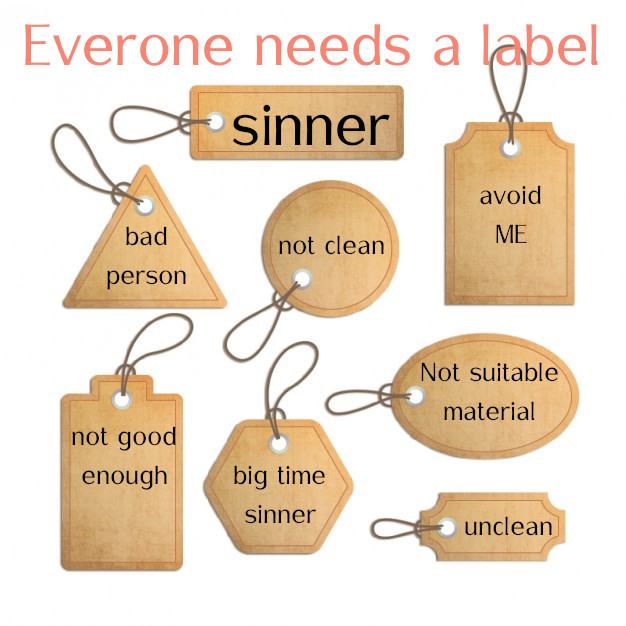
Friend of sinners (not!)

Jesus was a friend of ‘sinners’ and for that we should be grateful, otherwise what hope was and is there for us. The other day I thought I wonder if he really was a friend of sinners, for it was not something he claimed for himself but what was said about him:

 The Son of Man has come eating and drinking, and you say, ‘Look at him! A glutton and a drunkard, a friend of tax collectors and sinners!’ (Luke 7: 34).

Labels

‘Sinners’ is a label, and of course a true description, but it can be easy to use labels. I doubt somehow if Jesus labelled people or saw them according to the label given. I suggest he was a friend of people, and cut across all the societal and religious labels. In the Lucan passage the next story is of Jesus being invited by one of those who specialised in labels (a Pharisee) and asked Jesus to come and eat with him. We read:

One of the Pharisees asked him to eat with him, and he went into the Pharisee’s house and reclined at table.

He eats with people! Those with labels and those who can dish the labels out. While eating at Simon’s house a ‘woman who was a sinner’ came in to the house. The interaction that follows is more than a little inappropriate by the custom of the day, and Simon is understandably offended, saying to himself that this woman is a ‘sinner’ and any prophet would have seen that, even if blindfolded. Two ways of seeing the person who has interrupted the meal – a ‘sinner’ or a ‘woman’. Jesus asks the penetrating question:

Do you see this woman? (Luke 7:44)

Simon had only seen the woman, but in seeing the woman as a sinner he had not been able to see either the woman or the activity of God in his own front room.

Was Jesus the friend of sinners? Well he ate with the righteous and the unrighteous. He saw beyond labels.

The label put on Jesus, ‘friend of sinners’ is partially true, but one that if I attempt to follow him should be aimed at me too.

It is important who we eat with (angels are very interested in this but that is another topic) but it is more important how we eat with them. As friends.

If you build it?

‘If you build it they will come’ (Field of Dreams, 1989) is a powerful inspirational strap line. Go do something, set it out and there will be a response; rather than try to get the result consider the context. A truly motivational directive. At some level this is what lay behind the flow of the OT hope where something will happen in Jerusalem and the nations will be drawn to it. In the days when there was no visible centre there (Temple) the hope was for its rebuilding and the nations would then come to that place where the glory of God was and acknowledge the One true God. Such a strong motivational and eschatological hope.

Cyrus was proclaimed the Lord’s anointed and in the (normally) last book of the Writings (2 Chronicles for us) we read that he instructed the people to go (re-)build a temple in Jerusalem:

This is what Cyrus king of Persia says:
‘The Lord, the God of heaven, has given me all the kingdoms of the earth and he has appointed me to build a temple for him at Jerusalem in Judah. Any of his people among you may go up, and may the Lord their God be with them.’ (2 Chron. 36: 23).

In Matthew’s Gospel with its focus on the fulfilment of Scripture we find such a clear echo of those words as that Gospel closes with the ‘Great Commission’:

Then Jesus came to them and said, “All authority in heaven and on earth has been given to me. Therefore go and make disciples of all nations, baptizing them in the name of the Father and of the Son and of the Holy Spirit, and teaching them to obey everything I have commanded you. And surely I am with you always, to the very end of the age.” (Matt. 28: 18-20).

The parallels are clear:

  • authority given
  • go
  • promised presence.

Fulfilments are not repeats but often transform the original hope. As inspirational as the ‘go build it’ was and a stretch to faith, the scope of the Jesus’ commission and the how to do it are in another league all together.

Build it somewhere becomes be everywhere; go to a place becomes go from a place; and the clear implication is that the Temple being built will not be with literal stones, nor confined to a specific geography but invisible and universal.

In Field of Dreams the challenge was to build something not knowing what the result will be. Build something and believe there will be a result was a clear challenge to faith. In the Jesus’ commission the challenge to faith is so much greater. Don’t even build something, but have a very clear focus, and something will be invisibly built. He also does not focus on ‘they will come’ but on ‘I will come’.

Everywhere can manifest somewhere: ‘where two or three are gathered together’; but the somewheres must never claim to be everywhere nor create borders that stop people going everywhere. (I hope that sentence makes sense!) Jerusalem is not the goal, the New Jerusalem is the goal, that image of the total transformation of the then known world, the presence of God being the light that fills everywhere. That presence can manifest in specific places at specific times, but when any wonderful expression of God is held on to it can eventually resist the very reason for the manifestation. This is why there is such a need for continued apostolic and prophetic ministry as new terrain is entered into. Any centres that are reproduced, in the big scheme of things, can only be temporary. The Revelation vision is not I saw a Temple, nor I saw many Temples, but I saw no Temple, the city without a Temple.

The Jesus’ commission is of the continual movement into new terrain by those imbibed by his Spirit, God building something where previously there was either rubble or nothing. At the core is a multiplication of ‘disciples’ (learners) and those who are walking in the light of the presence among them.

If we do not keep the big picture in front of us, the steps along the way will become the camp, the model to be reproduced. There is no model. There is only a journey and the step we take on that journey will depend on our context at that time. True north sets the direction; the Spirit calls for followers; followers are promised his presence.

SHARE ON:

Post PermaLink

A diverse meditation

While doing the washing up this morning I had a meditation. I know some of you will be surprised I had a meditation… What!! I even hear some of you saying to yourselves – Martin doing the washing up, it must be a sign of the end of all things! Shame on you…

Once we move beyond (abandon) the book of Revelation as some kind of history written in advance and allow it to be a revelation that opens our eyes / imagination to all things pertinent at all times we can have a few insights that do more than fill us with fear. (When was fear ever the context in which we were to make decisions?)

Then I heard what sounded like a great multitude, like the roar of rushing waters and like loud peals of thunder, shouting… (Rev. 19:6).

Come, I will show you the punishment of the great prostitute, who sits by many waters (Rev. 17:2).

After this I looked, and there before me was a great multitude that no one could count, from every nation, tribe, people and language, standing before the throne and before the Lamb (Rev. 7:9).

The above are a sample of Scriptures from Revelation. The sound like the roar of rushing water: I have written on this before, the diversity of sound, the languages together, no language above another. That is the sound of heaven. In contrast Babylon sits on (Gk.: epi) many waters. Using power but to only express one aspect.

The multitude made up of, the oft-repeated phrase in Revelation, those from every nation, tribe, people and language.

How far do we have to go for ‘on earth as in heaven’. I was meditating this morning on a city that has a tremendous ethnic diversity, and considering the prominent expression of the body of Christ there. If I contrast my meditation with that of Revelation:

  • I heard the sound like that of many waters
  • I heard the sound and it was one voice that I heard
  • I saw the make up of the people – cultural, ethnic, color and language diversity
  • I saw a monochrome people.

I do not write this though as critical of anywhere. My meditation took me to my own house and context. We must continue to pray ‘on earth as in heaven’ – then make room for the wonderful mess. Waters coming together are always dangerous.

I am focused too on a future trip to Brazil. So much going on there. A key is the voice of Brazil, not the Portuguese translation of a voice from elsewhere.

Heaven on earth. Now that is a dream (for the old) or a vision (for the youth).

SHARE ON:

Post PermaLink

A little more in Genesis

Another Pentecost theme of course comes with the Tower of Babel (Gen 11). The confusion of the languages was in order that ‘what they propose to do will not be possible for them’… if Pentecost is in some way a reversal of the confusion of languages, then there is an intended release through Pentecost for true imagination and collaboration. Yet Pentecost does not reverse Babel. They do not all speak the same language, but something richer and more diverse takes place – they hear them speak in their own language. There is an honouring of the diversity and cultural differences, but each can experience heaven in their own setting.

In Babel there is the humourous element. The people say ‘let us build a tower with its top in the heavens’. God’s response (who is in heaven) is to ‘come down’. Apparently the tower was not that impressive! Perhaps it was such a pimple on God’s landscape that he could not see it from the heavens? Babel / Babylon will always rise up with ‘wonderful’ aims and promises. But it rises up, and is always unfinished (‘they left off building the city’). With chapter 11 we finish a kind of ‘OT of the OT’. It is to the story of Israel what the OT is to the story of Christ and those in him. We have then the backdrop to Israel’s (sadly failed) royal priestly journey for the nations (Gen. 10). We end the series of falls: the series of alienations through failing to live within boundaries. Hence salvation has to have a core theme of reconciliation, finding the boundaries, releasing others to live within their boundary.

Every aspect of life is deeply impacted with the ‘falls’:

  • God and human relationship, with the primary element not knowing who God is. ‘I heard you… I was afraid and I hid’.
  • The intra-human relationship, beginning at the gender level as shown by the Adam / Eve fall out. Patriarchy is a result of the fall: hence I see Jesus as necessarily male and Jewish (the two primary ‘sinners’).
  • The intra-human with family breakdown, murder; the building of towers, nations etc.
  • The human and resultant thorns and thistles of creation. The whole environment is polluted as a result of sin.
  • There is human and demonic warfare. Whatever and whoever the devil and demons are they are not somehow the equal and opposite of God. They might though be the equal and opposite of humanity. (Hence dehumanisation is demonisation in the extreme.) They are there for us to overcome: hence again the necessity of Jesus’ humanity.
  • The pride of nations rising up in conflict. Diversity gets turned to conflict rather than mutual edification.
  • And whatever the strange chapter 6 deals with of ‘the sons of God’ and the ‘daughters of humans’ it indicates somehow the wrong alignment of the angelic and the human.

Every aspect of human life is affected. And every aspect of the above is lived out in right alignment in Jesus, the only true human.

I am agnostic if there was ‘a’ historic fall, as I am also agnostic about a literal Adam and Eve. But a fall, or series of falls there certainly was and this seems to culminate with the corporate desire to ‘make a name for ourselves’ (Gen. 11: 4). What a contrast to the work of God who promises to make Abraham’s name ‘great’.

Gen. 1-11 sets the scene.

  • A creation that God is committed to (hence no burning up in the end – but the new heavens and new earth, with the Greek indicating ‘renewed’ rather than having no relationship to what has gone before).
  • A creation that is good, and with everything within it to release potential for perfection. Perfection is not the beginning, but the end. The beginning is potential.
  • A series of falls are described – seemingly to indicate what needs and will be redeemed.
  • A creation that humanity was to steward. The image in the garden is strong temple type language. Let your kingdom come on earth (or at least the garden) as it is in heaven.
  • Creation is to be the place where heaven is revealed. Humanity is deeply honoured by heaven. Materiality is where spirit is made visible; humanity is where divinity is to be revealed.

SHARE ON:

Post PermaLink

Starting Again

Another year so I have started again in Genesis. Always good to come back to Scriptures afresh (although anticipating what is yet to be read to also realise that parts of Scripture never seem that fresh… Leviticus and freshness?).

So just a few reflections. Genesis 1:1-3 and then the clear way in which Pentecost echoes it: wind and speech. The wind can only come from heaven, speech in phase 1 is from God, but in phase 2 from those touched by the Spirit. ‘God spoke’ becomes ‘and they all began to speak…’

God named what he created: ‘God called the dome Sky’ etc.

But in chapter 2 he brings to the human all the animals – ‘to see what s/he would call them; and whatever the human called each living creature that was its name.’

That is quite something indicating the partnering of heaven with earth from the get-go.

Genesis 3 and the expulsion from Eden. Leaving with a perception of being abandonned, but in reality God goes with them. The echoes with the 2 disciples leaving Jerusalem to go to Emmaus again seem clear. (I take it the two were also husband and wife: Mary and Cleopas.) Jesus goes with them in their journey of disappointment. Their eyes are opened, hearts burning to replace the burning swords of exclusion.

Genesis 4 and the response to the first recorded murder. Not an eye for an eye but protection.

Then today reading on the flood. Difficult to be a literalist. I only noticed this time round that the waters covered all the high mountains under the whole heaven to depth of fifteen cubits. Now that would be a FLOOD.

The literature is rich and far too rich to be reduced to literalness.

So the opening days I have enjoyed my readings. Maybe even Leviticus and the later genealogies will be fresh and exciting this year too!!

SHARE ON:

Post PermaLink

Animals together

Jesus might have had a little twinkle in his eye when he sent out the disciples imparting an identity to them:

I am sending you out like sheep among wolves. So be as wise as snakes and as harmless as doves.

Apparently on the ‘wolf restaurant’ there are all varieties of dishes with lamb as the star of each dish: roast lamb, boiled lamb, barbecued lamb, lamb in salsa… They seem to just love eating lamb! Just a tad vulnerable I think.

It struck me the other day that if Isaiah has a value as a backdrop to so much of the New Testament we have two passages there that tie in: Isaiah 11:1-9, and the shorter passage Isaiah 66: 25

Wolves and lambs will eat together.
Lions will eat straw like oxen.
Serpents will not bite anyone.
They will eat nothing but dust.
None of those animals will harm or destroy
anything or anyone on my holy mountain of Zion.

For those who have followed our journey through the ReConquista we have come to understand that Paul’s Gospel had at its heart ‘convivencia’, and that the body of Christ as royal priesthood carries a catalytic responsibility for the society where it is located so that the society might be a place where at a real level convivencia is manifest. This is indeed a tall challenge when we look at the state of the world as we have it, but we would also contend that society has been hampered from experiencing anything approaching convivencia by the invasion of empire into the church. Imperialism draws on (supposed) external authority to legitimise its behaviour as the ‘good’ manifestation of power so as they can at least give benefits to those who comply if not punish those who do not comply. In Christendom terms it means we can name some nations as ‘sheep’ nations and expect increasingly for some kind of Christianised laws to be applied, allowing us to purify the land through increased border controls.

This is why we are convinced that there is a revolution (a turning around) that is at hand. 500 years after the Reformation there is a rooting out of imperialism. For empires to really shift there has to be a shift in the church. The breaking free from the paradigm of ‘the few at the centre who shape the future, promising benefits to those who comply, while in reality the benefits make their way back to the centre.’ At the last supper Jesus set the pattern of breaking the centre. He gave himself away, including to Judas, thus any former centre had been dissipated. Pentecost follows the same pattern – on all flesh, and with an emphasis on the margins. The margins became the new focus – hence not a hope of a rebuilt temple in Jerusalem!

In these days something has to be pioneered, and maybe the place where this could take place is in ‘secularised’ Europe. I consider it is certainly easier to see such a shift in a place where the church is already marginalised. Easier never to dream of being a centre when without power, than of having a key place at the table of power (early church vs. post-Constantine). All that has to be dealt with is ‘fear’ and all that needs to be increased is faith.

Lambs among wolves – that is a fear inspiring identity, and requires a faith increase.

Convivencia – the lamb and the wolf lying down together, eating together. The vision of the kingdom, a vision of convivencia. Sadly, as we have seen in the ReConquista, the wolf identity was too often taken by those who claimed to follow Jesus. At best we end up with wolf against wolf (war) and at worst the followers of Christ place on the table their ‘enemy’ to eat: a complete reversal of the Jesus’ paradigm.

This next phase will require faith at a new level, and with it many changes of paradigm. It will require mission being understood as relocation. Sent among. It will require witness more than evangelism. Or maybe evangelism will not be something done but something proclaimed – a new order of being and relationship, and that will have to be witnessed to. It will require an understanding that we are not here to get as many out of the world into the church, but as much of heaven into the world.

There are many ways this can be expressed. Of late the understanding of Israel and then the church as royal priesthood has been illuminating. The pursuit of the path toward nationhood by Israel marked her failure, and the alignment of church with Imperial power so that there was a mutual endorsement of each other likewise marked her failure. But if we can recover the vision of this being God’s world, and that there is a redeemed people so that the presence of heaven might be beyond that redeemed people (‘the two hands of God’ as per the early church fathers) we will see a profound shift and progress. Maybe if we can embrace new paradigms more opens up than is closed down. Of course we will lose something – our specialness in the wrong sense; an understanding of grace as salvation as opposed to a gift-calling to serve and to lay down one’s life; a shift from power to love; from the taking of life to the giving of life.

Royal priesthood as calling, or maybe we can suggest it will manifest as a true convivencia. Space opened up where all can live together, where hospitality reigns, where it is not dependent on age, gender, race nor religion. Holding that space in humility with the clarity that Jesus alone is the way to the Father is a challenge. He exhibited what it was to create convivencia. Those who set themselves against that were the religious exclusivists, those who would not give hospitality would find that their future would be harsher than that of Sodom. The way of Jesus is not one way among many, but it is the way for the many to live together.

Challenging days ahead. But as lambs we have to be.

SHARE ON:

Post PermaLink

Posting a good quote

We are in Gibraltar and making a plan or two. While on the road we have read a little of The Day the Revolution Began and a few days ago we read Wright in the opening paragraphs of a chapter on Romans. These depth contained in these few sentences slowed us right down:

The primary human problem that Paul notes in Romans 1:18 is not “sin”, but “ungodliness”. It is a failure not primarily of behaviour (though that follows), but of worship. Worship the wrong divinity, and instead of reflecting God’s wise order into the world you will reflect and then produce a distortion: something out of joint, something “unjust”. That is the problem, says Paul: “ungodliness” produces “out-of jointness,” “injustice.”

For us very profound. And if our paradigm for God’s core is ‘power’ then we head in one direction, if ‘love’ then the direction changes…”

SHARE ON:

Post PermaLink

Get a sword

I have seen a little bit of to and fro on the ‘get armed / right to have guns’ scenario and this little problematic verse from Luke 22:36 thrown in:

But now let the one who has a moneybag take it, and likewise a knapsack. And let the one who has no sword sell his cloak and buy one.

The issue with the Bible is that it does not give us a set of rules, a checklist that we can tick off. Checkbox with ‘buy a sword’ is not how it works. We have to wrestle with the Bible, and eventually these issues are issues of faith. How do I read it in the light of the call to follow the Lamb wherever he goes.

So what thoughts on this verse? I am not swamped in books here so cannot even say ‘the Bishop says…’

1. The times are changing is the context of the question. Remember when I sent you out – no sword, no provision and all that? Did you come out of it OK?

“When I sent you out with no moneybag or knapsack or sandals, did you lack anything?” They said, “Nothing.” (22:35)

That was then… now you need to expect something different (‘but now’). This is not a time of being accepted but of being rejected.

2. The immediate reason for the instruction is in the verse that follows the sword instruction:

For I tell you that this Scripture must be fulfilled in me: ‘And he was numbered with the transgressors.’ For what is written about me has its fulfillment.”

So a very plausible explanation is that there was a necessity of having some weapons among the arrested band of disciples so as there was guilt – transgression (and certainly transgression of the Sermon on the Mount) – that could be put on them. If this is the reason once Jesus found out that they had two swords he said – ‘enough we don’t need any more than that’. Just enough evidence but certainly not enough to respond in violence to the accusers.

And they said, “Look, Lord, here are two swords.” And he said to them, “It is enough.”

Jumping forward when Peter did use the sword, presumably one of the two, Jesus very quickly responded with his rebuke of Peter:

And when those who were around him saw what would follow, they said, “Lord, shall we strike with the sword?” And one of them struck the servant of the high priest and cut off his right ear. But Jesus said, “No more of this!” And he touched his ear and healed him. Then Jesus said to the chief priests and officers of the temple and elders, who had come out against him, “Have you come out as against a robber, with swords and clubs? When I was with you day after day in the temple, you did not lay hands on me. But this is your hour, and the power of darkness.” (Luke 22:49-53)

The rebuke in Matthew is even stronger

And behold, one of those who were with Jesus stretched out his hand and drew his sword and struck the servant of the high priest and cut off his ear. Then Jesus said to him, “Put your sword back into its place. For all who take the sword will perish by the sword. Do you think that I cannot appeal to my Father, and he will at once send me more than twelve legions of angels? But how then should the Scriptures be fulfilled, that it must be so?” At that hour Jesus said to the crowds, “Have you come out as against a robber, with swords and clubs to capture me? Day after day I sat in the temple teaching, and you did not seize me. But all this has taken place that the Scriptures of the prophets might be fulfilled.” Then all the disciples left him and fled. (Matt. 26:51-56)

So if Jesus is literally saying we have enough swords so don’t go and buy any more (‘It’s enough’) the reason for the swords could well have been on let’s give them some evidence. The rebuke when the sword was used was absolutely clear. ‘Put your sword back in its place’.

In John 18:36 we have:

Jesus answered, “My kingdom is not of this world. If my kingdom were of this world, my servants would have been fighting, that I might not be delivered over to the Jews. But my kingdom is not from the world.”

So again it is clear that violence was eschewed by Jesus. Whatever he meant by the sword was not ‘get armed’ and certainly not ‘the kingdom is under threat so be armed to defend it for righteousness’ sake!’

There might even be one more possible way in to the Luke passage. What if Jesus was provoking the disciples to a higher understanding? What if they were to make a response of ‘but we take your teaching seriously and we are not planning on buying a sword’? Maybe that is why Jesus is not simply saying two swords are enough, but maybe in response to the ‘we have two’ that he is somewhat exasperated with their lack of kingdom response and he comes back with a ‘That’s enough of your nonsense’.

Anyway… no way can I consider this verse the endorsement for possession of weaponry.

SHARE ON:

Post PermaLink

Jesus’ family line

This will be my last post pre-Christmas… So to one and all who read and follow these rather random posts a thank you and trust that you will have some great reflections over this period. Maybe a time to re-centre.

Matthew’s Gospel is one that has the oft-repeated phrase or concept of fulfilment of Scripture. The opening words that introduce us to the ‘genesis’ of Jesus Christ resonates with the first book of the Hebrew scriptures and so it goes on right to the final words of Jesus in the Great Commission and the echo of Cyrus’ words at the close of the Hebrew Scriptures and the normal last book of the Writings (2 Chronicles).

His account of the family line for Jesus is interesting with his setting of it as being in 3 sections of 14 generations, positioning the entry of Jesus as at the end of the Exile. Then in the genealogy we have the mention of four women. The inclusion of women in this way is highly unusual for biblical or ancient non-biblical records. Maybe Matthew does not appear as radically non-patriarchial as Luke, but he outdoes Luke at this point. Then consider who he includes.

Tamar, Rahab, Ruth and Bathsheba. Tamar subjected to incest, Rahab described as a prostitute (and non-Jewish), Ruth a Moabite and perhaps a seducer, and Bathsheba a married woman caught up in David’s adultery.

A pure line? Not so, neither pure racially nor sexually.

Of course one could argue none of that means anything as we go on to read of the virgin birth, but given the unusual element of including women in these ancient records their inclusion surely must be communicating something significant. Maybe well-beyond the three simple points I make here.

  • Jesus has enough crap attached to his genealogy to screw up his identity, but finds his identity in his heavenly alignment. (He also has the stigma of his own questionable legitimacy; the identity of a refugee; the probable loss of his father at an early age to contend with.)
  • Given that none of the women are described in any way as relating to any wrongdoing indicates something huge. (Even Bathsheba is referred to that she ‘had been the wife of Uriah’.) Identity flows from our direction rather than our origins.
  • Pure qualifications do not seem to be the channel that heaven needs to enter the world.

Christmas: God with us, but not any god, the God revealed in Jesus. Not a religious judgmental God, but one desiring to be tarnished with humanity’s mess. Good news and true peace that resolves inner conflicts.

SHARE ON:

Post PermaLink

The mistaken prediction?

Peter Enns had Christopher M. Hays and C. A. Strine explain the thesis of their book When the Son of Man Didn’t Come which (I summarise) suggests Jesus’ prediction about his return indicates he expected it before the end of the first century. In that sense he was mistaken but only if we understand prophecy as prediction. Prophecy is rather conditional and hence:

The Kingdom has not been fulfilled, as Peter explains, because people dropped the ball. Therefore, everyone should bust their butts to speed up the arrival of the Kingdom of God.

I of course have hardly done the book (or indeed the three posts) justice so here are the three posts:

peteenns.com/on-why-jesus-hasnt-come-back-yet-and-the-answer-may-shock-you/
peteenns.com/guess-what-prophecies-arent-predictions-of-the-future-you-can-look-it-up/
peteenns.com/why-jesus-hasnt-come-back-yet-according-to-the-new-testament/

Hays-book-200x300My purpose in picking this up is not to cover the book – the material looks excellent – but to suggest that the coming of the Son of Man is not primarily referring to the parousia and thus I am not convinced that Jesus was predicting that event. And given that I do see prophecy as conditional (and there are unfulfilled prophecies in Scripture – John Goldingay has some great examples of that) and that I am pretty convinced about Open Theism the ‘solution’ presented in the book is not an issue for me. However… here is where the posts began:

“Truly I tell you, there are some standing here who will not taste death until they see that the kingdom of God has come with power” (Mark 9:1).

He assured them, “Truly I tell you, this generation will not pass away until all these things have taken place” (13:30)—“all these things” apparently including reference to the “Son of Man coming in clouds with great power and glory.”

In light of that promise he adjured them again and again, “keep alert . . . keep awake . . . keep awake” (Mark 13:33-37), for “truly I tell you, you will not have gone through all the towns of Israel before the Son of Man comes” (Matt. 10:23).

Admittedly, he said that nobody would know the “hour or the day” of his return, but in general terms, Jesus definitely prophesied that he would be back before the end of the first century.
And since we are still here, it seems like he was pretty wrong!

The coming of the son of Man does seem to be rooted in the Danielic vision of chapter 7:

I saw in the night visions, and behold, with the clouds of heaven
there came one like a son of man, and he came to the Ancient of Days
and was presented before him.
And to him was given dominion and glory and a kingdom,
that all peoples, nations, and languages should serve him; his dominion is an everlasting dominion,
which shall not pass away, and his kingdom one that shall not be destroyed.

If we give these verses a Christocentric interpretation then this could be a future vision of final judgement. In the context it is probably giving great hope that a representative will indeed be granted by God to rule when the beastly oppressing nations are judged. If Daniel, in the form we have it, is essentially placed in the Maccabean period then we have here great hope of God’s intervention. In the NT the hope is taken beyond that to the hope of Jesus as Messiah’s rule. I think a question we have to answer is when does that take place? Or maybe does is there one and only one future event that will indicate that has taken place? (Incidentally in the above scriptural quotes from the posts, the Matt. 10:23 one of ‘before the Son of Man comes’ does not even use parousia type language. Jesus uses the verb erchomai probably just referring to his reunion with the disciples in the very near future, after the twelve disciples have gone out in his name and before they head toward Jerusalem.)

Jesus said to the High Priest that in Mark 14:62:

“you will see the Son of Man seated at the right hand of Power, and coming with the clouds of heaven.”

This is surely not a prediction concerning the parousia but that if they have eyes to see the resurrection will indeed be evidence that Jesus is vindicated and is coming with the clouds of heaven not to earth but to the Ancient of Days.

In the Olivet Discourse we have in the three passages:

Immediately after the tribulation of those days the sun will be darkened, and the moon will not give its light, and the stars will fall from heaven, and the powers of the heavens will be shaken. Then will appear in heaven the sign of the Son of Man, and then all the tribes of the earth will mourn, and they will see the Son of Man coming on the clouds of heaven with power and great glory. And he will send out his angels with a loud trumpet call, and they will gather his elect from the four winds, from one end of heaven to the other. (Matt. 24: 29-31).

But in those days, after that tribulation, the sun will be darkened, and the moon will not give its light, and the stars will be falling from heaven, and the powers in the heavens will be shaken. And then they will see the Son of Man coming in clouds with great power and glory. And then he will send out the angels and gather his elect from the four winds, from the ends of the earth to the ends of heaven. (Mark 13: 14-27).

And there will be signs in sun and moon and stars, and on the earth distress of nations in perplexity because of the roaring of the sea and the waves, people fainting with fear and with foreboding of what is coming on the world. For the powers of the heavens will be shaken. And then they will see the Son of Man coming in a cloud with power and great glory. Now when these things begin to take place, straighten up and raise your heads, because your redemption is drawing near.

Maybe Matthew’s addition of ‘the sign’ of the coming of the Son of Man is significant, but even if not the coming of the Son of Man is not primarily a coming of Jesus a ‘second’ time from heaven to earth, but of the Son of Man coming to the Ancient of Days, as per Daniel. If we think fluidly, such as the Christ Event being the Incarnation – Baptism – Ministry – Cross – Resurrection – Ascension – Return we can likewise suggest that the ‘Coming of the son of Man’ predictions are not tied into the commonly understood return of Jesus but refers to all evidences that the Son of Man has indeed come in the clouds to the Ancient of Days. The sign and the reality are there to be seen.

In the light of that I do not think we need to posit that Jesus was mistaken. I do though suggest that given the conditional nature of prophecy that we can ‘hasten the day’ of his return. We do not build the kingdom, the New Jerusalem does not rise up, but comes down from the throne of God from heaven to earth, but I tie together the building materials of 1 Cor. 3 and the materials of the New Jerusalem and suggest the delay is because there is as yet insufficient building material for the cosmic temple, the New Jerusalem, the transformed earth. So to quote from the posts I do agree that:

Therefore, everyone should bust their butts to speed up the arrival of the Kingdom of God.

SHARE ON:

Post PermaLink

Perspectives