Simply profound

Ever find something hard to understand – or is it only me? I was once told that truth is both simple and yet profound. Sometimes though getting hold of what someone is saying / writing is not always so easy. Words used, and wait for it, the ‘presuppositional pool’ might mean we don’t quite get it. In this post I am going to recommend a video and a post from two important contributors in the realm of theology and its application.

I am grateful for Roger Mitchell’s work and also for having the privilege to dialogue with him so (I think) I have some grasp on his important writings. In his introduction to the video that appears below he writes:

If you find me hard to read as some do, although by no means all, then this talk will help hugely!! As an activist I find it s much easier to make sense at a popular level when I’m in context hands on. Here I am!

There is so much meat in the talk and his explanation of why he pursued his PhD is very clear. He came at it with three questions:

  • why do the rich and powerful always end up at the top?
  • why is it the same way in the church?
  • and why has the church actively supported / endorsed and strengthened that scenario?

Let the ‘ouch’ of those three questions sink in and then here is the link to the video:

The second post I suggest that is more than worth a read is one by Andrew Perriman. The opening paragraph reads:

Here I want to try and answer some questions sent to me by someone who grew up in the “reformed, fundamental, SBC” tradition but has spent the best part of the last year deconstructing his faith “down to nothing.” He has been reading the work of historically-minded interpreters like Pete Enns and NTWright, but has been having a hard time finding a way forward. His faith is sinking. “I currently don’t see any reason to be a Christian or to continue in the Christian way.”

Sinking faith feeling

I do not find and agreement with the perspective that Christendom is the fulfilment of the hope that God is acknowledged as Lord of the nations, so on that I do not go along with Andrew, but his writings and his insistence on the narrative shaping theology is invaluable. This post I reference above will help enormously in understanding this.

Render to Caesar

Give therefore to the emperor the things that are the emperor’s, and to God the things that are God’s (Matt. 22:21).

A nice neat verse to keep my spiritual life and my relationship to the powers separate. Be a good boy and just do whatever the powers ask because the two are ever so separate.

Really?

The context for the ‘render to Caesar / God’ reply is toward the climax of the ministry of Jesus. It is centred in occupied Jerusalem and the compromised Temple. The revolutionary has come to town. He has made his entry into Jerusalem on a donkey coinciding and contrasting with the military parade coming in from the west (see: https://3generations.eu/posts/2017/03/provocative-or-what/). The whole city was in turmoil as ‘the prophet from Galilee’ had arrived (Matt. 21:10, 11). Soon after this he makes the very dramatic (and deeply prophetic) act of turning over tables in the Temple, calling for it to be a house of prayer for the nations.

So the scene is set. Tension is high. How dangerous is he? What kind of revolution is he likely to spark? What will be the event that provokes the start of something that will be hard to stop?

The Pharisees with Herodians look to trap him. He is being set up to lose. They pose the question about the legality (from the Torah point of view) of paying taxes to Rome. Pay taxes (the Herodian view) and how ineffective Jesus will appear. He will be seen as lacking courage and selling out. However, refuse to pay taxes and he can be arrested on the grounds of sedition.

Jesus first asks for a coin. They produce the coin, and he deliberately asks them about the image and title on the coin. These ‘holy’ questioners are able to produce a coin with an image on it that is an affront to their own religion, even blasphemous. The image is of Tiberius and the wording is ‘high priest’, ‘son of the divine Augustus’.

In that world the coin (or any such article) belonged to the person whose image appeared on it. The coin therefore was Caesar’s – or so he claimed. Here they (religious Jews) are with pagan coinage, image and titles proclaiming the Imperial myth. ‘Give it back, have nothing to do with that system’ is certainly how Jesus’ response can be understood. (We might well argue though without money we cannot buy and sell… and we might wish to object in one less that 667 ways!). Further you (Jews), as a sign to the world, are image bearers, you bear the image of God (as do all humans). Indeed the whole world belongs to God. The coin belongs to Caesar – that is his claim – but you belong to God. So there is a simple transaction that is to take place. (Caesar’s claim was also false – thus complicating the response required.)

The question started at the wrong end. If the second part is not worked out in totality how can the first part ever be answered? In the light of 100% to God now what are you going to do with the first part, the demand for taxes by Caesar?

There is probably another aspect underneath the passage, a strong allusion to 1 Maccabees 2:29-41 where the dying Mattathias says to his sons:

Judas Maccabaeus has been a mighty warrior from his youth; he shall command the army for you and fight the battle against the peoples. You shall rally around you all who observe the law, and avenge the wrong done to your people. Pay back the Gentiles in full, and obey the commands of the law.

The result of ‘paying back the Gentile in full’ was the armed revolt, the Greeks were defeated, the Temple cleansed and a royal dynasty that lasted 100 years was established.

The instruction was to ‘give back to the Gentiles what they deserve’, and do it within the boundaries of zealous observation of the law.

The texts and the events of the Maccabean period were well known as part of the context in which the people understood the Roman occupation. In the light of that Jesus response is not a clever division of state over here and faith over there – one public and one private. His answer is revolutionary. Give back to Caesar what he deserves. Pick up arms as per the former rebellion against the powers? Maybe some understood it as that.

In the context of being an image bearer how do we respond to the state? The state is not ordained from above. All powers are relative, none can command absolute obedience.

Allegiance to Jesus? Revolution with Jesus.

Reconciliation – how?

The second question that Johnson’s article presented was how we answer the question of how is a person reconciled to God. Through the atoning work of Christ on the cross being the answer.

Good answer… and the ‘sub-‘answers?

Well they can really vary. He died for all and all means all and all are saved / reconciled. He died just for the elect, those predestined by God. He atoned for sin in the sense of paying for our debts… he appeased God… and so the answers go on.

So given that I am responding to the article and so cannot be put outside the box as unorthodox here are a few pointers as to where I am at.

  • A first and very important point for me is that God did not need to be reconciled to humanity. The issues are not on his side! He was in Christ reconciling the world to himself. There is no sense of God being appeased, his ‘wrath’ is not some sort of mega-anger!
  • The death of Jesus is for all, not for a few. Fully understanding how his death accomplishes this might finally evade us, evidenced by the variety of metaphors used in Scripture. In some way his death is for Israel, he is their representative, so that the curse if broken off them. The chosen people then are all those who are in Messiah – first the remnant of (natural) Israel who respond to Jesus and those grafted in of Gentile disciples. This does have implications for who are ‘the chosen people’. Messiah is chosen and all in him are chosen. The death of Jesus makes a difference to all previous divisions. There is literally a new humanity whose task is to prepare the materials for the new creation.
  • All those who by faith receive this Jesus as Lord are part of that redeemed community. Those who knowingly reject this Jesus (and not simply a Jesus presented to them theologically) are lost.
  • The warnings of Hebrews are not theoretical as there has to be a continuance in the faith. Those who persevere to the end will be saved.
  • Getting ‘saved’ has been reduced to a prayer and a pronouncement that the person who has said that prayer is now ‘born again’ (using a phrase that Jesus only used once!). Salvation in Scripture is far more than being safe. It is about moving from one dimension to another, living out what is seen – living as though there is already a new creation.
  • There should be clear evidence of reconciliation. The ‘sinner’s prayer’ might be a good starting point. It is certainly a very bad end point. The evidence of reconciliation has to affect every aspect that the falls damaged. This includes human inter-relationships, care for the creation (‘mother earth’ is not too big a heresy – humanity came from the earth, but creation is not divine, nor was my mother!). We are rightly appalled at the appeal for abortion on demand, yet the way we are happy to pollute the planet and rob future generations of life seems OK. That is not how it should be.
  • Will all be reconciled to God? Will there be those who lose their salvation? We’ll find out one day.

I am convinced that there will be some major surprises when this creation is transformed by the appearance of Christ. Surprised how far the death of Jesus reached and to who. No one will have made it there through their own self-effort. Even for those who ‘fear God and do what is right’ in every nation (regardless of faith) will make it because of the death of Jesus.

A narrative going somewhere

How do we read Scripture? Many decades ago I came across an early lecture by NT Wright where he suggested that the authority of Scripture lay in its narrative. This probably should not surprise us, after all so much of Scripture is narrative. It is certainly not laid out as a systematic theology. Even the books of the law are mainly narratival, and where we have laws they are in the context of being given to a people on a journey.

An aside: the image is of Derek Flood’s book ‘Disarming Scripture’. I am not covering the material he covers here and it is more than worth a read. He says we can have an approach that is a blind obedience to what we read or a faithful questioning. He suggests that the Bible itself demands the latter, and in approaching the violent texts of Scripture shows how both Paul and Jesus selectively quote passages and ‘delete’ parts. I suggest this is not a cop out and challenges us to read, ‘be read’ and place Jesus at the centre of all things.

The narrative takes us from Creation to New Creation. It travels through a series of ‘falls’, the calling of Israel, the failure of Israel, the beginnings of a faithful remnant as marked by the baptism of John, centring in on the baptism of the only true human / remnant of Israel (Jesus). It is inevitable that once he is baptised John must decrease, the one who was the ‘greatest born of women’ prior to that watershed, for from then on the least in the kingdom of heaven would be greater than John. The watershed is marked and huge. The NT, and indeed Jesus himself does not give us the option of being faithful to the narrative of Scripture by equalising all things. With Jesus there is a seismic shift. This is why he has to be the lens that Scripture is read through and critiqued, and in that sense parts of it ‘rejected’.

From Incarnation through resurrection and outpoured Spirit the narrative follows those who have responded to the ‘Gospel’ and are collectively known as the body of Christ: those caught in the in-between, already having received the firstfruits of the Spirit but not yet living totally out that fullness, nor living in the fullness of what is yet to come. A new humanity on a journey, a narrative pushing for a fitting end, with a new heaven and new earth (a merism for all of creation being renewed).

Now when I read Scripture I kind of have that overview. Texts that come from an earlier part of the story are from that part of the story. They might not be relevant as is for me today. How to treat slaves might not be what I need, but there might be principles there that apply in the ‘chapter’ of the story that I am living in. Not harvesting to the full extent of the field might or might not be a good principal in an agricultural society, but surely the ‘deliberately not maximising profits’ and making sure that we make it easy for those who need to get something of ours even though they have not worked for it, could well make those earlier instructions to continue have relevance in our current chapter.

I am not so interested in was there an historical Adam (I don’t think so), or where was the Garden of Eden. I could even on a certain day be convinced that the devil does not exist (in the sense of a personal devil) – though whether he does or not I am committed to cast out demons and seek to confront demonic powers where I see them! It is quite easy being an agnostic on such things when there is a conviction that God is the author and he will be the finisher of the story that we are living within. On some issues I am not ‘orthodox’. In spite of living for two years in the Tarshish where Jonah was headed for, I think it is a made up story. But one with such a point. And a narrative worth referring to as if were ‘true’, for the (point of the) story is so true. Nineveh never took three days to cross, but always our Ninevehs take 3 days to cross (https://3generations.eu/posts/2018/04/the-third-day/)

I could go on with other examples. And with great joy I realise I could be quite wrong on some of my readings. What seems more important to me is that there should be growing evidence that Jesus, the God-human, is reflected in who I am, what I say, and how I act. To continue that journey I will need to go back to Scripture, read and re-read the various parts of the narrative, regardless of what ‘chapter’ they are of the story. I will have to let those texts ‘read’ me, while I keep an eye on where God is taking it all. To a New Jerusalem that can only come from another dimension, but can only be assembled from the acts of kindness and love carried out in this dimension.

Reading and being read

Understanding Scripture is a life-long challenge. What was once obscure can become clear, and vice versa! Johnson’s lecture sits in the context of a shift from ‘if you are orthodox you will tick the infallibility / inerrancy box’ to ‘so you accept the authority of Scripture so explain to me how you read it’.

There are die hard 7 day creationists, not because of compelling scientific evidence, but because of a prior commitment to a biblical view. There are also convinced evolutionists who are evangelical believers, e.g. Francis Collins who led the Human Genome Project that was at the forefront of mapping DNA. His book ‘The Language of God’ ties together his work as a scientist and his firm belief in God as the author of life.

There are (really there are) those who believe in the priority of male over female as part of creation and redeemed order, and there are those who refute that. That was a disputed area some 30+ years ago and although the discussions rumble on there certainly is not the same strength that suggests anyone who explains ‘man as the head of woman’ in a non-hierarchical way is denying the authority of Scripture. The same arguments abounded a few generations earlier with the debate on slavery where one well-known evangelicals of the day said that slavery was one of the clearest tenet of Scripture! Now issues of sexuality are centre stage, with evangelicals on both sides of the many divides.

I have become more agnostic on certain issues, realising how we can use Scripture to defend us, reading there what we want to read. Dare I suggest God is more interested in my ability to reflect Jesus than he is in my doctrinal set of beliefs. Orthodoxy (right doctrine, though one could argue that the word should mean giving right glory) and orthopraxy should go hand in hand. The Pharisees knew the Scriptures but…

The challenge that the shift Johnson outlines is how do we read Scripture if we are not simply finding a set of textual evidences that back our view (and sometimes either ignoring ones that don’t or doing them a disservice by squeezing them into our already formed box). There is a challenge beyond how we read the Bible – it is allowing it to read us! That’s when the ouch can hit our rightness. More tomorrow.

How long is the cord?

I wrote yesterday about how Johnson’s article presented two questions; one concerning authority and the other concerning reconciliation to God. The former relates to Scripture, the second to the atoning death (and resurrection) of Jesus.

In the old days, particularly when the authority of Scripture was being challenged, doctrines such as infallibility and inerrancy developed. Those terms took a belief beyond inspiration. Of course even with those terms there were added terms such as ‘as originally given’. The original manuscripts of course we no longer have, so in all very hard to prove. What also were we to make of statements such as ‘the mustard seed being the smallest of all seeds’ – not scientifically accurate.

I understand the desire to make the Scriptures incredibly strong and therefore totally trustworthy, but to strengthen them in that way I am not sure is warranted.

I like to talk of the authority of Scripture and how we are to live (faith and behaviour) as followers of Jesus in faithfulness to the narrative of Scripture. So terms such as authority, truth etc. fit comfortably for me. However I also have to accept that even the term ‘Scriptures’ are somewhat problematic. Which canon? And please do not exclude the book of Revelation (or even call it a ‘disputed book’ as Luther did), the surest exposure of the politics of empire that exists!

There are elements of faith with any approach to Scripture – I am very happy to accept what I read (66 books) as the canon. That means I have to exercise some measure of faith in the process the church was involved in that eventually formalised a canon (or different canons). The work was not unlike that of the formation of the Jewish canon. They used the law, the prophets and the writings, and eventually made sure some books were excluded, seemingly to make sure that ‘Christian’ writings were not used. The canon were, more or less, the books in use (found useful, cf. 2 Tim. 3:16) that were formalised. In the same way the Christian canon developed, hence the different canons.

By what authority – for me the 66 books of our old and new testaments are that authority. I cannot prove they are the right ones nor necessarily the only ones, but by faith in the work of God within the historic Christian community that I identify with those are the ones.

Inspired – for sure. Inerrant – not ready to tick that box. Contradictions within the books – maybe I would rather use the word ‘conflicts of views’. I don’t think we are to iron them all out so as they disappear, but rather with a Jesus-lens we let them argue it out, and we seriously have to raise the volume of the texts that carry a Jesus-revelation. Ultimately Jesus is the revelation of God that Scripture bears witness to. We cannot place Scripture above Jesus, nor can we create a Jesus of our own making that Scripture does not bear witness to.

In the next post I will amplify a little on the adjustment of the volume of the text so as some are louder than others. We have to ask ourselves ‘how do read that text?’, ‘what does it say to me / us?’, and also ask ‘how are we being read by that text’. We might not always get it right, but the Scriptures point to Jesus, not simply with a historic meaning, but primarily in the sense of calling us to identify with and follow the only embodiment of the Godhead in human flesh.

Labels – useful or not

The early followers of Jesus were given the name that has stuck to us ever since. They were called ‘Christians’. Not a term we tend to use in Spain as with all labels they communicate what is understood by the hearer. Of course coming up with alternatives is not always easy.

Most of the readers of this blog I guess have grown up with the label ‘evangelical’. A number of years ago I read a very informative article, a lecture given to the American Theological Society in 1995 by Robert Johnson entitled ‘Orthodoxy and Heresy: a Problem for Modern Evangelicalism’. (My words) in the old days defining heresy was easy. Affirm the inerrancy (or at least plenary inspiration) of the 66 books and that only those who have prayed the sinner’s prayer are / will be saved. He describes that approach as a ‘bounded-set’ approach. If one has a set of beliefs within the boundaries one is orthodox; step outside and one is a heretic. He then shows how there had been a shift – and the lecture is almost a quarter of a century ago so the shift has continued – from a ‘bounded-set’ approach to a ‘centred-set’ approach.

With the centred-set approach there are two key questions. One related to the Scriptures and one related to ‘salvation’. The questions are:

  • By what authority do you believe what you believe and teach what you teach?
  • How is someone reconciled to God?

The answer to the first is on the basis of the authority of Scripture and the second through the atoning death of Jesus. Many, many different versions of the Christian faith can answer those two questions in the affirmative. A ‘hard-line’ fundamentalist can certainly answer it, as can a person affirming same-sex committed relationships as being approved of by God.

Hence the difficulty. Difficulty in defining who is in and who is out! Maybe though the challenge is bigger than the difficulty. The challenge is to be defined more by who we are than what we believe. The early followers of Jesus were just that – followers of Jesus. The label was terminology to focused more on their behaviour than their beliefs.

Following Jesus is very personal. I have to interpret what that means for me – in the light of being faithful to the narrative of Scripture. I am certainly not on the fundamentalist end of the faith… I am centred in with the two affirmative answers I outlined above. Having put a stake in at that point, how long is the cord attached to the stake? A lot longer than would have restricted me to stay within the old-bounded set approach of yester-year. I’ll try and explore how long my cord is over the next few posts.

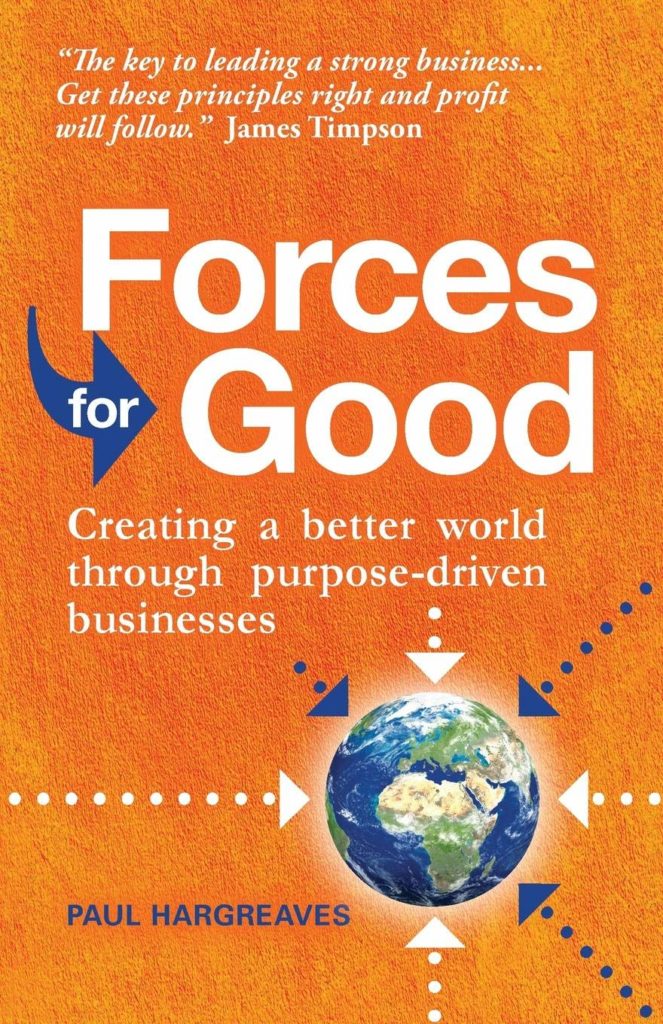
Forces for good

I was recommended this book and am enjoying it. Paul Hargreaves is an entrepreneur and is unashamed about such issues as profitability, but what I like is that is not his only, nor primary, bottom line. His concept of ‘purpose driven business’ outlines four bottom lines:

  • people
  • planet
  • profit
  • personal change

It makes a great read… I think there are also a few other considerations to be added – like how to strategically lose money as that is one of the first tasks Jesus set himself. He broke the power of mammon at the start.

Another area I found very interesting was where he listed 7 feminine traits (mostly found in women) that make for great leadership:

  • empathy
  • vulnerability
  • humility
  • inclusiveness
  • generosity
  • balance
  • patience

Masculine traits, Paul suggests, include:

  • competitiveness
  • goal-orientation
  • independence
  • assertiveness
  • protectiveness

Probably true. But are they masculine traits – or simply sinful? Jesus died as male!

So the last few parts are my musings. The book is great.

Certainly not all Greek

No need to read the verses above! Just a lot of the word ‘anthropos’ that appears there including the part that affirms that Jesus’ identity post resurrection is as ‘the man Christ Jesus’… and yet that is what I wish to challenge.

The resurrection is a very key event which has enormous ramifications for creation. The resurrection is not a Greek alive-after-death scenario affirming that there is life after death, rather it is the resurrection of a physical body that affirms God’s ongoing commitment to his work of creation and secures a physical future.

Jesus died, Jesus rose again. The body that went in the grave is the one that came out and there was a transformation of that body. He enters the grave male and comes out…

A little speculative theology about to be embarked on here.

I have considered the question about resurrection and gender in my little head before and had previously reasoned that if sexual identity is an element of my identity then resurrection would include that element. Recently though I have re-considered. So a little journey to get to where I am speculatively settling.

A few basics first, and in this terminology is not always easy. I consider that God is neither male nor female, but both masculine and feminine. Humanity (and I appreciate there are biological exceptions to this) are either male or female but both are masculine and feminine. In other words I am using male / female biologically and masculine / feminine to relate to characteristics, and in that open up the whole scenario to the critique of cultural and gender stereotypes.

Jesus was male and Jewish. Jewish as they were the redeeming nation that had lost the plot. Born of a woman and born under the law he came at a time when the ‘sins of the Jews’ had reached fullness:

Therefore this generation will be held responsible for the blood of all the prophets that has been shed since the beginning of the world, from the blood of Abel to the blood of Zechariah, who was killed between the altar and the sanctuary. Yes, I tell you, this generation will be held responsible for it all (Lk. 11:50,51 – ‘sins of the Jews’ is a cheeky, but I think appropriate, adaptation of the term ‘sins of the Amorites’ from Gen. 15).

The nation called to be the means of redemption are condemned under the power of sin and therefore needed a representative redeemer. He is the Jewish Messiah. He dies as a Jew – we will come back to his resurrection in due course on this. He is not only Jewish but male, not because of some inherent superiority in the male gender – far from it. Male, as male had partnered with the powers, as expressed in patriarchal rule. Such dominance is antithetical to the kingdom of God. Jesus, as male, broke, through his relationships, behaviour, words and action this male dominance. A simple example of his cultural opposition to patriarchy is in Luke 11: 27,28:

As Jesus was saying these things, a woman in the crowd called out, “Blessed is the mother who gave you birth and nursed you.”
He replied, “Blessed rather are those who hear the word of God and obey it.”

Her world view spilled right out in the presence of such a truly human presence. A woman’s status was like climbing a set of steps to the pinnacle. A woman needed to be married (step 1), to have children (step 2), to have a male child (third step) and the ultimate was to be a woman who not only gave birth to a male child but to a rabbi of the stature of Jesus. In one short sentence he corrected this totally. A woman’s status was not tied to her marital nor maternal relationships. Males are not superior, females are not subservient.

He is male, not to demonstrate superiority, but to deal with patriarchy. Unless sin at the sharp end is dealt with there can be no redemption. If he dies as Jew he dies for the world; if he dies as male he dies for humanity. Now to the resurrection.

He rises as new humanity, a humanity that is neither Jew nor Greek. Hence I do not see Jesus today as Jewish. He dies as Jew, he rises trans-national. And then… yes I think I have also moved ground on the maleness of the resurrected Jesus. He dies male, but ‘in Christ there is neither male and female’. This verse uses the term ‘and‘ when referring to male and female, unlike the ‘nor’ when referring to Jew / Greek and slave / free. The ‘and’ pushes us back to Genesis when God created male and female. New humanity is not male and female.

There is in heaven a human mediator:

For there is one God and one mediator between God and mankind, the man Christ Jesus, who gave himself as a ransom for all people (1 Tim. 2: 5,6).

I chose this translation with all its clumsy male language deliberately. ‘Mankind’ would be much better translated as’ humanity’, and the term the ‘man Christ Jesus’ is the generic ‘anthropos’ (humanity) not the specific ‘aner’ (male). Jesus was male, he (?) is now still fully human, but this verse leaves open the gender issue in the sense of ‘male’ or ‘female’.

The Godhead was not and is not male nor female. The Godhead was not Jewish. Jesus in the incarnation was both Jewish and male, but now?

OK, but when?

Evidently not May 21, nor October 21, 2011!! So many miscalculations so now it is my turn… I am soliciting a little help from 2 Peter 3 and his three-fold reason as to why the parousia was still future for him, and as it turns out for us too. (Before looking at his perspective, it is worth noting, as an aside, that although he uses language that could be pressed, if taken literally, to mean the destruction of creation this is not likely his meaning. Two reasons – he uses typical apocalyptic language (strong metaphorical and physical language to describe the significance of an event, not to describe the literal result); and the second reason for not taking it as literal is he has already stated that the flood had ‘destroyed’ the world of that time. It did not physically and literally destroy that world.)

Peter seems to list three reasons in response to those who mocked about his ‘coming’ (2 Peter 3: 3, 4; parousia, the common word related to his coming, and carries the meaning of ‘presence’). The three factors are laid out in verses 8-12.

But do not forget this one thing, dear friends: With the Lord a day is like a thousand years, and a thousand years are like a day. The Lord is not slow in keeping his promise, as some understand slowness. Instead he is patient with you, not wanting anyone to perish, but everyone to come to repentance. But the day of the Lord will come like a thief. The heavens will disappear with a roar; the elements will be destroyed by fire, and the earth and everything done in it will be laid bare. Since everything will be destroyed in this way, what kind of people ought you to be? You ought to live holy and godly lives as you look forward to the day of God and speed its coming.

  • A perspective of time – what seems to be forever to us is not viewed the same way by God.
  • Any ‘delay’ means more people can be rescued. This is a very interesting perspective and challenges the pessimistic view that ‘only a few will be saved’. The longer the delay the more that will perish is the result of the pessimistic view. (A much longer discussion needed here, but I suggest we need to reverse ‘only those who receive Jesus will be saved’ to ‘only those who reject Jesus will be lost’. Maybe one day I will post on that… maybe…)
  • It is the third reason that pushes me again to underline the unfinished work of Christ. How we live, what we look forward to speeds (brings it closer in time) the parousia. There is a work for us to do. There is a future and we align our lives in the light of that, we focus on the future, that vision burns of a new just world and as a result the future will take place sooner rather than later. I take that literally, and as I have written in the past, the work we are involved in is in the preparation of the material that God requires for the New Jerusalem. We cannot build it – an unfinished Babylon is all we can achieve, but a finished New Jerusalem is what comes down from heaven, from the throne of God. Only God can do this; the perfect cannot rise up; it has to come down to transform what is here.

But the jewels, the gold, the precious stones? They originate here. Wood, straw and the like are not part of the materials God will use, and Paul acknowledges (in the context of ‘temple’ construction) that there are apostles whose works are simply that. How they work will not survive the fire, it will be considered of no eternal value. In that light he provokes us all to consider what our works consist of. God will and is building with the material that we supply that passes the fire test.

When will he come? When the work of Christ is finished… the aspect of his work that he is now doing through the body. Jesus explained to his disciples that his food was to do the will of God who sent him and to ‘finish the work’ he was given to do. And in like manner so he sent us… to finish the work.

It is time to get an eye that sees the world that is to come, the world that is the other side of the fire that destroys all unrighteousness. What world do we see? If we are to hasten that day then we need to align our lives with the values of that world, not this; we must sow seed now that is the seed for that harvest. Small acts now, but vital ones. The mockers mock, but the seers work.

Perspectives