Be engaged

In considering that the apostolic gospel is political I consider that such a long-term vision challenges:

  • Party allegiance. We might be aligned to a particular party, but we cannot be bought. There is no party that is perfect, no party that is Christian. The critique of the Gospel is that we have all fallen short of the glory of God. All parties and all systems certainly have! In a given situation we might always put our vote somewhere specific, the guiding choice has to be how redemptive we consider the vote is, how beneficial to a healthy, relational and equitable society the direction that party would move us in.
  • The apostolic vision is one that looks long term, and resists simple short term action that is justified by the outcome. Although in a time of crisis short term responses are always necessary. If a house is on fire we need to get the people out rather than leave them there while debating the best building materials to employ.
  • It challenges strongly the belief that change can only take place from the top, indeed I suggest that the apostolic Gospel suggests it rarely takes place from the top.
  • Challenging the idea that we have to be in power to be effective, it raises an interesting issue. Maybe (if there was such a thing!!) a Christian party would be best placed not in power. That is a challenge to the voter – vote for us, we do not aim to be in power! However bizarre that might sound the apostolic vision is a challenge to the power dynamic, and to the hope that someone elected will do it for us. Servanthood and a denial of vested interest has to be promoted and the empowerment of the grass roots, rather than power and an unconnected representative body.

An apostolic vision also recognises that:

  • Almost certainly with any party that we vote for, there will be policies that they endorse that we do not agree with. There is necessary compromise along the way. If God ‘allows’ we most certainly cannot legislate. The compromises that God is pleased with are the redemptive ones, the ones that might not be perfect but move it to a better place.
  • We also have to consider what are personal values and what are public ones. I might have a personal value that comes from following Jesus, but do not believe such a value should be imposed on society.
  • That our hands are not clean. We are all implicated in the system of destruction. The issue is that we are not clean, but in not being clean we do not have to be dirty. Our choices, our life-style has to be set through redemptive, though compromised, decisions.
  • That God works not to give people a guilt complex so that they might find him, but gives them a shape, a set of boundaries, within which they can find him. We likewise should not look to off-load righteous legislation but create a shape where people can prosper. All legislation should be redemptively creating shapes where people can best develop who they are. Sin is to not be the person I can be: a person in my skin representing the character, persistence and love of God. Sin is not avoiding through legislation a set of predetermined evils.

There are troubled areas for believers that often swing their vote. But as we cannot legislate in an absolute fashion we come back to the dirty world and the compromises that are required.

Abortion is often the single issue politics that determines the ‘Christian’ vote. Yet the issue is multi-faceted and the factors that surround it are complex, certainly including education and economics. It also sits on a spectrum of pro-life issues. What our response is to the current and pressing crisis related to climate change and global warming. Every response to this issue is a pro-life choice, ultimately determining who will live or not. Abortion and abuse of the climate are connected to the future of the unborn, and to those already born.

We could add xenophobia (and nationalism) likewise as they sit on that same spectrum. They are all positions that reflect on who we wish to prosper / live. The death of Jesus as a privileged male and a compromised Jew was for all, regardless of faith, gender and national identity.

The vote for a believer is indeed a challenge. We cannot simply vote along party lines. Also we do not carry a vision of getting our person to the top (the word of God came to John in the wilderness). We can though be governmental and help create a shape that pushes back the powers that control so that those who are equipped can come through to occupy in a humble spirit positions that are there. I consider that we are here to create and hold a shape.

In creating a shape – lifestyle, relationships, prayer, action… there are also those who we will partner with. Theologically we cannot simply partner with those who profess faith. Paul had friends who had a lot to lose, as far as wealth and status was concerned, on the basis of his vision, but were committed to be with him and support him. They had not recognised Jesus in the sense of at the level of personal allegiance to him, but they were simply convinced that Paul carried a vision for the future of this world. That vision was not one that was compatible with the structures as they were currently defended in his imperial world.

Who do we partner with? On a spectrum we are at times tempted to place, for example, atheists at the opposite end to that of Christians. I suggest we need to think again. There are atheists who are anti-God and there are atheists who do not believe in god. I too do not believe in god. I share my non-belief with a number of ‘good’ atheists. We have that in common, even if they do not share my belief in God.

More often than not there are those who are believing in a false god who are at the other end of the spectrum of those we can work with. Some of those might use our language, but fill it with other meaning. ‘God’, ‘Jesus’, ‘the cross’ are words – the meaning we fill them with is what is important. There might be those who are ‘Christians’ that we cannot partner with, how they understand the cross (by this sign we conquer) might be in such a strong contrast to how we understand it (the instrument that we carry daily for our own death) that we cannot partner with them. Our connections might be those who do not believe in god.

Theologically we have hope and vision for this life… and beyond. And as eschatologically the age to come is shaped from this one we cannot not work in this age. Our political involvement at whatever level, whether fruit is seen now or not, is vital. It can produce fruit now, and even if it fail will become seed for the age to come. (Again I applaud where an atheist who has no belief in an age to come in which they will participate is committed to work for a better future. If they can how much more should I be willing to do so.)

Disruptiveness has to be part of the political involvement. Particularly given how privileged we are. Most of us do not have the context of the threat against our lives, and in that context Paul even gave a voice of caution. That is not our context so we have responsibility for those who are threatened. The current Extinction Rebellion is making a very real impact. People are willing to be arrested for their beliefs. Yet the resistance is overwhelmingly white. In our cultures a non-white person is rightly cautious about being arrested. This does not negate the movement, but we must be slow to pat ourselves on the back when our protest is a privileged one.

Practically drawing on the work of Roger Mitchell he suggests that from the life, teachings and example of Jesus there are 9 areas that should prioritise our energies and commitments. The notes below are mine, so I hope I do not misrepresent.

The making space for the feminine. Given that cultures, structures and societies have been formed by men and the masculine, holding space for a feminine voice and creative response is vital. The lock up in Cataluña is an example of this. The age old conflict is in lock up because of power. No one can back down. A person such as Ada Colau, the mayoress, is not weak, indeed has to have more strength than those who resort to power and endorse violence. She is also a good example of who we have to take care of by taking responsibility to hold back the powers that seek to ‘steal, kill and destroy’. There are those who can speak to this much more than I can. There are some males who probably can, but the best we (males) can normally do is to be silent but hold space so that the voice of the feminine woman is heard.

The prioritizing of children, to whom the kingdom belongs. To reduce the future for the unborn to the issue of abortion is simplistic and wrong. Jesus prioritised children. Health care and education are two aspects, for sure that come to the top of the list when making space for the future, as are the issues mentioned above when touching on abortion.

Advocating for the poor. This moves beyond the patronising of doing things for those less privileged, to doing it with them. We cannot be those who do things to the poor, sometimes we might only be able to do things for them as it can be hypocritical to assume we are ‘with’ those who find themselves economically marginalised. These issues hit home. We can demonise the top 1% and immediately baptise the next 4% as being OK simply because that is where we find ourselves.

Care for the creation. This is God’s world and it is our habitat, and the habitat of those who are yet to live. The original habitat was in order to create an environment where God could be at home. Planting trees could be our greatest contribution to the future. The tree biblically is what bridges the arts and practical sustenance – maybe this could be a factor in why humans are described as trees?

Freeing prisoners. Of course we spiritualise the words of Jesus who came to set the prisoner free. Yet there are prisoners at all levels in society, as all systems will imprison. There are no simple answers, but the level of imprisonment in certain Western world countries indicates something is desperately wrong. Restorative justice aligns to Scripture in a way that punitive justice does not.

Promoting health. Jesus healed and did good. Healing is multi-faceted, and each political response is a sign of who God is. I find it hard to see how health is a privilege that can only be offered to the wealthy, and not at some very real level a responsibility to provide for as many as possible. We live as aliens in Spain but have stood against private health insurance. Maybe in some situations that might be necessary, but our approach to health care is shaped by our beliefs in the Gospel.

Confronting the powers. This is one I like a lot! Confrontation is not simply to put something in its place but to give an opportunity for the person representing that power to act humanly.

Making peace. Blessed are… We live in a fractured society that has its divisions. Divides so often because a voice that comes from a different experience and perspective is so often not heard, other than in that particular circle. We can allow voices to be heard, that is the only way that we will hep people move forward without the felt need to shout, or the reaction through intimidation or inferiority to be silent. At a very small level Gayle and I had a good experience in having someone stay with us who took a different stance on the Brexit issue and a different take on money. We were enriched.

Publicizing the good news of peace. Politics and faith do mix! We can at al times be ready to give a reason for the hope that is within us. How and what we share has to be shaped by the love of Jesus. This too cannot be ‘top-down’.

Until he come (parousia) we work, relate, disrupt and proclaim (ekklesia). What we do now will, if done in line with the patient apostolic vision of lives laid down in love for the world, will come through the fire. Are we politically involved. For sure, with a small ‘p’ or a large one. Everything we do is about shaping the future, the future here and now and the future then. The small responses we make are so vital. They too are political.

Terminology speaks

The Imperial world of the NT gave the Gospel an inevitable conflict politically. There was a vision of transformation within it. The terminologies were so in your face:

  • Son of god
    The common and official title of Augustus Caesar in Greek documents was ‘Emperor Caesar Augustus, son of god’. An inscription from Pergamum refers to Augustus as ‘The Emperor Caesar, son of god, Augustus, ruler of all land and sea’.
    Caesar’s did not claim to be god but were seen as invested with the divine and to such an extent that each subsequent ruler was termed ‘the son of the divine (previous) Caesar’.
  • Peace through his blood who did not resist, or through the blood of those who resisted.
  • Who is ‘lord and saviour’ and ‘king of kings? And this came with the further question of how is that lordship and kingship defined, and outworked. Jesus is not simply the alternative Caesar, one who also acts in the same way! Power, top down; or love with empowerment beyond.
  • The word euangelion (Good news) was used in ancient Greece of the public announcement of good news. It was used of a public declaration of a military victory or public policy. In the Roman world it was used whenever there was a royal ascension to the throne. The good news of Caesar Augustus the son of the divine Caesar. (Augustus, being the successor to Julius Caesar.)
    When the apostolic band came to a Roman city and came with a gospel message the expectation was of a proclamation concerning the activity of an emperor. The person in the street was not pinning their ears back with an expectation of a three point sermon but of representatives of the government to proclaim good news. Government representatives they most certainly were!
  • Paul taught about the ‘kingdom (basileia) of God’, the very term used by Rome of their basileia (empire) of Rome, basileia being the Greek term and the vast majority of the world where Paul travelled was Greek speaking.
  • Then the term ekklesia (church) was loaded with political implications. We have a very challenging question to answer when we ask what was in Paul’s mind when he was planting and encouraging ekklesias in city after city? Each Roman city already had an ekklesia – the political assembly that was the means to shape the future of the city. Each significant city had a Roman assembly… and here comes Paul planting a heavenly assembly, an assembly of Jesus Christ. I have no doubt that the very name ‘ekklesia‘ suggested that this assembly was the representative of Jesus called to shape the future of the city.
    We have to ask what was Paul, for example, teaching on a daily basis in the hall of Tyranus in Ephesus. I consider it had a strong political message, so strong that the rulers of Asia (Asiarchs) became friends with Paul without ever responding to the ‘pray the sinners prayer now’ part that we assume was his message. They could not, or would not, get that part but so got the other part that they wanted to preserve his life. So different to the Jewish leaders who wanted to extinguish the life of Jesus to preserve the nation and Temple!
  • We pray till he come, we anticipate his parousia. Cities longed for the parousia of the emperor, the royal visit. Great blessing would come to the city, areas where they were struggling to see Roman culture expressed would receive such a boost. With the simplicity of the common meal those early disciples proclaimed his death until his parousia.

The political apostolic Gospel

The marks of an apostle were with Paul. He mentions signs and wonders and miracles, yet Jesus had said that there would be those with signs, wonders and miracles that he would distance himself from. Paul says that the miracles were accompanied with ‘great patience‘. An apostolic vision works today for the long term. At the heart of it is a conviction that a death by one is a death for all; a death in one place is for all geographies; a death at one time for all time. The apostolic carries a long-term vision of transformation of God’s world. A political vision that is not looking simply for short term fixes but long term healing. In that there will be great gains, and if the ground is not held great losses.

A great egalitarian Scripture

I will from time to time look at a few of the wonderful Scriptures that overwhelmingly convince me that status by gender is not something the Gospel entertains. Of course as always how we read Scripture is an issue for we can read it to almost defend whatever view we wish. Maybe if I get round to it I will also look at that. But for an opener there are two verses that record for us an interchange between Jesus and a woman that are simply mind-blowing (Luke 11: 27, 28). They follow on from some pretty hot teaching and activity by Jesus, demonstrating wisdom, understanding and the delivering power of God in a way that had not been seen before. In that context the woman says:

As Jesus was saying these things, a woman in the crowd called out, “Blessed is the mother who gave you birth and nursed you.”

Jesus responds immediately. He does not need to wait to consider what she said. We read

He replied, “Blessed rather are those who hear the word of God and obey it.”

In this very short exchange comes an amazing contrast of world views. A world view that was common to the day and the starkly contrasting world view of Jesus as far as the status of women was concerned. The woman holds to the dominant world view of her day concerning the gender difference, and she articulates, without realising it, what the culture has taught her about as far as significance was concerned. She is so impacted by what she sees, hears and experiences when encountering Jesus directly that from deep inside something spills out.

It spills out, almost involuntarily, because the very act of speaking (shouting?) out as she did in public was not something that her world view supported. The impact of Jesus provoked her in that moment to act beyond what she believed was even appropriate. Her speech even confronted her own views!

Her world told her that her gender had a status that could increase with every break she might get in life:

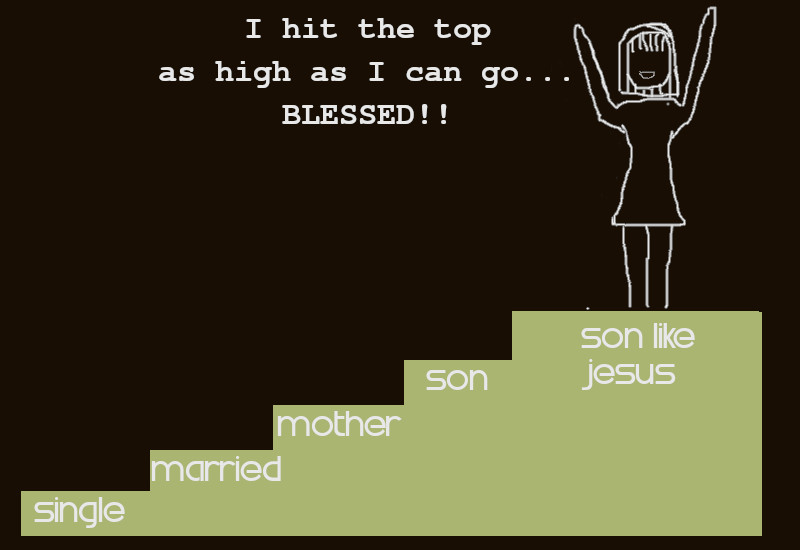
She would start as the daughter of, growing up her status might increase if she was not single. So singleness was the base level. If however she could be married – be the wife of someone – she would go to the next level. Married but childless? That was not something she could live with easily. So to bear a child was the next level… and if the child was a male an even higher status was hers. That was as high as anyone could ever hope for, but on this day when she encountered Jesus she realised there was one higher step: imagine giving birth to a rabbi who lived, taught and behaved as Jesus did.

Blessed is the mother who gave you birth and nursed you.

The contrasting view is the one Jesus came back at her with and in a few words turned her world upside down. Status is not based on gender, it is the same for women and for men. It is simply becoming who we were meant to be. There is no higher blessing, perhaps I might even suggest no higher glory.

Pause for a moment. Being the mother of Jesus is not the highest calling for a woman. Mary is blessed, but…

The Gospel is crazy. It does not put us down but pulls us all up. Unless of course we take a superior attitude then it seriously does pull us down. There are not many attitudes that God actively opposes but pride, arrogance, superiority? The Gospel has always been good news for the marginalised. And it will not appear as good news to those who do not make way for others to discover who they are and express who they are. Freedom to discover and to express rather than restrictions and blockages will always be the bias of the good news that Jesus brought.

What on earth are we to do?

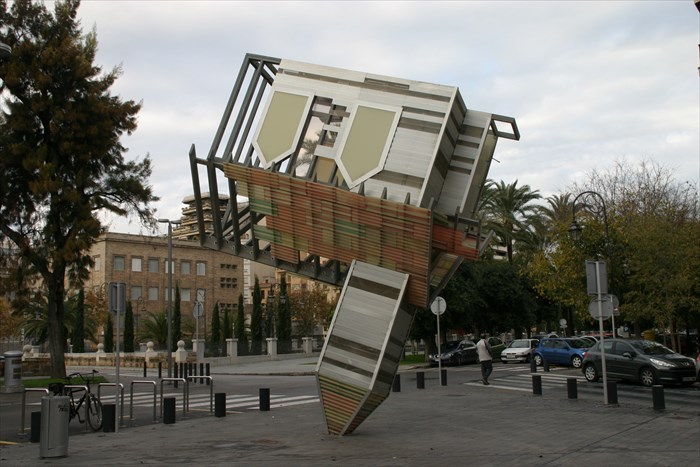
The photo is of a piece of art in Palma de Mallorca. A replica of the original created by Dennis Oppenheim, and called the ‘Device to Root Out Evil’. The original was objected to due to its choice of a church being turned upside down, but what better image to use? I certainly do not consider it to be sacrilegious but highly appropriate.

The sculptor chooses a very traditional shape for the building and with the spire driven into the ground it speaks volumes. The top becoming the bottom and the building not simply sitting on the land but into the land.

Paul might not have recognised the traditional shape but I think he might well have approved of the overall image. In Imperialism there is always a very clear ‘top’ or ‘centre’. From there all is shaped and controlled. Promises are made, with the clear framework that where there is compliance there will be reward, though the real beneficiaries are located at the centre. Other centres can develop, but they remain subservient to the main centre. Such centres only have carefully delegated monitored authority, certainly no authority is distributed. In the Imperial world of Rome there can be other ‘kings’ but Rome will remain the ‘city that rules over the kings of the earth’ and Caesar will continue unchallenged as ‘king of kings’.

The language of the NT Gospel is unmistakably political. Caesar is not only not acknowledged as ‘lord’ but Jesus is proclaimed as ‘Lord of lords and king of kings’. This is not because the Jesus message is a mirror of Rome’s, but rather Rome is being exposed as a pathetic parody of the real. The same words are used but the effecting of the reality is perverted by Rome with peace no longer coming through the life laid down, but through lives taken; the power overcomes, and if necessary through violence, rather than a submission to the violent powers. At the heart the contrast is of power enforced and of love extended.

The evil to be rooted out is indeed deep in the soil. It is an evil that enslaves one and all to a system, and the evil is so pervasive it is personified in Paul’s writings as ‘sin’ (singular) or in Revelation it manifests as a beast or beasts in union. An alternative structure, but one that is mirrored on the Babylonian top-down will not root out evil. Such a structure will eventually be used by evil as and when it proves helpful to do so, as it will not bring about a shift to the deep evil embedded in the soil. The church can never therefore be a comfortable bed-partner to the status quo, the subversive nature of it has to be present.

I propose then that Paul was crazy – truly crazy! He went to a place that already had an ekklesia, whose purpose was to serve the Imperial centre of Rome, and he went there with a conflicting message concerning the kingdom of God (basileia being the Greek word for kingdom, the same word equally used by Rome of her own ’empire’). On first hearing he must have sounded as a political insurrectionist whose time on earth was going to be limited. Yet there was some strange elements to the message. There was a ‘religious’ tone to it, and at the centre was a dead Jew whom Paul proclaimed was not simply ‘alive’ but risen from the dead.

His message was certainly political, but it could not be pressed into serving a particular wing (‘party’). What was clear was the message did not serve the status quo, for he was declaring that all hierarchies were not recognised ‘in Christ’. Not surprisingly the result was that ‘not many wise, not many noble’ were those who responded to the message! This irrelevant group should have been no threat to Rome’s order, and yet amazingly there were riots. Riots inspired by Jews were expected, for if Jesus was Lord he was not the one accursed of God but his name was now the only name through which salvation would come. (Acts 4:12 – ‘Salvation is found in no one else, for there is no other name under heaven given to mankind by which we must be saved.’ The ‘we’ both linguistically and contextually are Jews. No other name – not even the name of Abraham!) Jews reacting could be predicted, but a riot inspired by silversmiths (Acts 19)? This shows the extent of the impact (and understanding of the implications) of his message.

To narrow the work of Paul down to one element, such as he is creating a political movement, would be to be in error, but to avoid the obvious implication of the central political sound would be (in my perspective) to shift where the core of his message was.

Complex, complex, complex! To simply take the teachings of Jesus, the understanding of Paul’s Gospel and to proclaim them as shaping a new politic would not do justice to his Gospel, but to ignore that would be criminal!

We probably cannot give a simple answer to what on earth was Paul doing, but we cannot ignore his context of a one world government complete with its 666 mark of the beast; nor can we diminish his passion for a whole inhabited world (oikomene) to have opportunity to hear the message of hope.

It is very difficult to add the word ‘para’ to what followers of Christ are involved in, if they are motivated by something of this political (small ‘p’) vision and purpose. It is also quite difficult to give the word ekklesia to any group of those who want to use the term ekklesia in a way that only legitimises themselves.

We live at the end of the Christendom era. The apostolic calling is very strong whenever there is a shift. Perhaps we are in what will be viewed as the biggest shift in the civilisation of humanity. We might never know what on earth Paul was doing, but we will certainly have to figure out between us all what on earth are we to do. If it does not carry a political element with a vision for a transformed society it will be very hard to show that our message is faithful to the one Paul received from heaven.

The apostolic of every generation or situation have to rework the application of the Gospel without ever changing the Gospel itself. If we want to be faithful we will have to renounce hierarchy, be personally upended and immersed in the soil. Could there be a people who are called to root out evil? Could that be possible? If not, could there be a crazy gang who rose up (and went down deep) who were committed to a seriously thought out attempt to do so?

Following Tim Suttle

I get a number of feeds each day of blogs that I follow, and have just begun to follow Tim Suttle at Paperback Theology: https://www.patheos.com/blogs/paperbacktheology/

Today he wrote, with reference to Stanley Hauerwas’ book Resident Aliens under the title of Christianity Shouldn’t Be Infused With Politics—It Is a Politic. Ever since the late 90s when I was involved in prayer teams to cities I have been strongly convinced that the Gospel is political – the language of ‘church’, ‘repent’ and all other such language is deeply political, and the exposure of the spirit of empire that comes to a sharp focus in Revelation, so of course in reading the article I am already biased toward it. Here though are a few quotes:

Christianity is a whole new way to be human that requires a complete reordering of the way we organize our lives both personally and communally—or politically. Christianity is a politic.

That’s where we are. I mean, nobody who begins with “Greater love has no one than the one who lays down their life for a friend,” could ever end up with the American brand of radical individualism. Nobody who begins with “Consider the lilies…” could ever end up with present day consumer capitalism. Nobody who has taken seriously the story of the Good Samaritan could end up with nationalism.

He writes as an American so of course critiques Christianity in that context, but the application is certainly not limited to the USA. Here is the link:

PaperBack Theology

Mis-fitting – to be fit for God’s world

On October 13, 2018 (Will we make a difference) I wrote:

The façades are opening. It is not simply that we will be able to see the bizarre nature of the Western economic system that only operates if there is debt (debt will always result somewhere in slavery and at some measure an inevitable eating tomorrow’s bread today) or the paucity of public political debate but we will be able to see some very deep roots… unless we close our eyes to what is being revealed. The familiar can close the façades down, although I wonder if we (believers) will even be able to do that this time round. And beyond the familiar there are factors that hamper our sight. Those will be found in our commitment to a shallow Gospel that does not challenge nationalism, patriotism, patriarchy and the deep inequalities in society. If we do not heed at this time that the Gospel is neither Jew nor Greek, slave nor free, nor male and female we will find our eyes will not even see what is before us and we will simply look for ‘normal’ to be restored.

What is being exposed in the days that lie ahead (and I am sure much more can be added to this) are:

greed and consumerism
misogyny
protectionism that demonises the ‘other’

The inevitable result will not just be trade wars, but war. It will not simply be a major shift to extreme right wing policies (as we see rise in Europe) but the establishing of a neo-nazi totalitarianism that will eventually be seen not be favourable to faith, including that of the Christian faith.

Yesterday I read an article in the Guardian (Spain Turkey far right Vox culture war) that makes for both insightful and frightening reading. In the name of values how an anti-feminist position is central to what is taking place. The goal in Europe the article says is:

Not a new Europe, not even an old Europe, but a Europe modelled on an imaginary, mythical past. A monolithic Europe dedicated to halting and reversing progress.

‘Might is right’ has to give way to humility being the path. I remember many years ago taking a prayer week where the working together of the body of Christ was a challenge. Everyone had their own agenda and each expression was more ‘right’ than the other. As I prayed that morning I sensed strongly that a pathway of humility was the only way forward. One of the leaders who was participating in the week was away on business in London that day. He came back saying that he had been praying about the lack of unity, and as he came over a hill and could see the city in front of him the Lord said to him ‘humility is the path forward’.

As a male it is very hard for me to recognise misogyny. Is it in me? I would be foolish to claim that it was not… that is the problem so often. We assume we are free but fall painfully and blindly short.

I am more convinced than ever that there is a fresh discovery of the Gospel. Yes there will be understandings of the cross that Tom Wright describes as ‘pagan’ that will have to be jettisoned, or at least radically revised. There will be perspectives concerning the work of the Spirit that will expose the gap between being ‘born again’ and yet harbouring and fostering old fallen creation values. At the heart of all this will be an incredible new vision of humanity. This will never take place without feminisation. Whether the church leads in this or not is unimportant. The lead might well come from the world. It might well come from the political world. In Spain the dormant seeds of Paul’s Gospel are in the land (and in Turkey, referencing the Guardian article, the fruit of the seeds have been cut off – the seven churches of Revelation… but the seed remains). Maybe they are beginning to germinate at this time. Maybe this is why there is such a push for this one-cultural Europe. Maybe the enemy is moving because the Spirit of God is hovering. Certainly we need to push for this again. We have our battles in Spain. Our focus is on the political scene, ever grateful for the women who have humbly taken their place.

If there is any value in this post I dedicate it to the memory and testimony of Rachel Held Evans (photo at top… check out her writings). Too young (37 years old) to die. But the seed will continue. (Health Updates). One newspaper described her as a ‘hero to Christian misfits’. Come on you misfits!

Friend of sinners (not!)

Jesus was a friend of ‘sinners’ and for that we should be grateful, otherwise what hope was and is there for us. The other day I thought I wonder if he really was a friend of sinners, for it was not something he claimed for himself but what was said about him:

 The Son of Man has come eating and drinking, and you say, ‘Look at him! A glutton and a drunkard, a friend of tax collectors and sinners!’ (Luke 7: 34).

Labels

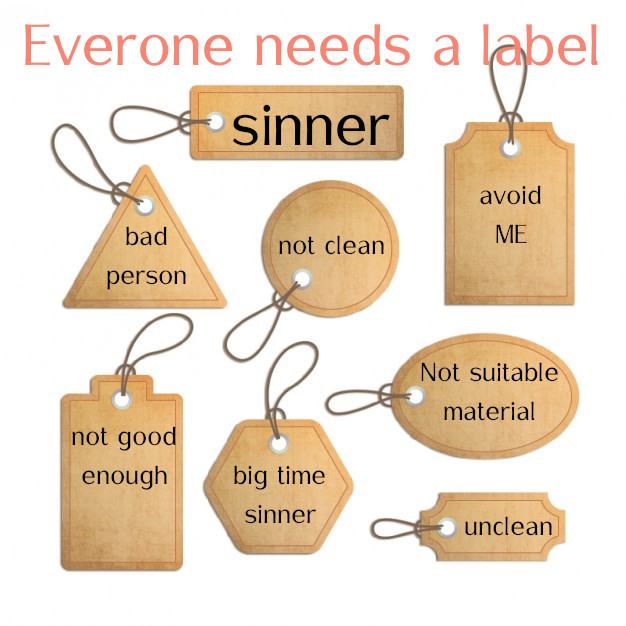
‘Sinners’ is a label, and of course a true description, but it can be easy to use labels. I doubt somehow if Jesus labelled people or saw them according to the label given. I suggest he was a friend of people, and cut across all the societal and religious labels. In the Lucan passage the next story is of Jesus being invited by one of those who specialised in labels (a Pharisee) and asked Jesus to come and eat with him. We read:

One of the Pharisees asked him to eat with him, and he went into the Pharisee’s house and reclined at table.

He eats with people! Those with labels and those who can dish the labels out. While eating at Simon’s house a ‘woman who was a sinner’ came in to the house. The interaction that follows is more than a little inappropriate by the custom of the day, and Simon is understandably offended, saying to himself that this woman is a ‘sinner’ and any prophet would have seen that, even if blindfolded. Two ways of seeing the person who has interrupted the meal – a ‘sinner’ or a ‘woman’. Jesus asks the penetrating question:

Do you see this woman? (Luke 7:44)

Simon had only seen the woman, but in seeing the woman as a sinner he had not been able to see either the woman or the activity of God in his own front room.

Was Jesus the friend of sinners? Well he ate with the righteous and the unrighteous. He saw beyond labels.

The label put on Jesus, ‘friend of sinners’ is partially true, but one that if I attempt to follow him should be aimed at me too.

It is important who we eat with (angels are very interested in this but that is another topic) but it is more important how we eat with them. As friends.

Digging down

With this post I finish the material we sought to share in Brazil and the earlier part will also summarise some of what I have already written about. Hope it is not too long to read right through. Tomorrow I will copy a writing from around 150AD – who said I was not a traditionalist?

We are not sure exactly how different the focus ‘up’ to limit hostile powers differs from digging down to the depths as the two have to be related. The spiritual powers gain authority from what has been sown (history affecting geography, down establishes up) and likewise the hostile powers shape what can grow and multiply (up solidifies what is down). They both affect each other. The dimension of digging down though has a very earthy element to it and it is necessary to hear the cry of the land to respond, even if that cry is at times twisted or inarticulate. The response to the cry has to be through us seeing a new way of freedom, proclaiming it and relating to what is around us as far as is possible as if the new way is the reality. This emphasis of digging down coincided with a dream we were sent for our work in Spain about finding the shape that held up false structures. That shape was like an arch and in the dream the person had Gayle said the shape reminded her of a boomerang. The challenge with the boomerang is that one can throw it away and it returns. This has been our experience of late, when we have had a verifiable significant shift witnessed reflected by a news item, but only for it to be replaced by something perhaps even stronger. This pushed us to consider how we need to go deeper.

We consider that this is becoming very necessary in the context that many of us are finding ourselves. We are to be pressing in for a ‘whole new creation’ and at the same time we are experiencing that being challenged as we are in danger of losing the good that has brought us thus far. Democracy is not sacrosanct but the shift to control and silence the voice of the people is a huge danger sign. The use of the term ‘fake news’ does alert us to manipulative elements and biases in news reports, but when it is used now in a popular way so that it becomes a blanket term to silence criticism and control the work of the free press, we should recall that this was one of the ploys of the Nazi movement in the 1930’s with their term ‘Lügenpresse’ (=fake news) to attack journalists who were trying to report the facts.

In the previous post I wrote of Paul’s apostolic message and how we need to get to the starting line with respect to his message. Paul’s summary sentence about the result of the community of God in Christ is very informative when it comes to the shapes that are deep in the land that hold up false structures:

There is neither Jew nor Gentile, neither slave nor free, nor is there male and female, for you are all one in Christ Jesus (Gal. 3:28).

It is this that has pushed us to look again at a deeper level on the issue of gender: neither male and female. Interestingly Paul changes the language from neither… nor to nor… and. A clear reference back to Genesis (God created them, male and female) suggesting that the destiny of humanity is not through going back but forward. We cannot underestimate how deep the gender issue is for the release and fulfilment of God’s future vision. We have to go deeper than simply ‘can a woman teach / have authority’ etc. Thank God for the work done on that to show the reading of Scripture (the ‘difficult texts’) do not need to be read at all in a limiting way. But pressing deeper to something very insidious, to the foundations of patriarchy takes us to another level, and opens up that Scripture is not simply written in a historic context (it is written, for example, pre-science as we know it) but also it is written an underlying patriarchal context – the context of the Fall. Scripture is God’s word to us but contextualised; it is a narrative that means we have to read it in context. If not, there would be a very strong argument to revert back to days of slavery and to defend that position, as did evangelicals at the time, on the basis of the clarity of Scripture. We do not have the right to change Scripture but we are compelled to free Scripture to be the word from God.

Likewise class issues (neither slave nor free) means we have to change how we see people. They cannot be seen according to the labels society put on them. Seeing people according to their destiny also necessitates relating to them in that way. The ‘fear’ narrative dehumanises people and what dehumanises is rooted in the spirit of antiChrist. I consider that perhaps dehumanising even leads to demonising, not simply in the figurative sense of the word, but by releasing demons to their work in that context… and certainly those who dehumanise open themselves up to demonic blindness and oppression, for there is in some measure an alignment with the spirit of antiChrist in the dehumanising response. More is being required of us, and given the wonderful outpourings of the Spirit and the release of gifts within the body this should not surprise us. The level is going up and so we are to go deeper, and our prayers for the glory of God to be revealed means how we relate to the ‘other’ will determine the level of glory seen. When glory comes it will come full of grace and truth with the evidence it has been manifest will be that the person we are relating will find their head has been lifted up (‘You are my glory and the lifter of my head’).

There still is something very deep to be worked through on Paul (a Jew) who says ‘neither Jew nor Gentile’ both in the specific context of how Israel is viewed and related to and the wider issue of nations and borders. We must always hold out, as Paul did, for those who are Jew by race to come to true faith. He saw that coming through a jealousy of what was taking place in the body of Christ. Jealousy is the fear or realisation that one is losing one’s place. Is there sufficient evidence that the church is marked by the presence of God? That is the pathway: through provoking jealousy to salvation, and so ‘in this way all Israel will be saved’ (καὶ οὕτως – ‘in this way’, not a temporal clause as sometimes translated ‘and then’, thus Paul is looking for a continual process not a one off end time event). ‘All Israel’ of course is a challenging phrase, but we have to remember that the debate in Israel was who was Israel, and it was defined by those who had true faith not had proven genealogy. How many of genealogical Israel can be part of ‘all Israel’ was a burden for Paul so he worked hard among the Gentiles to be an answer to his own burden.

A blanket support for Israel will I think blind us. After all they were not to be a nation as the other nations were, and so maybe we should be careful in simply wanting to help them become that. We should anticipate some very creative ways for the borders for the peoples being resolved there. And I consider that the body of Christ should be at the forefront of praying and working for those creative, reconciling paths. (I am aware that life in and or Israel is not easy with many who wish their annihilation. I am not suggesting an easy solution. If ever there is a geography that needs deep digging then that land is the place.)

Beyond Israel and the Gentiles though lie something for most of us much closer to hand. The deep nationalism that many of us have been taught to embrace has to give way to understanding the unity of all humanity. We are all from one source and within that God has given boundaries and times for the peoples to live:

From one person he made all the nations, that they should inhabit the whole earth; and he marked out their appointed times in history and the boundaries of their lands. God did this so that they would seek him and perhaps reach out for him and find him, though he is not far from any one of us. (Acts 17: 26,27).

Yes there are boundaries but they are not fixed for all time. They are fluid and are the place where angels are often encountered in Scripture. We are living at a fluid time in history, perhaps the time of greatest change. A time when many people can find God, and find him in a new geography. We cannot simply respond with fear to what we see nor with an appeal to sovereignty lest we find ourselves opposing what God is at work doing. The challenge is when God is at work there is also a great presence of the demonic seeking to pervert and suffocate what God is doing. There are no easy answers to the many challenging global and national crises but we have to be careful as the body of Christ that we do not fall quickly into the trap of finding the quick solution. If we lift our eyes we see him, then we see others in the context of a new world.

The body of Christ… What a call. Thank God there is variety within the body, but there also has to be an increasing connection to the world beyond. This leads me to the final aspect we shared:

We are not to resort to God is in control

I overstate things somewhat but in order to bring in a corrective perspective. We sing God is sovereign, but he gave that responsibility to us. He reigns in the heavens and one day his reign will be complete throughout all creation. The question is how is that accomplished? We can consider the commission in the Garden and from that understand that the responsibility was given to humanity. God was freely available for review and advice at the end of each phase of work – he came in the evening time. That commission came to rest on Israel’s shoulders, to be a light to the nations, and a priest before God on their behalf. At the fullness of time, the time of great darkness, the Light came into the world and the darkness could not overpower it. He, as the Second Adam, showed us the pathway, with the disciples saying ‘what manner of human is this?’. Raised as the eschatological human he becomes something for the body. Having gone down to the deepest place and risen to the highest place he filled all things.

The world is not out of control and God is deeply involved, but the key issue is that there is a major role for the body of Christ. Stewards taking responsibility. Maybe one day people will say, ‘we did not recognise you we thought you were the Gardeners working to restore all things.’ We await the parousia for the fullness of that, but can live now as a prophetic sign that is visibly pointing to that great day.

SHARE ON:

Post PermaLink

Sequential door openers

Jesus is unique at every level. He is no mere human teacher, not even simply divine, but the incarnation of God, so in what I write below I am not suggesting that Peter, Paul, et al., are on the same level. I say that as there is a pattern of sequential door opening at the human level that takes place.

Jesus once and for all opened the door for the restoration of all things and only he did that, Revelation 5 states clearly that only he is found worthy to break the seals and open the book of destiny. His work is completed and unrepeatable. We must not though mistake the work of Christ as meaning there is no work for us to do. Scripture makes that clear, as he was sent into the world to compete the work the Father gave him, so he commissioned his followers to go into the whole world to fulfil the work he gave them to do (Matt. 28, the Great Commission). That commission is a renewal of the Creation mandate to Adam and Eve and carries a clear understanding that the purpose is creation-wide resulting in the whole of creation becoming a Temple for God: hence I do not see any place for the rebuilding of a Temple in Jerusalem. (Likewise the rebuilding of the tabernacle of David might be a good analogy to raise up 24 hour worship, but the fulfilment in Acts 15 has to do with the inclusion of the Gentiles into the body of Christ.)

Jesus opens the door for Peter

There are different understanding on what it meant when Jesus gave Peter the keys of the kingdom, and maybe it carries different levels of meaning. His revelation as to who Jesus was is certainly one of the foundations for the future, and the keys given to him were not his exclusively. However, as apostle to the Jews, he plays a key role in opening up the pathway of salvation in Christ to the ancient people. He is the one who stands up on the day of Pentecost to make proclamation

And he testified with many other arguments and exhorted them, saying, ‘Save yourselves from this corrupt generation.’ (Acts 2:40).

Very strong language (‘Save yourselves from this corrupt generation’), the implication being clear for those who reject the message. According to the book of Jubilees we read that when a Jew who refused to circumcise their child they were committing the ‘unforgivable sin’ by declaring that they did not belong to the covenant people:

And now I announce unto thee that the children of Israel will not keep true to this ordinance, and they will not circumcise their sons according to all this law; for in the flesh of their circumcision they will omit this circumcision of their sons, and all of them, sons of Beliar, will leave their sons uncircumcised as they were born.
And there will be great wrath from the Lord against the children of Israel. because they have forsaken His covenant and turned aside from His word, and provoked and blasphemed, inasmuch as they do not observe the ordinance of this law; for they have treated their members like the Gentiles, so that they may be removed and rooted out of the land. And there will no more be pardon or forgiveness unto them [so that there should be forgiveness and pardon] for all the sin of this eternal error (the Psuedopigrapha book of Jubilees 15: 33, 34).

In the same way Peter uses language here that comes close to this. His language echoes the language we find in the Torah, and later in Acts 3:22,23 quoting the promise of a prophet like Moses being raised up and says that those who do not hear the voice of that prophet will be ‘cut off from their people’.

For Moses said, ‘The Lord your God will raise up for you a prophet like me from among your own people; you must listen to everything he tells you. Anyone who does not listen to him will be completely cut off from their people.’

Peter’s message is that Israel can be restored, but the restoration is through Jesus. (It is possible to cling to the Scriptures that speak of Israel being loved because of the patriarchs and a hope that there will be a future turning to God, but this cannot muddy the waters that Peter is proclaiming to Jews that the only way to salvation is through Jesus.)

Peter opens the door for Paul

Peter continues his work among the Jews and in Gal. 2: 7,8 Paul contrasts his calling with that of Peter’s. Peter being commissioned to the Jews while he was commissioned to the Gentiles. One an apostle to the Jew, the other to the Gentiles. Yet it was Peter who was chosen (ambushed?) to bring the Gospel to the Gentiles. The door was then opened, so I suggest there is a sequence: Jesus who died to break the curse of the Law opens the door for Peter to bring the message to the Jews that the time of the fulfilment of the OT prophetic had arrived, so calling them to enter the eschatological people / Israel of God. Peter later reluctantly went to the Gentiles and witnessed that

And God, who knows the human heart, testified to them by giving them the Holy Spirit, just as he did to us; and in cleansing their hearts by faith he has made no distinction between them and us. Now therefore why are you putting God to the test by placing on the neck of the disciples a yoke that neither our ancestors nor we have been able to bear? On the contrary, we believe that we will be saved through the grace of the Lord Jesus, just as they will. (Ats 15:8-11).

That was a strong revelation. There is no distinction, there is no second class level – and this is the apostle to the Jews who is saying this. Indeed the final sentence is more than a little provocative. He does not say they will be saved the same way as we Jews, but we Jews will be saved the same way as they are. There is such a shift in Jesus, the whole world is turned upside down. There might be a backstory to the work of Jesus, but truly he is the starting point, destiny is in him, he is the Chosen one from before the foundation of all things.

The door that was opened to Peter to work in the Jewish context is further opened by him to the Gentiles. Jesus not only took the curse of the Law (hanging on a tree, Gal. 3:13), but died at the hands of the Gentile Imperial powers, judged to be a rebel and a criminal thus opening the door for all who grasp that his death is for them to go free of the powers. His death is for all; restoration is for all; one new eschatological people being built into a Temple fit for his Spirit. I suggest, therefore that in some way Peter is used of God to open the door for Paul. Jesus to Peter; Peter to Paul; Paul to…

Paul opens the door to…

At the very least we have to recover the Pauline Gospel, and maybe there are implications of that Gospel that were hidden to Paul. In the same way as Peter did not clearly see the door that had opened to the Jews meant it was also open to the Gentiles, maybe Paul did not understand where this Gospel would take him. Peter certainly did not understand the full implications of what had been released at Easter and Pentecost, so is it possible that Paul didn’t see all the implications? That is somewhat irrelevant at this time as I am not sure we have even got back to the starting level of what he was up to. While in Brazil I posed the question to Gayle:

Do we have any idea what Paul was up to in his travels, lectures and proclamation across the Empire?

I suggest that whatever ideas we have do not come close to what was in his mind.

A final footnote: if ever we consider that Paul did not see the full implications of what he opened up anything we will understand has to accord with the narrative authority of Scripture. It has to be true to the story line from Creation to New Creation. What a provocation, first to find the starting line and then follow the trajectory.

SHARE ON:

Post PermaLink

One world government

Big bad world, global organisations paving the way for a one-world government. Do we escape? How do we avoid the mark of the beast? We have probably all heard those lines, maybe we even subscribe to a variation of them. Over the centuries there have been many candidates for the post of antiChrist. Famously Napoleon was one as troops advanced across Europe to implement his vision for the increase of his empire and as he rapidly put one relative after another on the various thrones of Europe he quickly became prime candidate for the supposed end-time role. Maybe those who thought so simply got it wrong and we still need to watch… or maybe the whole approach is just simply wrong.

My real issue with that type of teaching is it tends to produce a fear of the world and a withdrawal from, rather than an engagement with, the world. Maybe there is a one-world government to come (although I don’t think that is taught in Scripture) but even if there is to be such a situation we surely know what response to make. It is the same one as ever: get stuck in. Jesus specifically prayed that the Father would not remove the disciples from the world and I see no reason to suggest that prayer has been changed over the centuries since it was prayed. If we were to withdraw how could there ever be a redemptive presence in the world? Withdrawal would only mean one thing, the situation would deteriorate. The self-fulfilling prophecy that the word is an evil place, therefore avoid it, is not prophetic but simply self-fulfilling. The two elements of petitioning heaven and positioning within society are key for the future, and a de-positioning will not enable any petitioning to be effective.

However, back to the one-world government theme. Whatever the future holds I consider it more helpful to look to the past, the time of the NT, and to see the faith response at that time, as the faith response then might well be instructive today – and tomorrow – for our response.

The one time that the world was all-but under a one-world government was the time of the Roman Empire, and the contrasts of the Roman message and the Gospel message are quite incredible. A quick summary should suffice, starting with the term ‘gospel’:

  • A common use of the ‘gospel’ in the Imperial context was the good news of the ascension to the throne of a new emperor, who was proclaimed to be a son of the divine Caesar, being proclaimed as both saviour and lord.

    In the Roman imperial world, the ‘gospel’ was the good news of Caesar’s having established peace and security for the world (Richard A. Horsley, Jesus and Empire).

  • The proclamation that Caesar is lord is in obvious direct contrast to Jesus is Lord.
  • The Pax Romana established through military conquest contrasts the peace that Jesus established through the blood of the cross.
  • The ekklesia already existed in cities, the assembly that ran the city. We can read in Acts 19:39 that the city clerk’s response to the riot was to tell them that, ‘If there is anything further you want to bring up, it must be settled in a legal assembly.’ The legal assembly is the word ekklesia. Each city had an ekklesia, but Paul came to establish an ekklesia in Jesus Christ. It is hard not to believe that this raises the provocative question of who will shape the city, Rome’s appointed ekklesia or the one not made up by the mighty and powerful but established from heaven?
  • Then there is the Roman term for the Empire: basileia – the same term used for the kingdom (basileia) of God.

There are OT backgrounds to the various terms used in the NT but those take on new levels of significance when they clearly clashed with Rome’s preferred terminology. Paul and the apostolic proclamation did not change terminology in order to avoid any misunderstanding. He did not change so that people would clearly understood that the Gospel was non-political but spiritual. Indeed the refusal to change language, I suggest, was precisely because the Gospel was actually understood to be political. Not political in the sense of ‘if you follow Christ you will vote for a particular party’, but in the sense that ‘if you follow Christ your values will set you in conflict with all ideologies that call for your allegiance.’ As I heard someone once say: ‘Christianity will never make a good state religion!’

At a simple level those were the reasons why I would not take an oath when serving on a jury in court, nor swear allegiance to a flag or nation. The Lordship of Christ, then and now, absolutely relativises all other places where we serve, our ‘no’ having to mean ‘no’ so that our ‘yes’ to Jesus keeps us on course.

Life in the Empire was not easy for believers. As early as Nero Christians were blamed for the fire in Rome, and persecutions broke out from time to time. Believers lived in the squeezed place of not causing undue issues, seeking to follow practical advice such as: ‘If it is possible, so far as it depends on you, live peaceably with all’ (Rom. 12:18)’ while realising that the Empire always rewards those who comply, they being the ones with the freedom to ‘buy and sell’. (Revelation makes total sense in the context of the world at the end of the 1st Century, and has to be manipulated to make the imagery carry relevance for the 21st Century.)

Caesar’s rule was classically imperial. A few shape the future, promising benefits to all who comply, but the benefits simply flowed from the margins back to the centre. This is the critique we read of in Revelation with 28 cargoes (7=fullness x 4=creation / world) being carried back to Rome, cargo that included human life (Rev. 18: 12,13). The contrast of that life-consuming rule to the ecology of Jesus with life flowing out to the margins, life through the Lamb slain.

We shared on these subjects in Brazil in the context of their very divisive election. Choosing which way to vote in any election is a difficult decision for a believer, and we neither encouraged a vote for one candidate nor another, but wanted to put the task of the church in context. One candidate might be considered better (more redemptive) than the other, but the task of the church is to position itself for the future and protect a shape where those who enter the political sphere will serve the people. A huge element (for me) is whatever humanises people is pointing toward the liberation of the Gospel – for that reason a blanket support of capitalism (and in particular neo-liberalism) nor extreme socialism can receive our endorsement: both of which feed from the lives of people, the fodder of the beast.

Rediscovering the socially transformative nature of the Gospel has to be a major ingredient involved in a recovery of the apostolic message.

SHARE ON:

Post PermaLink

Perspectives