But if he is not in control?

I have put up a few posts that have referred to Open Theology that suggested God not being in control. It has provoked a few comments and even an email or two so thought maybe I should explore it a little further in a post. I have always leaned toward what is known as Open Theology where the future is not fixed and that it is not known in an absolute sense by God. Arminianism holds to a future that is known and Calvninism a future that is fixed. The divergence is really over how foreknowledge and predestination interrelate. For Calvinism foreknowledge is because of predestination. God has set something in motion, the outworking is according to his will and divine purpose therefore foreknowledge follows as an absolute. Arminianism reverses those. God knows the future and so what is predestined is according to what he foreknows. If we add to that the possibility of God being outside of time suggesting that he sees the end and the beginning simultaneously. Outside of time gives me immense issues (so Greek and not Hebraic) as it means that everything that has taken place, is taking place and has not yet taken place is now at one given ‘moment’ taking place in God’s experience. Really? The God who thinks, responds, reacts, ‘repents’, waits to see what we will do is not presented as an ‘outside of time’ One. We can resort to those descriptions of God as being anthropomorphic (though I am not convinced by that) or that there are aspects of God we do not understand, and insist that we cannot say ‘man’ (sic) with a loud voice and result with the word ‘God’ – as Barth said. Yet this God is knowable so we cannot simply make him the wholly other to us.

I was first introduced to Open Theology through YWAM and one of their main teachers in their discipleship schools, Gordon Olson, then came the writings of Clark Pinnock, James Sanders, Greg Boyd and others. Perhaps then for me the book Uncontrolling Love by Thomas Jay Oord was one of the best I have read on it. Open Theology challenges the supposed core historic given that God is in control. Comforting as that is at a personal level, it opens up a huge charge against God in the face of natural calamities, human abuse and the tragedy of suffering. God in total control is a comfort to me when I don’t know which way to turn, and probably is of comfort for those displaced from their nation en route to the ‘safety’ of Europe, but for those whose ‘boat’ has just deflated on the Mediterranean and they cannot swim and there is no rescue at hand I am not sure they are comforted that what they are about to experience is the will of God.

At least the Arminian position is easier to sit with, though if God is all powerful and he knew certain events would happen why no intervention? For the Calvinist (and the Muslim) where the will of God is being fulfilled it is genuinely hugely more difficult to explain, other than resorting to the category of ‘mystery’.

Uncontrolling love does not mean:

  • everything is out of control. A parent or guardian who does not control their children in an absolute sense does not mean that without control all children run amok. Values and an inner conscience bring some measure of self-control.
  • that God is without power and can do nothing! However, it does put a far greater emphasis on the effect of prayer.
  • that God does not know us. He knows us better than anyone else ever could. He has been present with us from conception.
  • that he does not have a purpose for our lives. It does not mean that he cannot speeak prophetically to us about events yet to come (and bear in mind that prophecy is conditional).

Uncontrolling love begins with ‘God is love’ and that love is releasing, he travels with us, works for our good with whatever room we gives to him. It means that the tragedies in the world are tragedies to us and to him – there is no ‘mystery at work’ for some higher purpose, though God will work through all things and there can come incredible redemptive results. The redemptive results do not witness to how there was a higher purpose but to the everlasting, unchanging, redemptive love of God. Witness Joseph to see a God at work. Betrayed and sold into slavery, but at the end he more or less states ‘you did not do this, but God did it!’. I suggest that he is responding with a heartfelt emotionally healed statement rather than a theologically nuanced response!

Uncontrolling love means that to use the term ‘omnipotence’ in the sense that God can do anything (but does not seem to!) is meaningless. It is not to suggest that there are limitations to the power of God, but that love determines where that power is shown and that love is uncontrolling.

Uncontrolling love means that God looks for partnership (prayer / availability / faith) to intervene. The heavens ‘belong’ to God but the earth is in the hands of humanity (Ps. 115:16). This is the pattern from the beginning, with humanity as the stewards for God on earth. The situation is further compounded with the partnership between humanity and the fallen powers. To destroy the works of the devil as a human was the task set before the Son of Man. His mission was to see on earth as in heaven and he gave that prayer to the disciples.

To pray let your kingdom come, is to acknowledge that the manifest extent of God’s rule does not include creation. Creation itself sees it this way as it waits for a manifestation of the children of God. Hence prayer is vital. When we pray we do not know all that is involved. There are factors at times beyond ‘God come do this’ that we might not be aware of, yet it is that prayer and desire that releases the hand of God.

Unanswered prayer…!!!!!!! Sometimes it is that we were misguided and not clean in our motives, but there are times when prayer is not answered as we desired. Maybe we did not discern the resistance and remove it… and maybe a whole bunch of reasons that we don’t know why. Praying for healing and the result being premature death is a challenge. Scripture faces those things head on. Premature death is in Scripture and it is not expressed as the ‘will’ of God. One reason is the divisions and jealousies in the body of Christ – and it is not always the guilty ones who die!! Paul rebukes the Corinthians – ‘and some of you have died’ – no need to rebuke them if the guilty have already died. They seem still to be alive hence the rebuke.

For sure there are things we do not see clearly. There are disappointments in prayer, yet I do not see how we simply categorise all of them as the will of God. In and through all of them if we remain faithful he will pull through a higher purpose. He certainly works that way for those who love him and are called according to his purpose.

The most positive aspect I find in the Open Theology field is that of partnering with heaven, of opening up a future that is good and healthy. I see nothing in it that minimises God, rather the opposite. A God who is never defeated, never depressed, always loving, always creatively calling, always longing for the partnership we can offer. There is no future that will take him by surprise, all possibilities and every permutation of it he knows. We are the ones who can create space for him, just as many throughout Scripture have before us.

However we work all this out God has us in his hands. ‘Cast all your anxiety on him for he cares for you… Be anxious about nothing, but in everything with thanksgiving make your requests known to him.’ So not controlling does not mean things are out of control and God can do nothing. He is with us and loves to hear us dialogue with him so that he can do those redemptive acts that do not cross the line of control. (The very real acts of judgement I consider have to nuance that limitation and there is an element to which judgement is an inbuilt result of behaviour.) He knows us intimately – from the mother’s womb and has been present throughout and will be.

SHARE ON:

Post PermaLink

Maybe no connection

When we were in Prague with a focus on prayer for the Czech Republic and for Europe one of the central focuses (plural = foca / foci / focuses???) was that of praying into time being unstopped and moving forward. The symbol of the metronome overlooking the city was helpful to us, provoking us to pray that time will not be marked with a ‘keep in step’ rhythm but by the imagination of a new future.

Now maybe there is no connection at all but so often there are signs that accompany prayer and a few nights ago I woke to remembering that I had watched a short news clip on a European community-wide survey that has been opened on changing the clock in Europe. A survey has been opened from July 4 – August 16th as to whether citizens want to retain the practice of summer time change. (An example article.)

A few weeks later Gayle and I were in the north of Scotland and a focus there was on setting true north. If that is set then we can know how to navigate. So two key issues – time being unlocked, and direction being set. On the latter it is not about getting the shape of the church correct (this was such an emphasis back in the day when the apostolic and prophetic foundations, 5-fold ministry etc., was our focus) but of the positioning of the church. That positioning has to be for (and set by) the world. I say set by as perhaps I should not have used the word ‘for’. If we are set by the world, then it will determine we are ‘with’ and even ‘in’ the world, and only in that sense ‘for’ the world. The day of doing things ‘for’ has to be superseded by doing things with, which can only result from being with.

I wonder… will there be something coming on the radar, short news snippets on ‘true north’? If there are maybe it will bear no connection to what we have prayed, and yet so often there are gently encouraging signs. Just wondering…

SHARE ON:

Post PermaLink

Spirit & Power: religion set the rules

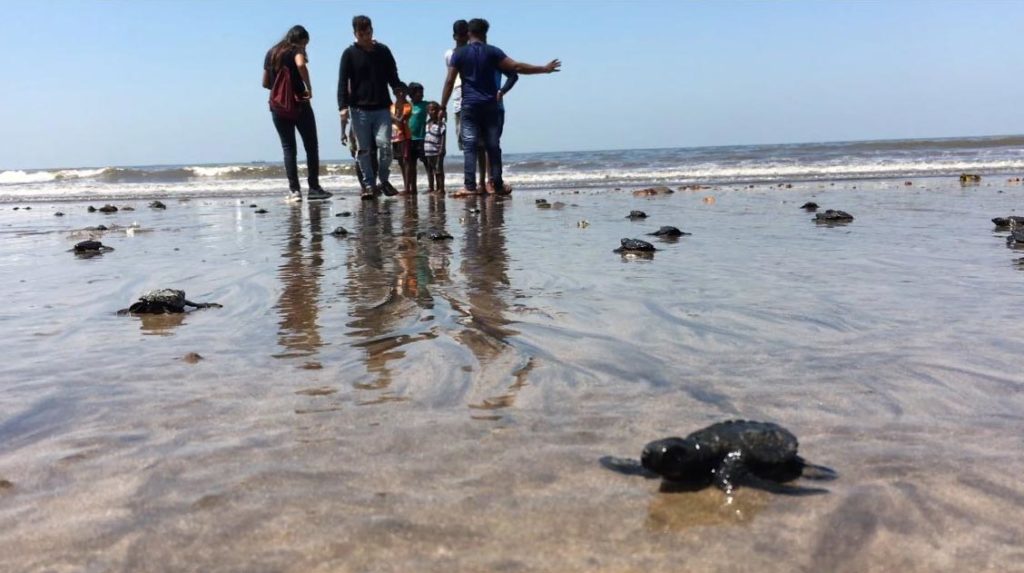
Glad I call this site ‘Perspectives’ as it gives me an opportunity to write from time to time some musings that enter my head. Today’s musing began when Gayle read me concerning a lawyer who used to play on his home beach in Mumbai as a child but when he returned as an older adult it was covered in trash. He began with one other person to try and clean it up and eventually engaged the wider community. It took over a year till they began to see the beach restored. When the beach had been in good condition all those years ago turtles had come and laid their eggs on it, but none had been seen in the previous 20 years. After cleaning it up the turtles returned. Although there is ‘no more sea’ in the new heavens and earth this surely is a theological statement concerning the imagery of the sea as the source of chaos and not a material statement about its non-existence. If what we do now is providing the building material for the age to come (our good works) maybe what this community is doing is making some sort of provision for that age. (Perspectives / musings!!)

The story did get me thinking about something that many religions have in common. They seem to elevate ‘spirit / spiritual existence’ above physical existence in a way that denigrates humanity. Thus embracing the ‘soma sema’ of Greek philosophy (the body is a tomb, the real me is inside this tomb… real life is non-physical, death is an escape, etc.). Or they embrace the exercise of power over as being the mark of righteousness. We see this with Paul as a ‘righteous’ Jew. Persecuting those who were renegade to the faith, viewing them as enemies and deserving of the expression of his zeal. The Crusades and some aspects of current terrorism are religiously motivated with the desire to impose what is ‘right’, and what is right takes precedence over the lives of others. In the realm of legislation we see this in a desire to express ‘sharia law’ over a society, and also the Christian variety of that where we wish legislation that imposes Christian values.

I, as do most believers, oppose abortion except for some very few cases. As far as I am aware this was also the personal position of Obama in the USA although his position on legislation was that it was a personal choice. Abortion is one of those very difficult areas for believers who are in public office. Personal beliefs and public legislation cannot always line up. The arguments are very far reaching, but the fact that the abortion rate was lower at the end of Obama’s time than before the famous Roe v. Wade ruling indicates the complexities involved.

Faith has a huge impact on the public life of a society and rightly so, but a religion, any religion that seeks to impose on the wider society often draws on the concept that righteousness is aligned to power over. Add to that the elevation of life that is a removal from society (spirit is superior) and maybe we can suggest that (most) religions have those two elements in common. The two elements result in a withdrawal from the wider society and an engagement that is an imposition of a change from above.

The Jesus way I think is different. Righteousness cannot be about expressing zeal against people. Paul concluded that what he formerly considered was an expression of righteousness he now saw as excrement and that he was indeed the chief of sinners. Righteousness has to be centred on enemy love. Zeal has to be a zealousness for the ways and character of God to infiltrate society: love permeating all relationships and actions. A spirituality that is life-affirming, that sees the (eternal) good in the actions of all around us.

Does such an approach compromise the message of the Gospel? Yes, if the Gospel is about power and the denigration of human existence. But if the Gospel calls all those who have heard the voice of Jesus to follow him and lay down their lives for others, and then ‘go’ with a focus on discipling all peoples there is no compromise, particularly when on that journey there is no elevation of self over others.

I end my musing with the question as to what contribution religion, in all its forms, has made to the world as we have it today when shaped by the twins of spirit above matter and power over others for righteousness’ sake. And what might happen if there was a genuine Jesus revolution by a new apostolic wave that was willing to work for the future with patience, knowing that the multiplicity of the small and the richness of diversity could yield a future so different to the one that will be ours if we continue on this current pathway.

SHARE ON:

Post PermaLink

Why God Is Not in Control

Here is a link to an article by Tony Campolo: Why God is not in Control.

He begins with:

All too often when there is news of a tragedy, such as a mass shooting or a child suffering from bone cancer, there will be someone who will say something like, “God is in control. We must accept that what’s happened is part of God’s plan!”

At the funeral of a young man who died in a mountain climbing accident, the pastor said in his homily, “We must see what has happened as God’s will!” At that, the father of the young man stood and shouted, “The hell it was God’s will! When my son died, God was the first one who cried.”

Other excerpts:

The story I get straight from scripture is that there are evil non-rational principalities and powers that are loose in the world, sometimes working through evil people (Ephesians 2:2) and that God is not the author of the confusion and disorder that come from these destructive powers (1 Corinthians 14:33).

All that God created was meant to be good, as it says in the opening chapters of the book of Genesis. Today, however, things are not as God willed for them to be…

As hard as it is for us to grasp, we have to accept that we have a God who was willing to give up power and give up control in order to live out love for us. That is what the cross is all about. The salvation story is about a God who humbles Himself and emptied Himself of power (the words “empty” is the translation of the word kenosis in the Greek of the New Testament) in order to express fully His love for us. In Christ, God became weak for our sakes and became, according to the theologian Jürgen Moltmann, the Crucified God. It’s the choice that God made when he came to us in Jesus Christ.

As a professor at Eastern University, I earnestly try to challenge my students to define themselves as agents of God..

On the societal level, they all are called to participate in the political process in wrestling against the “principalities and powers.” According to theologians such as Walter Wink and Hendrikus Berkhof, these powers and principalities include the corporate institutional structures of government and economic systems so that they can do the good that God wills for them to do, rather than the evil for which they are often responsible (Ephesians 6:12).

SHARE ON:

Post PermaLink

Our Fears…

If you are European a great weekly resource is Jeff Fountain’s weekly newsletter from The Schuman Centre for European Studies. In my inbox this morning came False Expectations Appearing Real. At a recent summit Dr Katrine Camilleri gave a blistering talk. She works in Malta right at the centre of the migration route from Lybia. She said:

For a country the size of a rock these arrivals strain not only our logistical capacities but also our longstanding tradition of hospitality. It is a little ironic that the country that prides itself on having welcomed St. Paul with unusual kindness, as the Acts of the Apostles tells us, welcomes these arrivals by locking them up in detention centres.

Migrants were held in detention in some cases up to 18 months. The conditions were completely substandard. The centres were overcrowded. People didn’t have access to basic services, which we knew were desperately needed.

Walls

Many, she said, were fleeing war and massive violation of human rights. The journey itself made many of them pass through hardships difficult to imagine. Many were legally entitled to international protection. Katrine couldn’t but ask if receiving these people who turned up at our doors asking for help was not completely out of sync, completely incongruent with our self-perception and with our European values?

The response of the EU to the asylum seekers who came through Greece in 2015 was much the same, she continued. Although we are part of a Union founded on the core values of solidarity and respect of human rights and human dignity, we saw states acting alone, refusing to see this as a European challenge and refusing to develop a common and effective response.

‘European states are still responding by putting up walls,’ Katrine said. ‘We put up these walls to protect ourselves from real or perceived threats to our culture, to our Christian values and heritage, to our stability, to our comfort and possibly to our security. Walls in many shapes and forms: border walls, ever more sophisticated and militarized border control measures, agreements with third countries such as Turkey, and Libya, countries where asylum seekers can’t find effective protection. The list is endless.

‘These walls are, in part, the result of indifference. Pope Francis talks repeatedly about the culture of indifference, which doesn’t allow us to see the needs of the other, much less to empathize with them. Fear makes you completely unable to think of anything else except your own protection. Everything looks like a threat and you respond accordingly. You put up walls to protect yourself.

Less human

‘On the individual as well as on the national level, fear leads us to build walls and makes us incapable of looking beyond our own self-preservation, to the needs of the people who are going to be affected by those walls.

‘I don’t want to minimise the challenges posed by large numbers of arrivals. The challenges are real. People worry that it will change Europe, and I say they are probably right. But I believe that what will change us is how we choose to react to this challenge. We can choose to put up walls, to react out of fear, out of an instinct for self-preservation or we can choose to welcome, to receive the people who are arriving at our shores, who are fleeing as we ourselves would want to be treated.

‘Reacting out of fear is also very problematic for what it does to us. Fear prevents us from seeing refugees arriving at our borders as people, as individuals with needs and with rights. Dead people at the border, arbitrary detention and miserable conditions, ill-treatment, abuse: what to do? Fear allows us to assume that the violation of human rights is in certain circumstances necessary and justified. Fear allows us to dehumanize the refugees and close our eyes to their needs and suffering, which we are obliged by law to respond to. We are obliged by law to protect and assist refugees.

‘Not only the face of Europe is changed but our soul. We become less human. We turn to the opposite of what we profess as individuals and as a Union, which is supposedly founded on solidarity and respect for human rights. We respond in a way that is anything but Christian even if we do it ironically to protect our Christian heritage.’

SHARE ON:

Post PermaLink

Can we hold the space?

The European project that has been a gift to create peace among nations is under great threat. That project, with such Christian people as Robert Schuman (1886-1963) at the foundation, has been criticised as it developed into the EU. Certainly far from perfect, but if any demise will lead to a pulling back into self-protective borders, we might be regretting the jettisoning of the imperfect. I do not simply refer to the Brexit, but to the responses and tensions within the EU over how the humanitarian crisis is faced. And of course this is not just a European issue but one that is affecting the USA very acutely also.

I live as a privileged immigrant. We have food, we have legal, if not full status. Yet we have come not too different to many other immigrants who are arriving for external reasons. They are forced to come and many wish to make a contribution to the land. We are not here for external reasons, but by inner conviction and seek to make a contribution to the land. We pay our taxes here, and as a result pay significantly more than if we remained registered in the UK. Many come here as privileged immigrants, do not pay taxes and call themselves ex-pats. Those who act in that way are not under any great threat of expulsion from Spain or another similar country. They are, after all, only doing at a personal level what major institutions do at the global level. Finances and power give them the right to live / exploit where they want and when. We do not want that right, and many cast adrift on the Mediterranean of course do not come with finances or power… but if given the opportunity would make a home in the European lands and seek to make a contribution.

The EU is more likely to collapse as a result of the shutting up of borders to the outsider than it is simply post-Brexit. A number of years ago, long before the Brexit we were sent an open vision someone had while praying. She saw that a hand came and took the UK out of a European map. Then colour and light drained out of Europe. This was long before the Brexit and at a time when there was no-one predicting that the referendum would go the ‘leave’ route. We held it as the track record of the person is exceptionally high and noted that she said the Brexit referendum would be about the future of Europe. A number of us have travelled to the place where the colour and light disappeared in the hope that we could sow into the future. There was a second part of the vision also.

While in Prague we were told that most of the Eastern European countries are looking to tighten their borders. We were told this by believers who did not seem to see this as an issue. However, it is not just Eastern Europeans. There are very real issues that Italy and Greece face as most immigrants arrive in those lands and it is easy to criticise their actions of turning away mercy ships. If they turn away ships and other European nations turn away we have a problem.

We are grateful that Spain (Valencia) welcomed the Aquarius (and two other ships) with 600+ rescued from the Mediterranean. Grateful that into a port that brutally shipped Spanish born Muslims in the 1600s it now welcomed some 400 years later others in return. This we have prayed for, ending in Gibraltar last year, and curiously the ship arrived under a Gibraltar flag!

There are very real issues being faced in the so-called developed West over immigration. However, we have contributed to the problem over decades. The supply of arms to these nations where the conflicts exist have meant countless thousands have been made homeless and lives put at risk is down to us. The wealth we have accumulated at the Southern hemisphere’s expense has likewise driven people this way. (And when in Prague, an ex-communist city, it was easy to see that there is no difference between capitalism in its dominant neo-liberal expression or communism. Both are servants of the evil of bio-power. Human resources are their fodder.)

We are not politicians, and they certainly need prayer for wisdom as to how to move forward as so much is at stake. We are not politicians but the Gospel does not allow us to think of the message of Jesus as non-political. We, as the body of Christ, and therefore some individuals within that body will have to step up, have to somehow hold open the space for the future. And in holding the space begin to speak some content into that. God created through holding space (to counter the ‘without form’) and then filled that space (to counter the ‘and empty’). We likewise have to hold space and this is vital at a time when there is the desire to collapse borders. The shape of the EU is not the issue but living as family across Europe is. The Pauline Gospel seems to drive us that way. Living in the one-world government era his one passion was to get to the extent of the borders. The Jews in Exile had a great opportunity to live out life in the imperial world of Babylon – but they hankered for the land and created the synagogue!

Can we hold the space? The lands are changing, and need to change. We have utterly failed in our stewardship of the lands, failing to be a resource to the rest of the world. We can only anticipate that there will be wholesale shifts of population. Can we hold the space for the new? This is not a time to allow small borders to shape the future. And in holding it can we begin to prophesy what will fill that space?

I hope, as a Brit, that the Brexit did not sow something into Europe of closing borders that is now being replicated in other nations. Maybe the Brexit had little to do with political shape and more to do with how open we will be to the other. If so something must begin in the body of Christ as we are called to be the salt of the earth. We will have to step up to hold back the pollution that rises so easily.

We can do so little. Gayle and I can live here as immigrants, love the land, refuse to live with a border mentality. We can begin there in response, but we know that will not in itself be enough. There will be more we will have to do, but we must start with what is in our hands.

SHARE ON:

Post PermaLink

Refugees welcomed

We have been travelling hence the silence on the blog. But changes are here! In Prague we were very focused on the shift of time, moving from the metronome which simply marks a rhythm, keeping everyone in line, to the clock, and not the mechanistic clock but the beat of the heart. We prayed for acceleration. Came home to Spain and in a few days the entrenched government was overturned, something that was certainly not predicted.

Then came the boat(s) into Valencia with over 600 refugees rescued from the Mediterranean. Spain a nation with a mercy, hospitality gift opening the doors and heart. A wonderful reversal too of history as through the port of Valencia many were brutally exiled in the Muslim expulsion (the focus of our prayers last year).

Now there is discussion concerning the removal of Franco’s body from the valley of the fallen, and o exhuming other bodies that were forcibly buried there in an act of conquest that proclaimed reconciliation (!!).

We might never know if any of the above was catalysed by the prayers of the team in Prague but there has certainly been an acceleration here. Our prayer is it will be a marker for Europe.

SHARE ON:

Post PermaLink

Paradigm – love not power

The power God who can do anything, and does do what he sovereignly pleases, who is in control of all things. A nice God to believe in when he is on your side, but leaves a lot of questions when his power is not displayed to bail out those who need it. With that kind of God either all things are being done according to his will and then in what sense is that will ‘good, pleasing and acceptable’, or we simply do not understand the higher purpose in what he does (does not do); prayer somehow becomes our part in persuading him to be a bit better than he really is. ‘Save my relative’ because we want that but it seems he is not so sure. The only way through those predicaments is to offer the fallback of ‘mystery’… or?

If love becomes the central paradigm and that love is non-controlling, that freedom is something that God deeply respects, and that this world he has placed into the hands of us, not so capable, humans there is a shift in understanding. Our lives are pulled into co-operation with him, of desiring what he desires (that all are saved and come to a knowledge of the truth, for example). Prayer becomes our responsibility to shift those principalities (and that word can be understood in a variety of ways) so that the angelic can partner with humanity and people discover a measure of freedom where choices can be made. Prayer is twinned with action to make space.

Once we move away from God’s choice being of ‘to salvation’ or ‘to damnation’ and understand choice to be an invitation to partner with him the responsibility for the mess we are in does not lie at God’s door but at ours. Surely that is the story taught concerning the original humans?

We really need to stop moaning about the lack of God’s intervention but find where we need to be positioned so that God can intervene where he so desires to. In the wilderness Jesus overcame the ‘strong one’ with the result of many interventions by God during those years till his death, then at the cross he did the same for us.

If love is the key, then we need to be touched by his love for us and for what and who are beyond us, as we do we will inevitably find ourselves in power conflicts where we have to resist the devil and then coming out the other side will make room both for the love and power of God to manifest.

Allah is simply the word that translates our English word ‘god’. If ‘the sovereign will of Allah’ is a belief held by some, and there are Christians who ave an all-but identical view of the sovereign will of God, can we really find a legitimate way of suggesting that they believe in two different gods? The Jesus-like God is the one who has to fill out the meaning to the word ‘god’, and those who follow Jesus will surely increasingly manifest love that is for the enemy not against them, with the power they carry being primarily the power of love.

SHARE ON:

Post PermaLink

Paradigm – we can fail

Promised success or called to be effective?

Words do have some measure of intrinsic meaning (etymology) but meanings change over time and in different contexts, so the real meaning of words is to do with what they communicate. In seeking to contrast the words ‘effective’ and ‘successful’ I need to explain the meaning I am seeking to inject into them. There has been a lot of emphasis on being an overcomer, being successful in both the Christian and non-Christian world, with very little critique on how that personal success impacts on others. One of the great challenges, for example, in the world of commerce and business is how to analyse the impact a business is making. Success might be measured in terms of the market share or the so-called bottom line, but how does one measure the resulting shift in the health of society? For this reason I consider that the better term to use is effectiveness. Success is measured by what I have achieved, effectiveness is measured by what I enable others to achieve, how I enable them to both discover who they are and what their contribution to the future is. I am not suggesting it is easy to measure, but what it does mean is I am not driven by a success measurement, but by a desire to see a shift beyond me for the sake of others.

Steve Lowton has recently put out a set of videos on ‘authenticity’. They carry a real weight and I recommend them. In the fifth in the series he explains a little about his journey of seeking to make a difference to the global trade routes, a journey that meant he lost considerable amount of money. Here is that video:

‘Failure’ pushed him into gardening (the original call on Adam and the way in which God first revealed himself). His first contract came from a place called Follifoot!! Given that Steve was instrumental in a walk to Rome (and beyond) the name was indeed a challenge. I have been glad to know Steve over years; he and Kathy have been a huge influence on our lives and values. Success makes us feel better but a desire to be effective makes any assessment over out lives on hold, waiting for the only fully true (and very generous) assessment that will come our way in the future.

I think one of the paradigms we have to shift from is the super-hero mentality. I fear where we have been driven to succeed, to tell the ‘success’ story that we could end up denying the very Gospel that calls us to align with Jesus to effect the wider world and those around us.

I am convinced that the many unknown people who have stumbled through life but motivated to serve, who have that tendency not to think of themselves too much will be the ones rewarded greatly, for no cup of cold water will be forgotten. Perhaps those who are sure they have accomplished so much for Jesus maybe should take a time out to ask if their personal assessment comes close to his.

I am glad we can fail. We can aim high, give it our best shot and come up short. We can re-assess, try again, do it better, or just realise for whatever reason we are not going to make it the way we thought we were. There is something so much bigger than our success at stake, and the time frame is not limited to our three score years and ten. The apostolic, Paul suggests, is marked by great patience. Waiting for something to change that might not shift for a century or two ahead, that is great patience, and into that shift the wonderfully encouraging stories of success play their part, as also do the ‘follifoot’ stories.

And finally – any resemblance to Gayle and I in the accompanying image is purely coincidental.

SHARE ON:

Post PermaLink

Paradigm – the witness challenge

We are called to witness not evangelise

Careful!! I am not saying do not evangelise, but I am challenging the core of what we are called to be. I also promised to write a little tersely so do not want to nuance what I write too much. I do write though with a conviction that we are first called to be witnesses, and in particular witnesses to another world, or maybe we could say to the true calling of this world. Summed up in 2 Corinthians 5: 16-19 (emphasis added):

From now on, therefore, we regard no one from a human point of view; even though we once knew Christ from a human point of view, we know him no longer in that way. So if anyone is in Christ, there is a new creation: everything old has passed away; see, everything has become new! All this is from God, who reconciled us to himself through Christ, and has given us the ministry of reconciliation; that is, in Christ God was reconciling the world to himself, not counting their trespasses against them, and entrusting the message of reconciliation to us.

Good verses to read while also looking in a mirror… Everything is new, not will become new, and not simply the born again person has become a ‘new creature’ but there is a whole new creation. What a challenge to live bearing witness to the new creation. Talk about a tension that affects all of life. We often say, for example, ‘money is rubbish’ yet we, like our neighbours buy our food, pay our bills through the rubbish that money is. How do we live having to use it, but to live in such a way that we bear witness to a different world?

Evangelism is challenging. When to say something, and how many times have we all kicked ourselves afterwards when we missed an opportunity. Yet evangelism can become an excuse not to live the life of witness, and even worse it can treat people as objects, thus effectively demonising the image of God. Evangelism in the sense of sharing the realities of sin, Jesus death on the cross, forgiveness etc. fits into the context of witnessing, but witnessing cannot be reduced to evangelism. It is a much bigger concept, and a much more demanding one. Come follow me as I follow Christ is much more demanding than ‘do not look at me but let me tell you the facts I have distilled from the Bible’.

The need for witnesses of the new creation is so needed, and if we took it more seriously would affect so much of what is taught and practised.

The body of Christ as royal priesthood

This has been a strong theme for us over the past few years but I do not apologise for the repetition. Losing sight of this is what caused Israel to lose her way, and is probably behind what gave rise to the synagogue life. In Babylonic exile because of sin can both be seen as a punishment and an opportunity. The opportunity being to live in the context of alienship within a strange land, but deeply connected to that strange land to help it move forward.

I grew up with only a pejorative understanding of the word ‘world’. It was not simply fallen but essentially evil and to be avoided. However, reading the Gospels it is evident that Jesus embraced that world. His work in Israel was both to bear the sin of Israel and to get the calling of the redeemed people back on track, restoring ‘witness to the nations’ as royal priesthood.

There are two ways in which a community of people, or a defined society / group can be seen. They can be seen as a community that is shaped by a concept of being there for one another. That clearly is an emphasis in Scripture concerning the church. Some 30 or so times we read in the Pauline letters the phrase ‘one another’ (love, encourage, rebuke, care for etc.). The other way of understanding a defined group is that their core raison d’être is as a movement. A movement is not in existence primarily for one another, but is motivated with a vision for the society beyond the movement, the society of which they are a part. MLK’s ‘I have a dream’ speech is a very clear articulation of a movement’s inner core. The dream is not that the Civil Rights movement will pat each other on the back but that they will catalyse a future day that is in line with the movement’s core convictions. A movement lives and acts to see the wider community transformed, and once the vision is fulfilled the movement no longer has a reason to exist. Community in the sense of being there for one another is present within Scripture but is subsidiary to that of movement. Israel was a community but had a calling that gave their ‘one another’ element a context. They were not to be a ‘I’ll pat you on the back’ kind of people but were to carry the Creator’s image into the whole world. The idea that an embassy in Jerusalem is fulfilling prophecy seems so sadly missing the point of prophecy… embassies of heaven in every locality, not found in a building with a plaque on the wall but living stones thorough whom the presence and values of Christ are shown. Buildings might be present but the real issue is the spiritual building fit for God’s presence.

If we grasp the royal priesthood call of God’s-through-redemption-people we will see that God has commissioned such a people to impact the world of God’s-through-creation-people. God is not coming to condemn the world but to redeem the world, the church and all that is in it is not the sum total of God’s belongings, the Scriptures pronounce that the earth and all its fullness is God’s.

God is at work in the church so that he can be at work in the world. This was the call of Israel all along as a special chosen people, chosen to be uniquely aligned with God so that the world might come into her destiny, so that the nations (Gentiles, not ‘nations’ in the narrow and modern sense of nation-state) might live out their destiny. We have to work out what means, the same as ancient Israel was to work it out. Were the nations to become subsumed under Israel, were they to live out all the same laws, even the ones that instructed them to avoid mixing the materials that their clothes were made from! Likewise we have to work it out, and I don’t think the direction is toward a ‘Christian nation’, but to enabling a nation to fulfil her destiny. Destiny seems always to be defined by something outward, hence a nation reaching her destiny can only be measured by the level to which they serve others, others outside its borders and all others within its borders.

The church in the land then has to serve in such a way as to limit the influence of the dominant principalities that resist the true destiny of a nation manifesting. In that sense the church will never make a good state religion! But is there to enable the nation to serve and facilitate values that are Jesus-values.

We could also write that God is involved in the world and there are areas where the church has to get her skates on and catch up, and in catching up get on board with some Jesus-values also.

SHARE ON:

Post PermaLink

Perspectives